
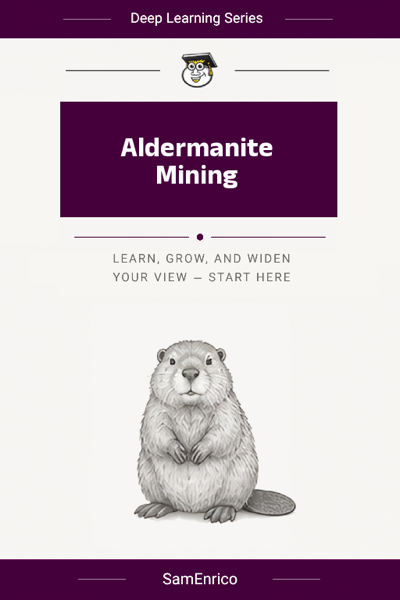
Non-FictionInformativeEducational
Aldermanite Mining eBook
A Coursebook on Aldermanite Mining
A Coursebook on Aldermanite Mining
Formats
Free sample
Chapter 1: The Unbreakable Crystal...--–- It began, as most geological discoveries do, not with a eureka moment but with a dull clink of a hammer on rock that refused to break. The year was 1978, though the official papers would later say 1980. The place was a dusty, fly-blown quarry in South Australia's Barossa Valley, better known for its wine than its mineralogy. A geologist named Ernie Segnit, a meticulous man with thick glasses and the patience of a glacier, was chipping away at a weathered phosphate pod exposed in the wall of the Moculta Quarry, also known locally as Klemm's Quarry. He was looking for wavellite, a common but pretty phosphate mineral that collectors prized for its radial, feathery sprays.
What he found instead was something that would quietly gnaw at the foundations of mineralogical science for over four decades.The specimen was unremarkable at first glance—a dull, white, earthy crust covering a fracture surface in the fractured marble. Segnit almost tossed it aside. But something caught his eye: a faint pearly sheen on a fresh edge, where the hammer had split the crust. Under a hand lens, the sheen resolved into a tangled mat of microscopic, colorless fibers, so fine they seemed to float in the air. They were softer than talc, crumbling under the pressure of a steel needle.
He bagged the sample, labeled it "Moculta – unknown white fibrous material," and shipped it off to the South Australian Museum. He had no idea that this insignificant-looking powder would, decades later, force a complete rewrite of phosphate mineralogy and reveal a crystal structure so strange it seemed to defy the rules of geometric order.This is the story of that discovery, but more importantly, it is the story of everything that discovery unlocked. This book is not a dry recitation of chemical formulae and unit cell parameters, though those are the bones of the matter. It is the narrative of a scientific heist—a forty-year-long conspiracy of misinterpretation, a clandestine redefinition that changed the mineral's identity overnight, and the subsequent realization that this "worthless" rarity held the structural keys to a new generation of quantum materials and green batteries. We will journey from the sun-baked quarries of South Australia to the high-contrast, cryogenically cold labs of European crystallographers.
We will trace the ghost of Professor Arthur Richard Alderman, the man for whom this mineral was named, and uncover why his most important discovery was nearly erased from history. We will learn why a mineral that cannot be mined has become one of the most intensely studied phosphate structures of the twenty-first century.For the student, the professional geologist, or the merely curious, this chapter lays the foundation. We will establish the historical and nomenclatural bedrock upon which all subsequent chapters are built. We will meet the key players, decode the bewildering shifts in chemical identity, and learn why the simplest question—"What is aldermanite?"—has an answer more complex and fascinating than anyone imagined. By the end of this chapter, you will understand that in the world of mineralogy, sometimes the smallest, softest, most breakable crystals conceal the hardest truths of all.The Accidental Discovery and the IMA's Quiet Nod The official story of aldermanite begins not with a bang but with a bureaucratic stamp.
In 1980, the International Mineralogical Association (IMA) formally ratified a new mineral species under the code IMA 1980-044. The proposers were Harrowfield, Segnit, and Watts, three Australian mineralogists who had spent months untangling the confusing chemistry of the Moculta fibers. The new mineral was named aldermanite, in honor of Professor Arthur Richard Alderman (1901-1980), a recently deceased geologist from the University of Adelaide. Alderman was a titan of South Australian geology, known for his groundbreaking work on the state's underground water resources and his meticulous mapping of the phosphate deposits that would later yield "his" mineral. It was a fitting tribute to a man who had spent a career in the dirt, looking for the hidden structures beneath the surface.The original description published in Mineralogical Magazine painted a picture of a simple, if rare, magnesium aluminum phosphate hydrate.
The proposed formula was a mouthful but seemingly straightforward: Mg₅Al₁₂(PO₄)₈(OH)₂₂·32H₂O. This suggested a structure dominated by aluminum and phosphate, with magnesium and water molecules rattling around in the spaces between. The mineral was declared a secondary (supergene) species, meaning it formed from the weathering of other minerals near the Earth's surface. Its physical properties were cataloged as we will explore in Chapter 2: Mohs hardness of about 2 (soft enough to scratch with a fingernail), a specific gravity between 2.0 and 2.15 (light for a phosphate), and a brittle, talc-like tenacity. Visually, it was described as colorless to white aggregates with a pearly luster, typically forming fibrous or flake-like crusts.For nearly forty years, this description stood without challenge.
Aldermanite remained a footnote in mineralogy textbooks, an extreme rarity known from only a handful of localities in the Mount Lofty Ranges of South Australia. It was a "collector's mineral"—a curiosity to be labeled and placed in a drawer, not a subject of serious scientific inquiry. A few papers confirmed its occurrence at other quarries: Penrice Marble Quarry, Tom's Quarry in Kapunda, Fairview Quarry in Robertstown. But no one looked deeper. The formula was accepted.
The structure was assumed. The mineral was, for all intents and purposes, solved.But the problem was that the formula didn't quite work. Chemists who attempted to balance the charges found themselves short of positive charge. The original analysis had missed something—or rather, two things.The 2021 Rebellion: Redefining Aldermanite The quiet academic slumber of aldermanite was shattered in 2021. That year, a team of renegade crystallographers—Elliot, Grey, and Willis—published a paper in the same Mineralogical Magazine that had announced the mineral's discovery forty-one years earlier.
Their title was unassuming: "Redefinition of the formula for aldermanite." But the content was a scientific coup. Using modern single-crystal X-ray diffraction and electron microprobe analysis, they proved that the original formula was not just incomplete—it was fundamentally wrong.The old formula, Mg₅Al₁₂(PO₄)₈(OH)₂₂·32H₂O, was thrown out. In its place, they proposed a new, radically different formula: [Mg(H₂O)₆][Na(H₂O)₂Al₃(PO₄)₂(OH)₆]·H₂O. To the untrained eye, this looks like a simple rearrangement. It is not.
This new formula recognizes two essential components that the original description had completely missed: sodium (Na) and fluorine (F).The implications of this redefinition cannot be overstated. Sodium had not even been mentioned in the 1980 analysis. It had been dismissed as a trace impurity, perhaps from the surrounding marble host rock. Fluorine had been similarly overlooked. But the 2021 team demonstrated that both elements are integral to the crystal structure.
Remove the sodium, and the layers collapse. Remove the fluorine, and the bond lengths distort beyond stability. Aldermanite is not a simple magnesium aluminum phosphate. It is a sodium magnesium aluminum fluorophosphate hydrate—a completely different chemical class.The structural details that forced this redefinition are explored in depth in Chapter 3 (Crystallography and Crystal Chemistry), but the essential point for our introductory chapter is this: the 2021 redefinition transformed aldermanite from a mineralogical footnote into a structural archetype.…
This is the end of the free sample. Get the eBook to keep going. Buy now
About this book
Details
- Author
- Moreau Margarett
- Publisher
- SamEnrico
- Language
- English
- Genre
- Non-Fiction, Informative, Educational
- Released
- 2026-06-02
- Pages (approx.)
- 142
- Available as
- eBook, Audiobook

Read better in the ZLOADR app
Your eBooks on your phone or tablet. Sign in with your SamEnrico account and start reading.
More by Moreau Margarett
 Partner Snoring Meditation GuideMoreau Margarett$11.99
 Vidnoz AI Face Swap GuideMoreau Margarett$11.99
 Understanding Phobia RootsMoreau Margarett$11.99
 Understanding Alcohol's Grip on the BrainMoreau Margarett$11.99
 The Silent Screams of Willowbrook: A State of CrueltyMoreau Margarett$11.99
 First Hour Breach Triage GuideMoreau Margarett$12.99
 African Consumer Market OutlookMoreau Margarett$12.99
 Understanding Incisors FusedMoreau Margarett$17.99
 How to Become a Digester OperatorMoreau Margarett$11.99
You may also like
 Hong Kong Handover 1997Dunn Johnnie$11.99
 Zumba For Postnatal Recovery CourseNeal Christian$11.99
 Zumba for BeginnersLadner Nikia$11.99
 YouTube Comment Mining GuideHumes Pandora$12.99
 Worry Box MeditationCarlin Rudy$11.99
 Workplace Stress MeditationNguyen Lynn$11.99
 Workplace Stress and Sleep RepairHawley Ivory$11.99
 Workplace Perfectionism CureDelaney Jeffry$11.99
 Workplace Injustice Anger GuideWallen Isabelle$11.99
 Work Addiction and Burnout LinkGreenwood Ester$11.99
 Women in Yoga and WellnessBeattie Galina$11.99
 Women in Stand Up ComedyChun Evangeline$11.99