
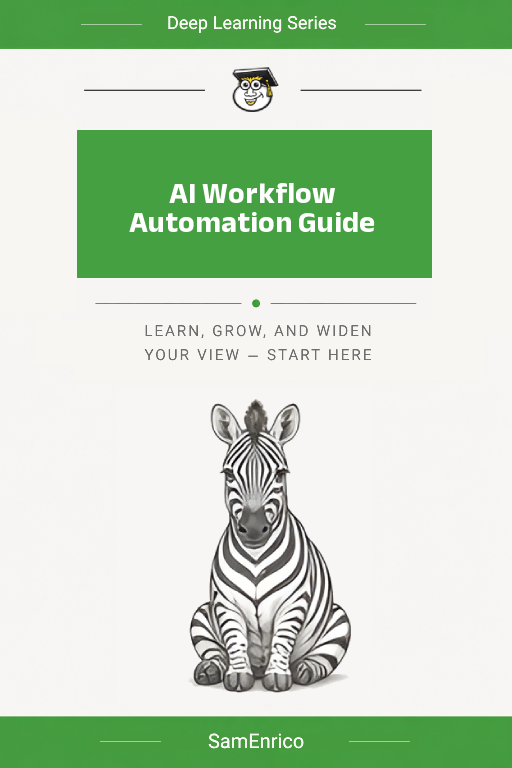
Non-FictionAnnual CheckupAutomation AI
AI Workflow Automation Guide eBook
Use Zapier AI, Make AI, or IFTTT to connect apps a
Use Zapier AI, Make AI, or IFTTT to connect apps and automate business workflows.
Formats
Free sample
Chapter 1: The Automation Lie--You have been told that automation is about replacing humans with robots. That is false. You have been told that AI will steal your job. That is also false. The truth is far more interesting, far more urgent, and far more liberating.The real lie is this: that the repetitive, soul-draining tasks you do every day—copying data from one spreadsheet to another, forwarding emails to the right person, downloading attachments, reformatting reports, chasing approvals—are somehow necessary.
That they are the price of doing business. That there is no other way.There is another way. And it does not require you to become a software engineer, learn Python, or hire a team of developers.This book is built on a simple premise: the skills that made you valuable in 2020—being organized, responsive, and detail-oriented—are now commodities. The skills that will make you valuable in 2026 and beyond are different. They are the ability to design systems that work without you.
To teach machines to handle the predictable so you can focus on the unpredictable. To move from being a doer to being an architect.Welcome to the AI-native era of workflow automation.The 2026 Tipping Point Let me paint a picture of where we stand right now.In 2010, the phrase "workflow automation" meant something narrow and technical. It meant IT departments writing custom scripts to move data between databases. It meant expensive enterprise software that took months to implement. It meant that if you weren't a programmer, automation was simply not available to you.In 2015, tools like Zapier and IFTTT emerged.
Suddenly, non-technical people could connect apps using simple "if this, then that" rules. If you received an email attachment, save it to Google Drive. If a new row appeared in a spreadsheet, send a Slack message. This was revolutionary. It saved millions of hours.
But it was still limited.The limitation was this: traditional automation requires structure. It requires that the data you're working with follows predictable patterns. The email subject line must always contain the invoice number. The form field must always be filled out correctly. The attachment must always be a PDF.
When those conditions are met, automation works beautifully. When they are not—when a customer writes "plz fix" instead of selecting the correct dropdown option—traditional automation breaks.We are now in 2026. And everything has changed.The change is not incremental. It is not a better version of the old way. It is a fundamental shift in what automation can do.
Large language models—the technology behind Chat GPT, Claude, Gemini, and dozens of others—have transformed automation from a rule-following machine into a judgment-capable agent.Here is the difference in concrete terms:Traditional automation (2015–2024): "If the email subject contains 'invoice', forward to accounting@company.com."AI-native automation (2025–present): "Read this email. Determine if it is an invoice, a question about an invoice, or a complaint about an invoice. If it is an invoice, extract the vendor name, amount, due date, and line items. If any of those are missing, send a polite reply asking for the missing information. If it is a question about an invoice, search our knowledge base for the answer.
If it is a complaint, flag it as urgent and draft a response for a human to review."The difference is not just technical. It is philosophical. Traditional automation assumes the world is orderly. AI-native automation accepts that the world is messy and works within that messiness.This is why 2026 is the tipping point. The technology is now mature enough, cheap enough, and accessible enough that every business—from a solo consultant to a thousand-person enterprise—can implement AI-powered workflows without specialized expertise.The Three Pillars of AI Workflow Automation Before we build anything, we need a shared vocabulary.
Every automation you create in this book will rest on three fundamental concepts. I call them the Three Pillars.Pillar One: Triggers A trigger is the event that starts your workflow. It is the "when this happens" part of automation. Triggers are passive—they wait for something to occur and then spring into action.Common triggers include:A new email arrives in your inbox A form is submitted on your website A new row is added to a spreadsheet A file is uploaded to a cloud storage folder A calendar event starts or ends A payment is received A social media mention occurs In the old world of automation, triggers were rigid. You could only trigger on exact matches.
In the AI-native world, triggers can be fuzzy. You can trigger on "an email that seems urgent" or "a support ticket that mentions a competitor" or "a lead form that contains budget keywords." The AI evaluates the incoming data and decides whether the trigger condition has been met.Pillar Two: Actions An action is what your workflow does after being triggered. Actions are active—they change something in the world.Common actions include:Send an email or Slack message Create or update a record in your CRMAdd a row to a spreadsheet Create a task in project management software Post to social media Generate a document or report Make an API call to another service In traditional automation, actions were linear. You did one thing, then another, then another. In AI-native automation, actions can be conditional.
The AI can choose between multiple possible actions based on what it learns from the trigger data. It can also generate the content of those actions—drafting an email, writing a summary, or creating a structured data output.Pillar Three: Intelligence This is the new pillar. This is what changes everything.Intelligence is the AI layer that sits between your triggers and your actions. It takes the messy, unstructured input from your trigger and transforms it into structured, actionable data for your actions.Intelligence can do many things:Classify: "Is this email a complaint, a question, or a compliment?"Extract: "What is the customer's name, order number, and issue from this support ticket?"Summarize: "Give me three bullet points summarizing this 2,000-word document."Generate: "Write a professional reply to this customer's question."Route: "Based on the content of this lead form, should it go to sales, support, or marketing?"Score: "On a scale of 0 to 100, how likely is this lead to become a customer?"Validate: "Does this invoice have all the required fields? If not, what is missing?"Transform: "Convert this unstructured text into a JSON object with specific fields."In practice, you will combine these capabilities.
A single workflow might classify an email, extract key information, summarize the rest, generate a response, and route it to the right person—all without a human touching it.The magic is that you do not need to understand how the AI works under the hood. You do not need to train models or label data. You need only to describe what you want in plain English. The AI figures out the rest.The Core Case Study: Customer Support Before and After Theory is useful. Examples are better.
Let me walk you through a concrete case study that illustrates everything we have discussed so far.Meet Sarah. Sarah runs customer support for a mid-sized Saa S company called…
This is the end of the free sample. Get the eBook to keep going. Buy now
About this book
Details
- Author
- Petrie Kurtis
- Publisher
- SamEnrico
- Language
- English
- Genre
- Non-Fiction, Annual Checkup, Automation AI
- Released
- 2026-06-01
- Pages (approx.)
- 149
- Available as
- eBook, Audiobook

Read better in the ZLOADR app
Your eBooks on your phone or tablet. Sign in with your SamEnrico account and start reading.
More by Petrie Kurtis
 Zumba for Postnatal Recovery GuidePetrie Kurtis$11.99
 Loneliness And Pet CompanionshipPetrie Kurtis$11.99
 Stalking Social Media Influencer CasesPetrie Kurtis$11.99
 Teen Emotional Intelligence GuidePetrie Kurtis$11.99
 LinkedIn Success Theater ExposedPetrie Kurtis$11.99
 The Amazon Skyway: When South America Conquered the AtlanticPetrie Kurtis$11.99
 Lost Letters of the Last Tsar: Nicholas & AlinePetrie Kurtis$11.99
 Understanding Duplication of Leg Mirror FootPetrie Kurtis$17.99
 Union Employer NeutralityPetrie Kurtis$12.99
 How to Become a Automobile-seat-cover InstallerPetrie Kurtis$11.99
 Circuit Design EngineerPetrie Kurtis$11.99
You may also like
 Hong Kong Handover 1997Dunn Johnnie$11.99
 Zumba For Postnatal Recovery CourseNeal Christian$11.99
 Zumba for BeginnersLadner Nikia$11.99
 YouTube Comment Mining GuideHumes Pandora$12.99
 Worry Box MeditationCarlin Rudy$11.99
 Workplace Stress MeditationNguyen Lynn$11.99
 Workplace Stress and Sleep RepairHawley Ivory$11.99
 Workplace Perfectionism CureDelaney Jeffry$11.99
 Workplace Injustice Anger GuideWallen Isabelle$11.99
 Work Addiction and Burnout LinkGreenwood Ester$11.99
 Women in Yoga and WellnessBeattie Galina$11.99
 Women in Stand Up ComedyChun Evangeline$11.99