
Non-FictionCompliance & Risk ArchiveAI
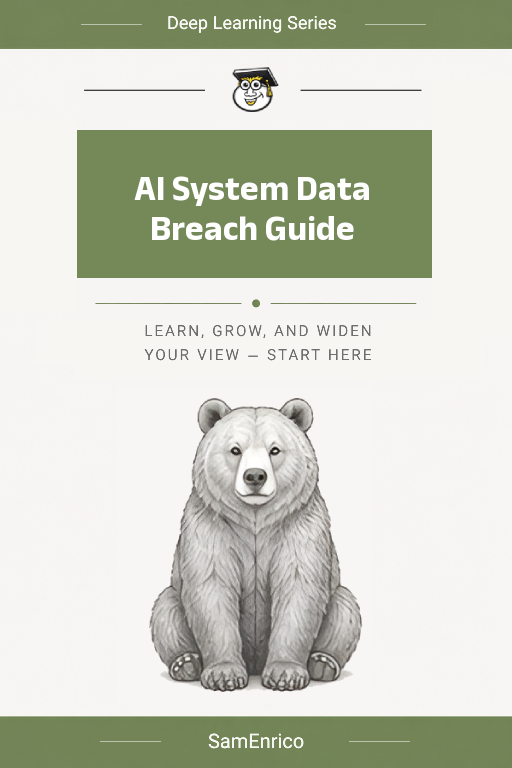
AI System Data Breach Guide eBook
Breach notification for training data leaks and mo
by Alger Chau
Breach notification for training data leaks and model inversion attacks under developing AI regulations.
Formats
Free sample
Chapter 1: The Memorization Trap–- On a Tuesday afternoon in March 2024, a staff attorney at a San Francisco hospital received an automated alert that she had never seen before. The alert came not from her organization’s data loss prevention system, not from its firewall, and not from its endpoint detection software. It came from a patient. The patient wrote: “I asked your new AI chatbot when my next appointment was, and it told me someone else’s name, diagnosis, and home address. Is this a mistake?” The attorney assumed a bug.
She reported it to IT. IT reported it to the engineering team. The engineering team ran diagnostics and found nothing wrong with the database, the application servers, or the network. They closed the ticket as “unable to reproduce.” Three weeks later, a local journalist published screenshots of the same AI chatbot outputting dozens of patient records. The hospital had not been hacked.
No database had been dumped. No credentials had been stolen. The hospital’s own AI had simply answered the questions it was asked—using the data it had been trained on. The organization learned a brutal lesson that day: traditional breach response assumes an attacker breaks in. But when your model memorizes your secrets, the attacker doesn’t need to break anything.
They just need to ask.This chapter explains why the security assumptions that protected your databases, file servers, and email systems for decades are catastrophically wrong when applied to AI. It introduces the concept of the “Memorization Trap”—the tendency of machine learning models to retain training data in ways that are invisible, unmeasurable, and exploitable by attackers. You will learn why your incident response plan is likely already obsolete, why your data loss prevention tools cannot see AI breaches, and why the distinction between “copying” and “learning” matters less than regulators think.The Three Assumptions That Kill You Every security architecture is built on assumptions. The assumptions that served defenders well in the era of relational databases and file servers become liabilities in the era of neural networks. Before we can fix the problem, we must name the assumptions that are failing.Assumption One: Data Has a Home Traditional security assumes that sensitive data lives in known locations.
A customer database lives on a specific server. An employee file lives in a specific shared drive. A financial record lives in a specific encrypted bucket. Because data has a home, security teams can build controls around that home: firewalls, access logs, encryption at rest, and monitoring for unusual queries. If an attacker wants the data, they must go to its home.
The journey leaves traces.AI systems violate this assumption from the moment training begins. When you train a model, you distribute the statistical essence of your data across millions or billions of numerical parameters. A single Social Security number does not live in a specific weight. It lives nowhere and everywhere. It contributes to the model’s ability to predict the next token, to recognize a pattern, to generate a plausible completion.
After training, you cannot point to a location in memory and say, “This is where the SSN is stored.” You also cannot say with certainty whether the model retained the SSN at all. The model itself does not know what it memorized.This creates a nightmare for breach response. In a traditional breach, you can query your database to determine exactly which records were accessed. In an AI breach, you cannot query the model to determine what it knows. The model has no introspection capability.
It can only respond to prompts. To understand what the model memorized, you must become an attacker yourself—probing, prompting, and extracting. Your investigation becomes indistinguishable from the attack you are investigating.The legal implications are staggering. Under GDPR Article 4, a “personal data breach” involves the “accidental or unlawful destruction, loss, alteration, unauthorized disclosure of, or access to, personal data.” If you cannot determine what data your model contains, you cannot determine whether a breach occurred. Regulators are increasingly taking the position that this uncertainty is itself a compliance failure.
If you train a model on sensitive data without implementing controls to measure and limit memorization, you are presumed to have breached that data if the model is later compromised.Assumption Two: Breaches Are Certain Traditional breach response relies on certainty. You know what data was stored. You know what data was accessed. You know who accessed it and when. This certainty enables precise notifications, targeted credit monitoring, and defensible legal positions.
The GDPR’s 72-hour notification clock assumes that you can determine within three days whether a breach occurred and what data was involved.AI breaches produce probabilistic knowledge, not certainty. Consider a membership inference attack against a medical language model. The attacker queries the model with a specific patient name and diagnosis. The model’s response—its confidence, its latency, its token-by-token probabilities—leaks information about whether that patient was in the training set. The attacker may conclude with 85% confidence that the patient was present.
But 85% is not 100%. Was there a breach? The attacker knows more than they did before, but not with certainty. The organization cannot say for sure what the attacker learned.This probabilistic nature breaks the GDPR’s notification framework. Article 33 requires notification “without undue delay” when a breach is “likely to result in a risk to the rights and freedoms of natural persons.” How do you assess risk when you only know probabilities?
If an attacker has an 85% chance of having learned a patient’s mental health diagnosis, is that a “likely risk”? Most regulators say yes above a threshold of 70-80%, but the threshold is not codified. Organizations must make judgment calls that will be scrutinized years later in litigation.Worse, the probabilistic knowledge flows both ways. You cannot be certain that an attack succeeded, and the attacker cannot be certain of what they learned. But the attacker can iterate.
They can ask the same question hundreds of times with slight variations. Each query increases their confidence. By the time they act on the information—selling it on a dark web forum, using it for blackmail, or publishing it for reputational harm—they may be 99% certain. Your uncertainty at the time of detection does not reduce your liability for the eventual harm.Assumption Three: Controls See Data Conventional security controls are designed to observe data as it moves, changes, and leaves. Data loss prevention tools scan files for patterns that look like Social Security numbers.
Database activity monitors log every query. Email gateways inspect every attachment. These controls work because data in traditional systems has predictable formats and clear boundaries. A Social Security number in a database looks like a Social Security number in an email. The pattern is the same.AI systems render these controls blind in three distinct ways.
First, the training process itself bypasses traditional controls. Data scientists copy sensitive datasets to Jupyter notebooks, cloud storage buckets, and GPU clusters that security teams have never audited. The data leaves its “home” without triggering alerts because the movement looks like legitimate research activity. Second, the model’s weights are indecipherable. A 7-billion-parameter model is 28 gigabytes of floating-point…
This is the end of the free sample. Get the eBook to keep going. Buy now
About this book
Details
- Author
- Alger Chau
- Publisher
- SamEnrico
- Language
- English
- Genre
- Non-Fiction, Compliance & Risk Archive, AI
- Released
- 2026-05-29
- Pages (approx.)
- 156
- Available as
- eBook, Audiobook

Read better in the ZLOADR app
Your eBooks on your phone or tablet. Sign in with your SamEnrico account and start reading.
More by Alger Chau
 Sugar Addiction and Inflammation GuideAlger Chau$11.99
 Caregiver Guilt DissolveAlger Chau$11.99
 Chronic Pain Sleep HypnosisAlger Chau$11.99
 Cortisol and Estrogen DominanceAlger Chau$11.99
 The Fire Below: Alhazen's Light and the Birth of Modern PhysicsAlger Chau$11.99
 Bubonic Babylon: The Plague That Shaped EmpiresAlger Chau$11.99
 Understanding Ectrodactyly–ectodermal Dysplasia–cleft SyndromeAlger Chau$17.99
 How to Become a Quilt StufferAlger Chau$11.99
 Electronics EngineerAlger Chau$11.99
 QuickBooks Online Side HustleAlger Chau$12.99
You may also like
 Hong Kong Handover 1997Dunn Johnnie$11.99
 Zumba For Postnatal Recovery CourseNeal Christian$11.99
 Zumba for BeginnersLadner Nikia$11.99
 YouTube Comment Mining GuideHumes Pandora$12.99
 Worry Box MeditationCarlin Rudy$11.99
 Workplace Stress MeditationNguyen Lynn$11.99
 Workplace Stress and Sleep RepairHawley Ivory$11.99
 Workplace Perfectionism CureDelaney Jeffry$11.99
 Workplace Injustice Anger GuideWallen Isabelle$11.99
 Work Addiction and Burnout LinkGreenwood Ester$11.99
 Women in Yoga and WellnessBeattie Galina$11.99
 Women in Stand Up ComedyChun Evangeline$11.99