
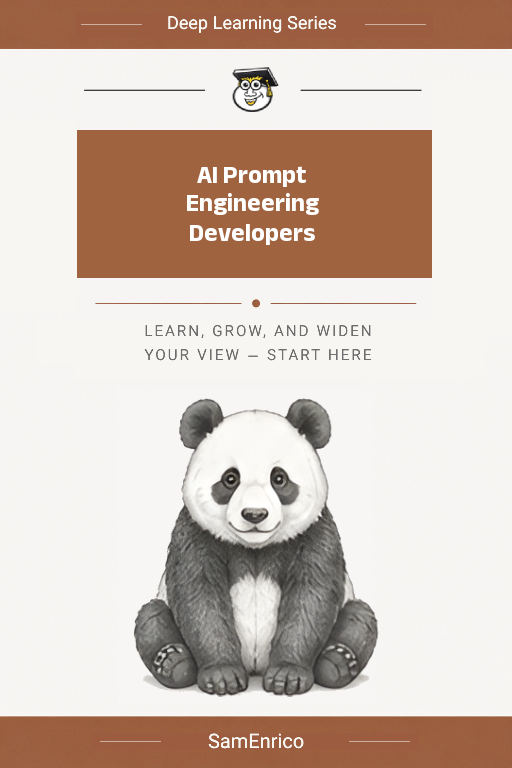
AI Prompt Engineering Developers eBook
Craft effective prompts for coding tasks using pro
by Rees Arlinda
Craft effective prompts for coding tasks using proven patterns and techniques.
Formats
Free sample
Chapter 1: The Probabilistic Pair...--–- The cursor blinks on an otherwise empty screen. A developer—let’s call her Priya—needs to write a function that retries failed API calls. She has done this a dozen times before. Each time, she writes a while loop, adds a try/except, implements exponential backoff, and logs the failures. It takes about twenty minutes.
But today, she has a new option. She opens a chat window and types: “Write a Python function that retries failed HTTP requests.”The AI responds in seconds. The code looks clean. There is a for loop, a time.sleep(), and a return if successful. Priya copies it, pastes it into her codebase, and commits.
She just saved eighteen minutes. Three days later, a production outage occurs. The failing API was not idempotent, and the retry logic—which had no backoff, no jitter, and no way to cancel—hammered the endpoint ten times per second. The downstream service crashed. The incident cost the company $47,000 in lost revenue and six hours of engineering time.Priya’s manager asks, “Did you test the retry logic?” Priya says nothing.
She knows the truth: she trusted the AI like an oracle, not the probabilistic state machine it actually is.This book exists because of Priya. Not one Priya, but thousands of them. The promise of generative AI for software development is real—enormous, even—but the gap between “it works in the chat window” and “it works in production” is where careers go to die. The difference between a junior developer who asks an LLM for code and a senior engineer who engineers prompts is not luck, not talent, and not access to better models. It is a systematic, repeatable, verifiable discipline.
That discipline is prompt engineering for developers, and it begins with one fundamental shift in mental model:An LLM is not a search engine. It is not an oracle. It is not a senior colleague. It is a probabilistic state machine that predicts the next most likely token based on the sequence of tokens you give it. Nothing more.
Nothing less.This chapter dismantles the mythology surrounding AI code generation. You will learn why unstructured Q&A prompts fail in production, how to think about tokens and temperature as configuration parameters, and the four-pillar framework that turns every subsequent chapter into a practical engineering toolkit. By the end, you will never again ask an AI “how do I do X?” Instead, you will configure its output distribution, constrain its behavior, and verify its results. That is the difference between vibe coding and software engineering.The Great Misconception: Your LLM Has No Understanding The most dangerous phrase in software development today is not “it works on my machine.” It is “the AI gave me this code.” Developers have begun treating large language models as authoritative sources, as if the model possesses internal knowledge of correctness, security, performance, or even basic logic. It does not.
An LLM has no beliefs, no understanding, and no intent. It has only probabilities.Let us be precise about what an LLM actually does. When you provide a sequence of tokens—a prompt—the model calculates a probability distribution over every possible next token in its vocabulary. The token with the highest probability is the one the model is “most confident” about, but that confidence is purely statistical. It reflects how often that token followed similar sequences in the training data.
If you ask “what is 2 + 2?”, the model assigns very high probability to the token “4” because it has seen that sequence millions of times. But the model is not performing addition. It is pattern-matching.Now consider what happens when you ask a vague or ambiguous coding question. “How do I handle errors in this function?” The LLM sees the tokens for “errors” and “function” and generates the statistically average response: a generic try/except block. It does not know your error handling policy, your logging framework, whether you want to retry or fail fast, or what constitutes a recoverable error.
It gives you the mean of its training data. And in software engineering, the average answer is rarely production-ready.This is the first and most critical lesson of this book: An LLM’s output is the statistical average of its training examples, not the solution to your specific problem. To get specific answers, you must provide specific context. To get constrained outputs, you must provide constraints. To get reliable code, you must treat the LLM like a junior developer who needs explicit instructions, not a senior who can infer intent.
That is structured prompting, and it is the foundation of everything that follows.The Probabilistic State Machine: A Mental Model for Developers To engineer prompts effectively, you must think of the LLM as a configuration interface. Every parameter you set—the prompt text, the temperature, the top-p, the system message, the context window—changes the probability distribution over the output. Your job is to shape that distribution so the most likely outputs are also the correct ones for your specific use case.Tokens: The Atoms of Meaning An LLM does not see characters or words. It sees tokens. A token is roughly four characters of English text, but the exact mapping depends on the model’s tokenizer.
The word “hello” is one token. The word “unnecessarily” might be three tokens: “un”, “necess”, “arily”. Code tokens are even more variable: “def” is one token, but “def init(self):” might be six or seven separate tokens.Why does this matter for prompt engineering? Because token counts determine three practical constraints that will affect every prompt you write.First, context window size. Every LLM has a maximum number of tokens it can process in a single request.
If your prompt plus the generated response exceed this window, the model will silently drop the oldest tokens. For GPT-4o, the context window is 128,000 tokens. For Gemini 1.5 Pro, it is one million tokens. For Git Hub Copilot running locally, it is only eight thousand tokens. Chapter 2 provides a complete comparison table with exact numbers for every major model.Second, cost.
Most commercial LLMs charge per token. If your prompt is 1,000 tokens and the response is 2,000 tokens, you pay for 3,000 tokens. A poorly written prompt that repeats the same context over and over in a loop can cost $50 per day. A prompt that unnecessarily includes the entire codebase can cost dollars per request.Third, latency. Token generation time scales roughly linearly with token count.
A 100,000-token prompt might take thirty seconds to process. For interactive coding, that is unusable. For batch processing, it might be acceptable.The practical rule that every developer should follow: Be concise but complete. Do not paste your entire codebase into every prompt. Do not write novel-length system messages.
Use token counting libraries (like tiktoken for Open AI models) before running prompts at scale.Temperature and Top-P: Controlling the Dice Roll The two most misunderstood parameters in LLM configuration are temperature and top-p (also called nucleus sampling). Both control randomness, but they do so in different ways. Understanding them is essential because the same prompt will produce very different outputs at different temperature settings.Temperature scales the logits—the raw output scores—before…
This is the end of the free sample. Get the eBook to keep going. Buy now
About this book
Details
- Author
- Rees Arlinda
- Publisher
- SamEnrico
- Language
- English
- Genre
- Non-Fiction, AI Operator
- Released
- 2026-05-29
- Pages (approx.)
- 141
- Available as
- eBook, Audiobook

Read better in the ZLOADR app
Your eBooks on your phone or tablet. Sign in with your SamEnrico account and start reading.
More by Rees Arlinda
 Nkrumah GhanaRees Arlinda$11.99
 Contract Abstraction for ProcurementRees Arlinda$11.99
 Imposter Neurodivergent GuideRees Arlinda$11.99
 Africa Bribery Enforcement LogRees Arlinda$11.99
 LTC Benefit Period Selection GuideRees Arlinda$11.99
 Indigenous Conflict Resolution GuideRees Arlinda$11.99
 The Reformation ExecutionersRees Arlinda$11.99
 Parent Time MeditationRees Arlinda$11.99
 Active Listening for KidsRees Arlinda$11.99
 The Lost City of Z: The Real-Life Indiana JonesRees Arlinda$11.99
 The Great Escape: The Untold Story of the 1977 New York BlackoutRees Arlinda$11.99
 The Silk and the Stars: How the Medici Bank Financed the Renaissance of the CosmosRees Arlinda$11.99
You may also like
 Hong Kong Handover 1997Dunn Johnnie$11.99
 Zumba For Postnatal Recovery CourseNeal Christian$11.99
 Zumba for BeginnersLadner Nikia$11.99
 YouTube Comment Mining GuideHumes Pandora$12.99
 Worry Box MeditationCarlin Rudy$11.99
 Workplace Stress MeditationNguyen Lynn$11.99
 Workplace Stress and Sleep RepairHawley Ivory$11.99
 Workplace Perfectionism CureDelaney Jeffry$11.99
 Workplace Injustice Anger GuideWallen Isabelle$11.99
 Work Addiction and Burnout LinkGreenwood Ester$11.99
 Women in Yoga and WellnessBeattie Galina$11.99
 Women in Stand Up ComedyChun Evangeline$11.99