
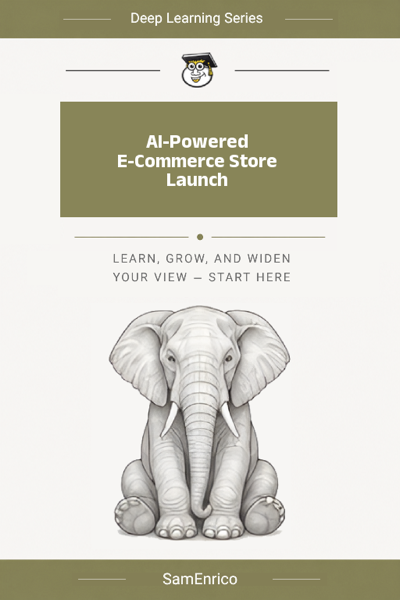
Non-FictionInformativeEducational
AI-Powered E-Commerce Store Launch eBook
A Coursebook on AI-Powered E-Commerce Store Launch
by Tam Miesha
A Coursebook on AI-Powered E-Commerce Store Launch
Formats
Free sample
Chapter 1: The $100 Lie--–- Every day, thousands of aspiring entrepreneurs type the same question into Google: “How much does it cost to start an online store?” The answers they get are dangerously wrong. You have probably read them yourself. Some blogs say you need five thousand dollars. Others say ten thousand. A few, the optimistic ones, whisper that you can start with just a few hundred.
They are all lying to you. Not maliciously, but lying nonetheless. The truth is far stranger and far more hopeful: you can launch a fully functional, AI-powered e-commerce store for less than the cost of a single dinner for two at a mid-range restaurant. That is the first lie we will dismantle in this chapter. The second lie is far more insidious: that you need to be technical, creative, or lucky to succeed.
You do not. You need a map, a set of tools, and a mindset shift that most entrepreneurs never make.This book exists because the rules of e-commerce have changed more in the past eighteen months than in the previous eighteen years. Artificial intelligence has democratized what once required armies of designers, copywriters, developers, and data scientists. A solo founder with a hundred dollars and a willingness to learn can now do what a ten-person team could not have done five years ago. But there is a catch.
The catch is that most people use AI like a hammer. They swing it at everything and hope something breaks open. That is not what this book teaches. This book teaches you to become an AI-augmented founder—someone who knows exactly when to let AI run, when to let AI assist, and when to step in personally. That distinction between automation and augmentation is the single most important concept you will learn.
Master it, and you will never fear being replaced by AI. Ignore it, and you will waste months chasing tools that do not fit your stage or budget.The Three Budget Tiers That Actually Work Before we go any further, you need to know exactly which version of this book you are reading. Not literally, but financially. Every chapter from this point forward will reference one of three budget tiers. You must place yourself in a tier now.
Do not skip this exercise. It will save you from frustration, overspending, and the paralysis of too many choices.Tier 1: The $100–500 Starter. You have almost nothing to invest beyond your time. You will use entirely free versions of AI tools: Chat GPT’s free tier, Canva AI, Google Gemini, and open-source image generators where available. You will manually do what higher tiers automate.
Your advantage is that you learn every system from the ground up. Your disadvantage is speed. Expect to spend eight to twelve weeks from idea to first sale.Tier 2: The $500–2,000 Accelerator. You have some savings, a side income, or the willingness to reinvest early profits. You will pay for mid-tier tools: Midjourney or DALL·E for professional visuals, Jasper or Writesonic for bulk copywriting, Spocket for supplier discovery, and basic ad automation.
Your advantage is speed and polish. You can launch in four to six weeks. Your disadvantage is the temptation to buy tools you do not yet need.Tier 3: The $2,000+ Scaler. You have capital from savings, investors, or an existing business. You will invest in enterprise-grade solutions: custom API access to GPT-4, Pecan AI for predictive modeling, full ad automation suites, and developer time for integrations.
Your advantage is pure velocity. You can launch in two to three weeks. Your disadvantage is the risk of overbuilding before validating demand.Here is the secret that no expensive course will tell you: most successful e-commerce founders start in Tier 1. They prove the concept with free tools. They reinvest their first profits into Tier 2 tools.
They upgrade to Tier 3 only when the revenue justifies the expense. You will see this pattern repeatedly in the case studies throughout this book. The solo entrepreneur you are about to meet started with exactly one hundred and twenty-seven dollars. She did not wait for more money. She did not borrow from family.
She simply started.Why Traditional Store Launches Fail Before we celebrate what AI can do, we must first understand what has been failing for years. The Lean Startup methodology, for all its brilliance, introduced a fatal flaw when applied to e-commerce: it assumed that building a minimum viable product required coding, design, and supply chain management. Most solo entrepreneurs cannot code. They cannot design. They cannot negotiate with overseas suppliers.
So they never launch. They read books. They watch tutorials. They buy domain names and let them expire. This is the first failure mode: analysis paralysis disguised as preparation.The second failure mode comes from the book One Click, which chronicles the rise of Amazon.
The insight there is simple but brutal: most entrepreneurs obsess over features and products while ignoring the user experience of buying. They spend weeks perfecting a logo that no one will remember and days writing an About Us page that no one will read. Meanwhile, their checkout process has eleven steps, their product photos are inconsistent, and their return policy reads like a legal document. Customers arrive, feel confused or distrustful, and leave. The entrepreneur blames marketing.
The real culprit is experience.The third failure mode is the most painful: the feast-or-famine launch. An entrepreneur saves up, spends thousands on inventory and ads, and launches with a grand fanfare. For three days, sales trickle in. Then they stop. The entrepreneur has no feedback loop, no way to know what went wrong, and no money left to try again.
They declare e-commerce a failure and move on to the next dream. This book exists to ensure that never happens to you.Automation Versus Augmentation: The Core Distinction Here is where most AI training goes off the rails. You will hear gurus say, “Automate everything!” They will show you dashboards filled with bots, integrations, and scheduled tasks. They will make you believe that your goal is to eliminate human effort entirely. They are wrong.
Not slightly wrong. Fundamentally, dangerously wrong.Automation means teaching a machine to do a repetitive task exactly the same way every time. Automation is wonderful for things like sending a post-purchase email, updating inventory counts, or backing up your database. Automation does not think. It does not adapt.
It does not improve without human intervention. Automation is a tool for efficiency, not intelligence.Augmentation means using AI to make better human decisions. An augmented founder does not ask AI to write an entire marketing campaign and then publish it blindly. An augmented founder asks AI to generate ten variations of a headline, selects the best two, and then edits them to match their brand voice. An augmented founder does not let an AI chatbot handle angry customers without oversight.
They let the AI triage common questions and escalate the difficult ones to a human. Augmentation is a tool for effectiveness.Throughout this book, you will see the word “augment” far more often than “automate.” You are not here to replace yourself. You are here to become a founder with superpowers. The solo entrepreneur you are about to meet…
This is the end of the free sample. Get the eBook to keep going. Buy now
About this book
Details
- Author
- Tam Miesha
- Publisher
- SamEnrico
- Language
- English
- Genre
- Non-Fiction, Informative, Educational
- Released
- 2026-06-03
- Pages (approx.)
- 160
- Available as
- eBook, Audiobook

Read better in the ZLOADR app
Your eBooks on your phone or tablet. Sign in with your SamEnrico account and start reading.
More by Tam Miesha
 Breathwork for Road RageTam Miesha$11.99
 Caregiver Communication GuideTam Miesha$11.99
 Section 179 Depreciation Deduction GuideTam Miesha$11.99
 Miracle Morning Routine GuideTam Miesha$11.99
 Neti Pot for SinusTam Miesha$11.99
 Tunnel Dream ArchetypeTam Miesha$11.99
 The Chemical Process CreativityTam Miesha$11.99
 Color Breathing For PainTam Miesha$11.99
 Anki For Bible VersesTam Miesha$11.99
 The Quantum Codebreakers: How a Cold War Race Changed the WorldTam Miesha$11.99
 The Magyar Storm: Arpad’s Raiders and the Birth of a Kingdom (9th Century AD)Tam Miesha$11.99
 The Complete Guide to the Fighter Diet ExtremeTam Miesha$11.99
You may also like
 Hong Kong Handover 1997Dunn Johnnie$11.99
 Zumba For Postnatal Recovery CourseNeal Christian$11.99
 Zumba for BeginnersLadner Nikia$11.99
 YouTube Comment Mining GuideHumes Pandora$12.99
 Worry Box MeditationCarlin Rudy$11.99
 Workplace Stress MeditationNguyen Lynn$11.99
 Workplace Stress and Sleep RepairHawley Ivory$11.99
 Workplace Perfectionism CureDelaney Jeffry$11.99
 Workplace Injustice Anger GuideWallen Isabelle$11.99
 Work Addiction and Burnout LinkGreenwood Ester$11.99
 Women in Yoga and WellnessBeattie Galina$11.99
 Women in Stand Up ComedyChun Evangeline$11.99