
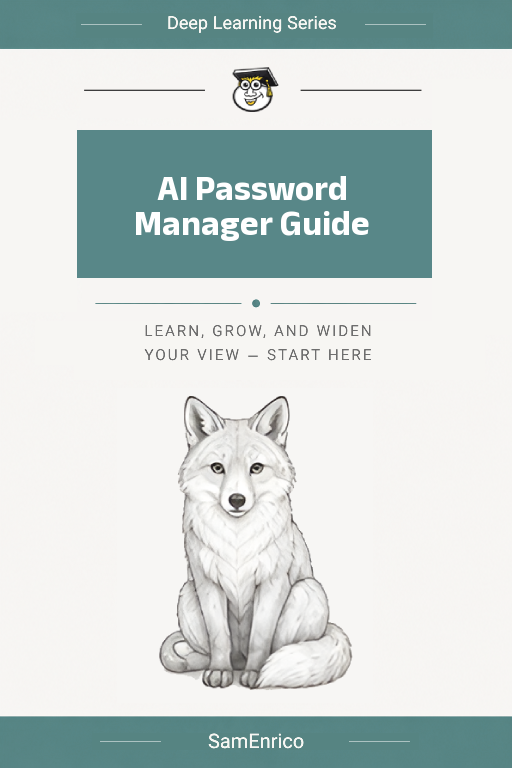
Non-FictionAnnual CheckupPassword AI
AI Password Manager Guide eBook
Use LastPass AI, 1Password, or Bitwarden to manage
Use LastPass AI, 1Password, or Bitwarden to manage business passwords securely.
Formats
Free sample
Chapter 1: The Spreadsheet Lie--–- It was 3:47 AM on a Tuesday when Mark, the IT director for a 200-person marketing agency, received the alert that would unravel his entire security model. A former employee—someone who had left the company eleven months earlier—had just logged into the agency’s primary Facebook ad account and spent $47,000 on fraudulent ads in under four hours. The ex-employee hadn’t hacked anything. He hadn’t cracked a password or exploited a zero-day vulnerability. He simply opened a spreadsheet.That spreadsheet had been shared with him via Google Drive two years ago when he was on the social media team.
It contained forty-seven passwords: Facebook Ads, Twitter, Linked In, Mailchimp, AWS, and—most painfully—the agency’s shared admin account for their client portal. When he was terminated, HR had revoked his email access and disabled his laptop. But no one had thought to revoke access to that spreadsheet. No one had even known it existed.The agency lost the $47,000. They lost the client whose data was exposed in the AWS bucket.
And they lost six weeks of productivity while forensic auditors traced every click that ex-employee had made. The final report contained a single sentence that haunted Mark: “No evidence of hacking. Credentials were obtained from an unmanaged shared document.”This is not an edge case. This is the new normal. And if you are reading this book, something in your own organization has already gone wrong.
You just don’t know it yet.The Password Illusion We have been told a comforting lie for three decades: that security is about choosing strong passwords and changing them often. This lie is perpetuated by well-meaning IT professionals, outdated compliance frameworks, and software vendors who profit from your fear. The truth is far more uncomfortable.Your employees are not the problem because they choose weak passwords. They are the problem because they are human, and humans optimize for convenience over security every single time. When you force a user to change their password every ninety days, they do not become more secure.
They become more predictable. “Spring2024” becomes “Summer2024” becomes “Fall2024.” The password changes, but the pattern remains. A simple dictionary attack with seasonal variations cracks these passwords in seconds.When you forbid password reuse, users do not memorize forty unique complex strings. They write them down. They save them in unencrypted browser storage.
They email them to themselves. They create a system that is, by every measurable metric, less secure than allowing them to reuse a single strong passphrase across low-stakes accounts while using a password manager for everything else.The data is unambiguous. Verizon’s Data Breach Investigations Report has shown for years that over eighty percent of hacking-related breaches involve stolen or weak passwords. Not sophisticated zero-days. Not nation-state espionage.
Credentials that were either guessed, phished, or found in a spreadsheet.The spreadsheet is the enemy. The browser’s saved passwords feature is the enemy. The sticky note under the keyboard is the enemy. And yet, these are the tools that the vast majority of businesses still rely upon.Consider what happens when an employee leaves your company. You disable their email.
You reclaim their laptop. But what about the thirty-seven Saa S accounts they signed up for using their corporate email address? What about the Trello board they created for a one-off project? What about the Zoom account they used for client calls? Those accounts remain active, attached to a email address that no longer exists or—worse—attached to a email address that has been reassigned to a new employee.
The new employee now inherits not just the old email address but also every unmanaged account attached to it.This is not a theoretical risk. This is a daily reality for businesses that have not yet adopted a password manager. And the problem is accelerating, not improving.The Saa S Multiplication Factor In 2015, the average small business used sixteen Saa S applications. By 2020, that number had grown to forty. Today, in 2026, the average business uses over one hundred and thirty distinct Saa S tools.
Many of these were signed up for by individual employees without IT approval, paid for by credit card, and never entered into any central inventory.Each of those accounts has a password. Each of those passwords is either stored insecurely, shared inappropriately, or forgotten entirely. Each represents a potential entry point for an attacker.This is the Saa S sprawl problem, and it is the single greatest unaddressed vulnerability in modern business. Your firewall is irrelevant if an attacker can simply guess the password to your Mailchimp account. Your endpoint protection is irrelevant if a former contractor still has access to your Google Drive.
Your SOC2 certification is irrelevant if you cannot produce an audit log showing who accessed which password and when.The password manager is not a nice-to-have. It is the only practical solution to a problem that has grown beyond human-scale management. No human can remember one hundred and thirty unique complex passwords. No spreadsheet can securely share access across a team of fifty. No IT department can manually offboard every Saa S account for every departing employee.But a password manager can.
And that is why this book exists.Zero Knowledge: The Non-Negotiable Foundation Before we go any further, we need to establish one concept that underpins every chapter that follows. If you take nothing else from this book, understand this: a password manager that can see your passwords is not a password manager. It is a breach waiting to happen.Zero-knowledge architecture is the technical term for a simple idea. The password manager’s servers should never, at any point, have access to your unencrypted master password or the contents of your vault. When you create your account, your master password is used to generate an encryption key on your local device.
That key encrypts your vault before it is ever sent to the cloud. The provider stores only the encrypted blob. They cannot decrypt it because they do not have your key.This means that even if the provider’s servers are hacked—and major providers have been hacked, a fact we will address honestly in later chapters—your vault remains unreadable. The attacker gets a pile of encrypted gibberish. Without your master password, that gibberish is worthless.AES-256 encryption, the standard used by all three providers covered in this book, is the same encryption standard used by the U.S.
government for top-secret documents. It has never been broken. Not once. Not by any nation-state, not by any research team, not by any quantum computer (yet—we will discuss the quantum threat in Chapter 12).But zero-knowledge only works if you never, ever share your master password. Not with IT support.
Not with your boss. Not with the vendor’s customer service. No legitimate password manager will ever ask for your master password. Anyone who does is a phisher.This is also why password managers cannot “reset” your master password for you. If you forget it, your vault is gone.
Permanently. That is a feature, not a bug. It means that no one—not the vendor, not a hacker, not a…
This is the end of the free sample. Get the eBook to keep going. Buy now
About this book
Details
- Author
- Brackett Asia
- Publisher
- SamEnrico
- Language
- English
- Genre
- Non-Fiction, Annual Checkup, Password AI
- Released
- 2026-06-01
- Pages (approx.)
- 151
- Available as
- eBook, Audiobook

Read better in the ZLOADR app
Your eBooks on your phone or tablet. Sign in with your SamEnrico account and start reading.
More by Brackett Asia
 Teen Boundary Setting GuideBrackett Asia$11.99
 Stalking Delivery Driver App CasesBrackett Asia$11.99
 Spin Class Motivation Mantra WorkbookBrackett Asia$11.99
 Loneliness Group Activities GuideBrackett Asia$11.99
 Facebook Envy Cycle Breaking GuideBrackett Asia$11.99
 Crimson Tides: The Blood Red Revolution That Redefined FashionBrackett Asia$11.99
 The Day the Internet Broke: How a Single Flaw Changed EverythingBrackett Asia$11.99
 Understanding Duodenal AtresiaBrackett Asia$17.99
 Tech Union Collective BargainingBrackett Asia$12.99
 Cider SommelierBrackett Asia$11.99
 How to Become a Carpet WeaverBrackett Asia$11.99
You may also like
 Hong Kong Handover 1997Dunn Johnnie$11.99
 Zumba For Postnatal Recovery CourseNeal Christian$11.99
 Zumba for BeginnersLadner Nikia$11.99
 YouTube Comment Mining GuideHumes Pandora$12.99
 Worry Box MeditationCarlin Rudy$11.99
 Workplace Stress MeditationNguyen Lynn$11.99
 Workplace Stress and Sleep RepairHawley Ivory$11.99
 Workplace Perfectionism CureDelaney Jeffry$11.99
 Workplace Injustice Anger GuideWallen Isabelle$11.99
 Work Addiction and Burnout LinkGreenwood Ester$11.99
 Women in Yoga and WellnessBeattie Galina$11.99
 Women in Stand Up ComedyChun Evangeline$11.99