
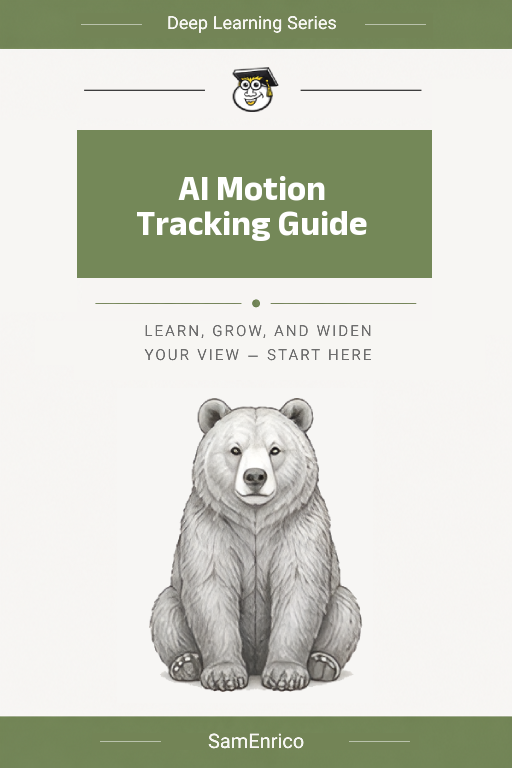
Non-FictionAI OperatorMotion Tracking
AI Motion Tracking Guide Audiobook
Craft prompts for AI motion tracking and object tr
Craft prompts for AI motion tracking and object tracking in video editing workflows.
Formats
Free sample
Chapter 1: The Melted Cheese Problem--–- Every video editor remembers their first AI betrayal. For me, it was a hand. A perfectly innocent prompt – "a person waving their right hand gently" – that should have produced a friendly greeting. Instead, the AI delivered something that looked like a Salvador Dali painting collided with a horror movie. The hand didn't wave.
It liquefied. Fingers became dripping wax. The wrist twisted into a spiral that violated at least three laws of physics. I stared at the screen for a full minute, equal parts fascinated and horrified, wondering where I had gone wrong.–- The answer, I eventually learned, was not in my vocabulary or my grammar. It was in my assumptions.
I assumed the AI watched video the way I did – as a sequence of meaningful scenes featuring recognizable objects performing understandable actions. A hand is a hand. Waving is waving. How hard could that be?–- Very hard, as it turns out. Because AI does not see hands.
It does not see waves. It sees numbers. Specifically, it sees a mathematical field of shifting pixels called optical flow, and it makes probabilistic guesses about which groups of pixels are likely to move together in the next fraction of a second. When those guesses fail – when the vectors that describe your thumb conflict with the vectors that describe your index finger – the AI doesn't think "that's impossible." It thinks "the most statistically likely next state is deformation" and obediently renders your hand as molten cheese.–- This chapter is not a pep talk. It is an intervention.
Before you write another prompt, before you blame the tool or curse the developers, you need to understand what you are actually talking to. The AI is not stupid. It is not broken. It is a spatial computing system that speaks a language of vectors, latent spaces, and probabilistic motion. You have been speaking English.
No wonder you're not understood.–- By the end of this chapter, you will be able to diagnose why a motion prompt failed – was it an optical flow collision or a latent space ambiguity? – before you rewrite it. You will understand the difference between Text-to-Video and Image-to-Video tracking, and why that difference alone can cut your failure rate in half. And you will have a five-part prompt anatomy that will serve as the skeleton for every successful track in this…
This is the end of the free sample. Get the Audiobook to keep going. Buy now
About this book
Details
- Author
- Witherspoon Thomasena
- Publisher
- SamEnrico
- Language
- English
- Genre
- Non-Fiction, AI Operator, Motion Tracking
- Released
- 2026-05-30
- Pages (approx.)
- 147
- Available as
- eBook, Audiobook

Listen in the VoxFlicks app
Audiobooks and audio dramas wherever you go. Sign in with your SamEnrico account and press play.
More by Witherspoon Thomasena
 Self Doubt for PilotsWitherspoon Thomasena$11.99
 Secret Garden JourneyWitherspoon Thomasena$11.99
 Rwanda Revolution Hutu GuideWitherspoon Thomasena$11.99
 Chronic Illness Wellness SpendingWitherspoon Thomasena$11.99
 Metta for ArtistsWitherspoon Thomasena$11.99
 Pixel Pioneers: The Secret War of the 8-Bit TitansWitherspoon Thomasena$11.99
 Networking Group or Mastermind BusinessWitherspoon Thomasena$11.99
 Video Call Conflict Management GuideWitherspoon Thomasena$12.99
 Understanding Mps ViWitherspoon Thomasena$17.99
 A Beginners Guide to Cyclo-cross (Volume 1)Witherspoon Thomasena$11.99
You may also like
 Hong Kong Handover 1997Dunn Johnnie$11.99
 Zumba For Postnatal Recovery CourseNeal Christian$11.99
 Zumba for BeginnersLadner Nikia$11.99
 YouTube Comment Mining GuideHumes Pandora$12.99
 Worry Box MeditationCarlin Rudy$11.99
 Workplace Stress MeditationNguyen Lynn$11.99
 Workplace Stress and Sleep RepairHawley Ivory$11.99
 Workplace Perfectionism CureDelaney Jeffry$11.99
 Workplace Injustice Anger GuideWallen Isabelle$11.99
 Work Addiction and Burnout LinkGreenwood Ester$11.99
 Women in Yoga and WellnessBeattie Galina$11.99
 Women in Stand Up ComedyChun Evangeline$11.99