
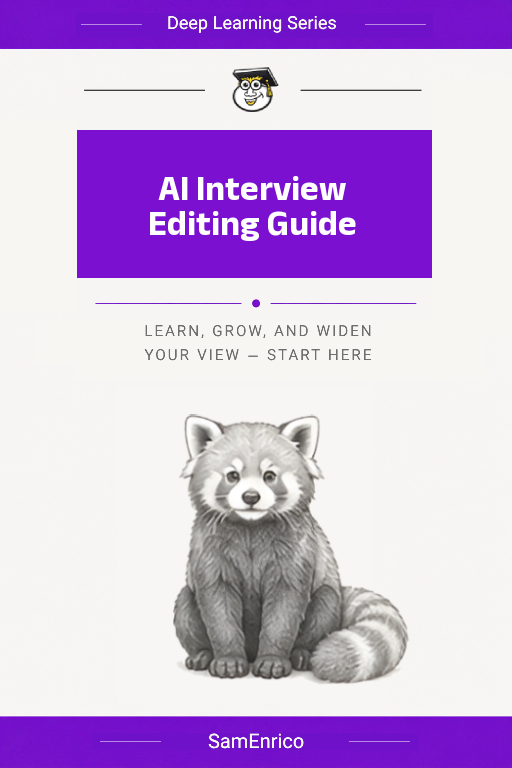
Non-FictionAI OperatorInterview Edit
AI Interview Editing Guide eBook
Use AI to edit podcast and interview videos by rem
by Redmond Nona
Use AI to edit podcast and interview videos by removing pauses and filler words.
Formats
Free sample
Chapter 1: The Sound of Silence--–- It begins with a single word. Not "hello" or "welcome" or even the guest's name. It begins with "Um." A tiny, three-millisecond utterance that carries the weight of a thousand lost viewers. You press play on your interview footage. The speaker opens their mouth.
And instead of confidence, instead of clarity, you hear hesitation. You hear the sound of your audience clicking away.This chapter is not about editing. It is about understanding why editing exists in the first place. Before you touch a single setting in Cap Cut, Premiere Pro, or Descript, you must understand the enemy you are fighting. That enemy is not "ums." That enemy is not silence.
The enemy is the gap between what the speaker intended to say and what the audience actually heard. And that gap is wider than most creators realize.Every interview is a battlefield of micro-signals. The way a guest pauses before answering a question. The way a host stumbles over a transition. The nervous laugh that follows an awkward silence.
These are not neutral events. They are leaks in the hull of your content ship. And water, as they say, always finds its way in.Let us begin with a simple experiment. Close your eyes for three seconds. Count silently: one-one-thousand, two-one-thousand, three-one-thousand.
That is the average length of a "thinking pause" in an unedited interview. Now imagine watching a video where, after every question, the screen goes black for three seconds. Would you stay? Of course not. But in audio terms, that is exactly what you are asking your audience to endure when you leave dead air in your interview.The Hidden Cost of Verbal Hesitation Here is a truth that separates professional creators from amateurs: audiences do not hear "ums" as neutral sounds.
They hear them as signals. Specifically, they hear them as signals of uncertainty, low competence, or even deception. This is not an opinion. It is a conclusion drawn from decades of psycholinguistic research.In a landmark study published in the Journal of Language and Social Psychology, researchers played identical recordings of a speaker answering questions. The only difference was that one version contained three "ums" per minute, while the other had zero.
Participants rated the speaker with "ums" as 18 percent less credible, 22 percent less confident, and 12 percent less knowledgeable. The same words. The same voice. The same answer. But the presence of those tiny disfluencies changed everything.Think about what that means for your interview content.
You could have a guest who is the world's leading expert on your topic. They could share insights worth millions of dollars. But if they say "um" before every sentence, your audience will subconsciously downgrade their expertise. The message loses. The messenger loses.
And you, the creator, lose retention, trust, and revenue.This is not a moral failing on the part of the audience. It is a cognitive shortcut. The human brain is wired to detect fluency as a marker of competence. When someone speaks smoothly, without hesitation, we assume they know what they are talking about. When they stumble, we assume they are making it up.
It is the same reason we trust a surgeon who speaks clearly and doubt one who hesitates—even if their actual surgical skill is identical.The pause, then, is not empty. It is full of meaning. And most of that meaning is negative.Why Your Audience Is Always One Second Away from Leaving Let us talk about the attention span. You have heard the statistics: the average human attention span is now eight seconds, down from twelve seconds just fifteen years ago. Goldfish, by comparison, have an attention span of nine seconds.
The joke writes itself. But these numbers, while dramatic, miss the real point.The real point is not that your audience cannot pay attention. It is that they have unlimited alternatives. The moment your content becomes boring, awkward, or slow, there is a Tik Tok video, a Netflix show, or a You Tube essay waiting to take your place. Your interview is not competing with other interviews.
It is competing with everything.Here is the data that should terrify you into action. You Tube's internal analytics team published findings showing that viewer drop-off spikes at three specific moments: the first five seconds (before the content starts), the fifteen-second mark (when pacing is established), and—most relevant to this chapter—immediately following any pause longer than 0.8 seconds in dialogue.Yes, you read that correctly. 0.8 seconds. That is less than the time it takes to blink twice. If your speaker hesitates for the length of a single deep breath, measurable numbers of viewers leave.
They do not wait to see if the next sentence is brilliant. They assume the awkwardness will continue, and they vote with their click.This effect is magnified in interview formats. Why? Because interviews have natural "turn-taking" pauses. Host asks question.
Guest thinks. Guest answers. Each of those gaps is an opportunity for the viewer to check their phone, scroll to another tab, or simply zone out. And once they zone out, they rarely come back.The solution is not to remove every pause. The solution is to understand which pauses serve the content and which ones serve only the speaker's ego.
More on that distinction later.The Psychology of Disfluency: What "Um" Really Means Let us get specific about the verbal tics that plague most interviews. The "um" and "uh" family. The "like" epidemic. The "you know" filler. The "actually" and "basically" qualifiers.
The "so" sentence starters. Each of these serves a different psychological function, and each requires a different approach to editing.The classic "um" is a signal of cognitive load. The speaker is thinking while speaking, and their mouth has outpaced their brain. They use "um" to buy time. But the audience does not hear it as thinking time.
They hear it as uncertainty. In a high-stakes interview—say, a CEO discussing earnings—every "um" undermines authority. In a casual podcast, the same "um" might sound authentic. Context matters.The "like" epidemic is different. "Like" has become a pragmatic marker, especially among younger speakers.
It can signal approximation ("It was, like, twenty dollars"), hedging ("I, like, think we should go"), or simply a verbal habit. The problem is that "like" dilutes every sentence it touches. It makes the speaker sound uncertain, even when they are stating facts. Removing "like" from an interview transcript often tightens the language so much that the speaker sounds twice as intelligent.The "you know" filler is the most insidious of all. It assumes shared knowledge that may not exist.
When a speaker says "you know" repeatedly, they are asking the audience to fill in the gaps. But audiences do not want to work. They want to be told. Each "you know" is a small burden placed on the viewer. Remove enough of them, and the content flows effortlessly.Then there is the silent pause.
Not all pauses are equal. A pause before an emotional revelation can be powerful. A pause while searching for a word is painful. The difference is intention. A dramatic pause says "listen to what comes next." A searching pause says…
This is the end of the free sample. Get the eBook to keep going. Buy now
About this book
Details
- Author
- Redmond Nona
- Publisher
- SamEnrico
- Language
- English
- Genre
- Non-Fiction, AI Operator, Interview Edit
- Released
- 2026-06-01
- Pages (approx.)
- 138
- Available as
- eBook, Audiobook

Read better in the ZLOADR app
Your eBooks on your phone or tablet. Sign in with your SamEnrico account and start reading.
More by Redmond Nona
 Hot Air Balloon CalmRedmond Nona$11.99
 Relationship Self Talk RewiringRedmond Nona$11.99
 Fitness Class SocializersRedmond Nona$11.99
 Adult Vaccine Booster ScheduleRedmond Nona$11.99
 The Gacy Property Search PhotographsRedmond Nona$11.99
 The Beast of Gévaudan: France's Blood Moon PredatorRedmond Nona$11.99
 Understanding MucormycosisRedmond Nona$17.99
 Project Management AnalystRedmond Nona$11.99
 How to Become a Cloth PrinterRedmond Nona$11.99
 Lenovo Supply GuideRedmond Nona$12.99
You may also like
 Hong Kong Handover 1997Dunn Johnnie$11.99
 Zumba For Postnatal Recovery CourseNeal Christian$11.99
 Zumba for BeginnersLadner Nikia$11.99
 YouTube Comment Mining GuideHumes Pandora$12.99
 Worry Box MeditationCarlin Rudy$11.99
 Workplace Stress MeditationNguyen Lynn$11.99
 Workplace Stress and Sleep RepairHawley Ivory$11.99
 Workplace Perfectionism CureDelaney Jeffry$11.99
 Workplace Injustice Anger GuideWallen Isabelle$11.99
 Work Addiction and Burnout LinkGreenwood Ester$11.99
 Women in Yoga and WellnessBeattie Galina$11.99
 Women in Stand Up ComedyChun Evangeline$11.99