
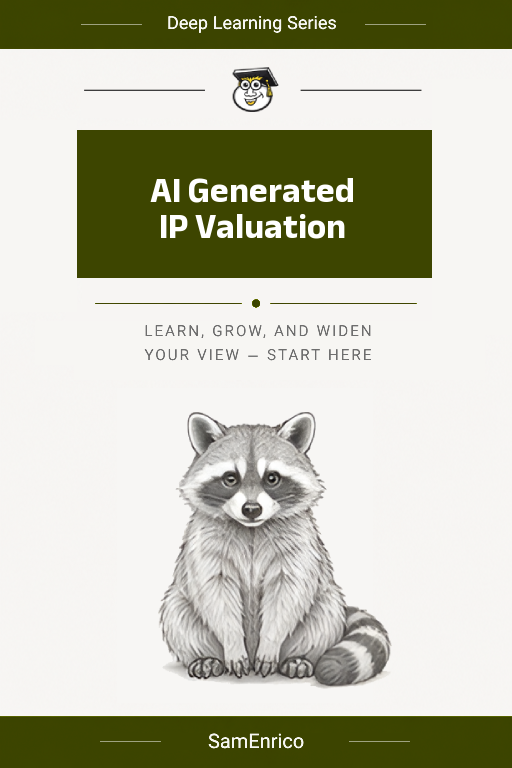
Non-FictionCapital & Valuation RegisterAI IP
AI Generated IP Valuation eBook
Values IP created by artificial intelligence inclu
Values IP created by artificial intelligence including ownership, inventorship, and valuation methodology considerations.
Formats
Free sample
Chapter 1: The Valuation Paradox...-- The most valuable assets on your balance sheet are likely invisible, unownable, and decaying faster than a startup’s runway. Welcome to the paradox of AI-generated intellectual property.In late 2025, a mid-sized pharmaceutical company called Verge Therapeutics found itself in an unexpected position. After spending 47milliontrainingagenerative AImodeltodesignnovelproteinbinders,themodelproducedacompoundthatshowedremarkableefficacyagainstatreatment−resistantcancer.Theboardwasecstatic—untilthegeneralcounseldeliveredthebadnews.Undercurrent U.S.Copyright Officeguidanceandthe∗DABUS∗precedentfromthe Patentand Trademark Office,the AI−generatedcompoundcouldnotbepatented.Themodel’soutputbelongedtonoone.The47 million training a generative AI model to design novel protein binders, the model produced a compound that showed remarkable efficacy against a treatment-resistant cancer. The board was ecstatic—until the general counsel delivered the bad news. Under current U.S.
Copyright Office guidance and the *DABUS* precedent from the Patent and Trademark Office, the AI-generated compound could not be patented. The model’s output belonged to no one. The 47milliontrainingagenerative AImodeltodesignnovelproteinbinders,themodelproducedacompoundthatshowedremarkableefficacyagainstatreatment−resistantcancer.Theboardwasecstatic—untilthegeneralcounseldeliveredthebadnews.Undercurrent U.S.Copyright Officeguidanceandthe∗DABUS∗precedentfromthe Patentand Trademark Office,the AI−generatedcompoundcouldnotbepatented.Themodel’soutputbelongedtonoone.The47 million investment had produced a potentially life-saving molecule that was, legally speaking, free for any competitor to copy, manufacture, and sell.The board’s next question was inevitable: “Then what did we just spend $47 million on?”The answer, as this chapter will reveal, is both everything and nothing. Verge Therapeutics owned the model, the training data, the compute time, the prompts, and the fine-tuning process. But they did not own the output.
And in the world of AI-generated IP, that distinction separates billion-dollar assets from academic curiosities.This is the valuation paradox that defines our era. Generative AI produces output at near-zero marginal cost, at unprecedented speed, and with increasing sophistication. Yet the legal frameworks that underpin intellectual property—patents, copyrights, trade secrets—were designed for a world of human inventors, slow R&D cycles, and tangible creations. When an AI generates a novel drug compound, a bestselling novel, or a million-dollar software library, the question “Who owns this?” has no consistent answer across jurisdictions. And without ownership, valuation becomes an exercise in fiction.This book exists to replace fiction with framework.
We will bridge the three solitudes of AI value: the engineers who build the models, the lawyers who navigate the liability, and the financiers who price the assets. By the end, you will have a repeatable methodology for answering three questions about any AI-generated asset: Can you own it? How do you protect it? And what is it worth?But first, we must understand the scale of the problem. The remainder of this chapter maps the landscape of AI-generated IP valuation, introduces the typology that will guide every subsequent chapter, and establishes why traditional valuation models fail so spectacularly when applied to autonomous creation.The Unseen Balance Sheet In 2024, for the first time in history, the combined value of intangible assets on S&P 500 companies exceeded 90% of total market capitalization.
Brands, software, data, patents, and copyrights now dwarf physical assets like factories and inventory. Generative AI is accelerating this trend at an exponential rate.Consider a simple example. A marketing executive uses Midjourney to generate 10,000 unique product images for an e-commerce campaign. The images cost 0.004each.Amongthemisanimagethatgoesviral,drives0.004 each. Among them is an image that goes viral, drives 0.004each.Amongthemisanimagethatgoesviral,drives5 million in sales, and becomes the company’s de facto logo.
What is that image worth? Under current U.S. law, it may be worth nothing because it cannot be copyrighted. A competitor can copy it, modify it, and use it without consequence. The $5 million in revenue is not protected by any exclusive right.Now consider the opposite scenario.
A software engineer spends 200 hours curating a dataset of 50,000 high-quality code examples, then uses that dataset to fine-tune an open-source large language model to generate security-audited Python functions. The fine-tuned model reduces the company’s development time by 40% and prevents three critical security vulnerabilities. The engineer leaves the company and takes the fine-tuned model weights—a 200-megabyte file—to a competitor. What is the value of those weights? Unlike the generated images, the weights may be protectable as a trade secret, provided the company took reasonable steps to keep them confidential.These two examples illustrate the central tension.
The output of AI (images, text, code, molecules) is often unownable. But the inputs to AI (datasets, prompts, fine-tuned weights, architectures) may be highly ownable. A CFO who treats all AI-related spending as a single line item is making a catastrophic error. The valuation of AI-generated IP requires disaggregation at the most granular level.The table below shows a simplified version of the typology we will develop throughout this chapter and refine in subsequent chapters. For each layer of the AI stack, we ask: Is it ownable?
Under what conditions? And what is the primary valuation driver?Layer Examples Ownable?Primary Valuation Driver Output Generated text, images, music, code Rarely (depends on jurisdiction and human contribution)Market comparables (if any) or zero Application Fine-tuned model, Lo RA, agent Sometimes (as trade secret or via contract)Cost approach + income potential Model Foundation model weights Possibly (as trade secret or open source)Replacement cost + optionality Algorithm Architecture, training method Yes (patent or trade secret)Future cash flows Data Training data, curated datasets Yes (if original selection/arrangement)Cost to recreate + scarcity value Prompts Prompt libraries, embeddings Yes (as trade secret)Cost to develop + utility Governance Compliance documentation, lineage records Yes (as ordinary business records)Compliance tax reduction The key insight—and the first of many counterintuitive conclusions in this book—is that the most defensible and valuable assets are often the ones farthest from the final output. A prompt library may be worth more than the images it generates. A dataset may be worth more than the model trained on it. A governance framework that documents data lineage may be worth more than all three combined because it reduces the compliance tax that would otherwise destroy value.This inversion of traditional IP thinking is unique to generative AI.
In the old world, the finished work (a novel, a patent, a song) was the asset. In the new world, the finished work is often a public good, while the means of production—the data, the prompts, the fine-tunes—remain private assets.The Three Failures of Legacy Valuation Before we can build a new framework, we must understand why the old ones collapse. Traditional IP valuation relies on three approaches, each of which fails in the context of AI-generated assets in specific and predictable ways.The Cost Approach: Training Is Not Owning The cost approach values an asset based on the cost to recreate it. For a traditional patent, this might include R&D expenses, prototype costs, and filing fees. For an AI model, the cost approach would include cloud compute, data acquisition, labeling, fine-tuning, and reinforcement learning from human feedback (RLHF).The problem is that cost bears no relationship to value when the output cannot be owned.
Verge Therapeutics spent $47 million training their protein binder model. Under the cost approach, the model’s output (the compound) would be valued at some fraction of that cost. But because the compound could not be patented, its actual economic value—the exclusive right to manufacture and sell it—was zero. The cost approach would have…
This is the end of the free sample. Get the eBook to keep going. Buy now
About this book
Details
- Author
- Christensen Wanda
- Publisher
- SamEnrico
- Language
- English
- Genre
- Non-Fiction, Capital & Valuation Register, AI IP
- Released
- 2026-06-01
- Pages (approx.)
- 156
- Available as
- eBook, Audiobook

Read better in the ZLOADR app
Your eBooks on your phone or tablet. Sign in with your SamEnrico account and start reading.
More by Christensen Wanda
 Coup Of 18 Brumaire Napoleon Takes Power GuideChristensen Wanda$11.99
 Talent Acquisition for PE Backed FirmsChristensen Wanda$11.99
 The Assertive Family MeetingChristensen Wanda$11.99
 Letting Go Of Emotional ControlChristensen Wanda$11.99
 The Relationship Loss Grief GuideChristensen Wanda$11.99
 The Veena’s Lament: Saraswati’s Divine MelodyChristensen Wanda$11.99
 Chinese Golden Week GuideChristensen Wanda$12.99
 Field Bean HarvestingChristensen Wanda$11.99
 Understanding Symphalangism With Multiple Anomalies of Hands and FeetChristensen Wanda$17.99
 How to Start a Wood Window and Door Manufacturing BusinessChristensen Wanda$11.99
You may also like
 Hong Kong Handover 1997Dunn Johnnie$11.99
 Zumba For Postnatal Recovery CourseNeal Christian$11.99
 Zumba for BeginnersLadner Nikia$11.99
 YouTube Comment Mining GuideHumes Pandora$12.99
 Worry Box MeditationCarlin Rudy$11.99
 Workplace Stress MeditationNguyen Lynn$11.99
 Workplace Stress and Sleep RepairHawley Ivory$11.99
 Workplace Perfectionism CureDelaney Jeffry$11.99
 Workplace Injustice Anger GuideWallen Isabelle$11.99
 Work Addiction and Burnout LinkGreenwood Ester$11.99
 Women in Yoga and WellnessBeattie Galina$11.99
 Women in Stand Up ComedyChun Evangeline$11.99