
Non-FictionAI OperatorConsumer Insights
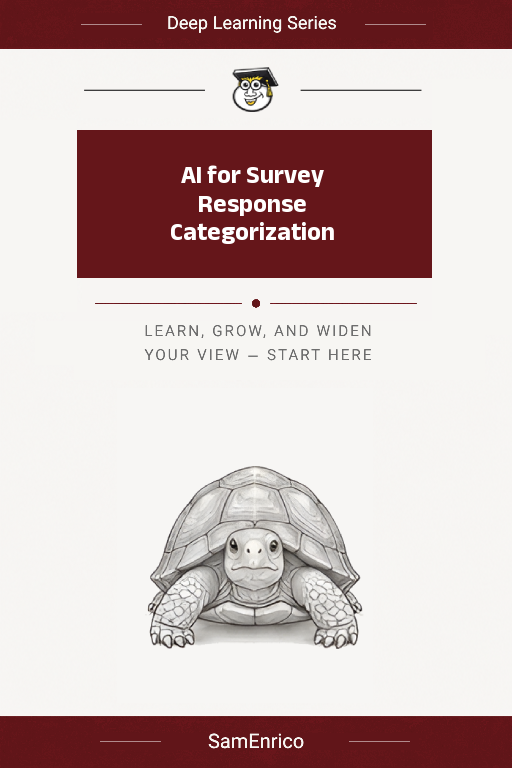
AI for Survey Response Categorization
Automatically categorize open-ended survey respons
Automatically categorize open-ended survey responses into predefined buckets using AI.
Formats
About this book
Free sample
Chapter 1: The Abandoned Goldmine--–- Every week, organizations around the world collect millions of open-ended survey responses. Customers pour their thoughts into text boxes. Employees write candid feedback in engagement surveys. Patients describe symptoms in their own words. Citizens explain why they rated a government service as “poor.” And then, almost universally, that text data dies in a spreadsheet.It sits there.
Unread. Uncoded. Unactionable.The quantitative data—the tidy 1-to-5 ratings, the multiple-choice selections, the Net Promoter Scores—gets dashboards built around it. Executives celebrate a 4.2 average satisfaction score. Product teams track feature adoption percentages.
But the open-ended comments? The ones that actually explain why that score is 4.2 or which feature caused frustration? Those get skimmed by one intern, summarized into three bullet points, and filed away forever.This is the great contradiction of modern market research and customer feedback. Organizations spend significant resources to ask open-ended questions precisely because they know closed-ended questions cannot capture nuance. Then they refuse to spend the resources required to analyze the answers systematically.
The result is a self-fulfilling prophecy: open-ended questions are considered “too hard to analyze,” so they are underutilized, which means they remain too hard to analyze.But that world is ending.Artificial intelligence has fundamentally changed what is possible with open-ended survey text. A task that once required a team of human coders working for two weeks can now be completed in fifteen minutes. A dataset that was previously reduced to “top themes from the first 200 responses” can now be categorized in its entirety, every single response, with consistent rules applied to every single comment. The goldmine of free text is no longer locked behind a wall of manual labor.The problem is not that the technology is missing. The problem is that most researchers, analysts, and business leaders do not know how to use it correctly.
They try to apply generic AI tools designed for document classification to the specific, messy, often contradictory world of survey responses. They do not understand the differences between zero-shot learning, fine-tuning, and active learning. They evaluate their models on the wrong metrics.…
This is the end of the free sample. Get the eBook to keep going. Buy now
Contents
- Chapter 1
- Chapter 2
- Chapter 3
- Chapter 4
- Chapter 5
- Chapter 6
- Chapter 7
- Chapter 8
- Chapter 9
- Chapter 10
- Chapter 11
- Chapter 12
Details
- Author
- Horvath Tamisha
- Publisher
- SamEnrico
- Language
- English
- Genre
- Non-Fiction, AI Operator, Consumer Insights
- Released
- 2026-05-27
- Pages (approx.)
- 147
- Available as
- eBook, Audiobook

Read better in the ZLOADR app
Your eBooks on your phone or tablet. Sign in with your SamEnrico account and start reading.
More by Horvath Tamisha
 Parenting with Emotional IntelligenceHorvath Tamisha$11.99
 War Correspondent MemoriesHorvath Tamisha$11.99
 Canva Brand Identity for Pinterest ProsHorvath Tamisha$11.99
 Step Six Readiness ChecklistHorvath Tamisha$11.99
 The Frozen Enigma: The Lost Expedition of the *SS Baychimo*Horvath Tamisha$11.99
 High School History TeacherHorvath Tamisha$11.99
 Learn to Play the BarytonHorvath Tamisha$11.99
 How to Become a Linen-room SupervisorHorvath Tamisha$11.99
You may also like
 Hong Kong Handover 1997Dunn Johnnie$11.99
 Zumba For Postnatal Recovery CourseNeal Christian$11.99
 Zumba for BeginnersLadner Nikia$11.99
 YouTube Comment Mining GuideHumes Pandora$12.99
 Worry Box MeditationCarlin Rudy$11.99
 Workplace Stress MeditationNguyen Lynn$11.99
 Workplace Stress and Sleep RepairHawley Ivory$11.99
 Workplace Perfectionism CureDelaney Jeffry$11.99
 Workplace Injustice Anger GuideWallen Isabelle$11.99
 Work Addiction and Burnout LinkGreenwood Ester$11.99
 Women in Yoga and WellnessBeattie Galina$11.99
 Women in Stand Up ComedyChun Evangeline$11.99