
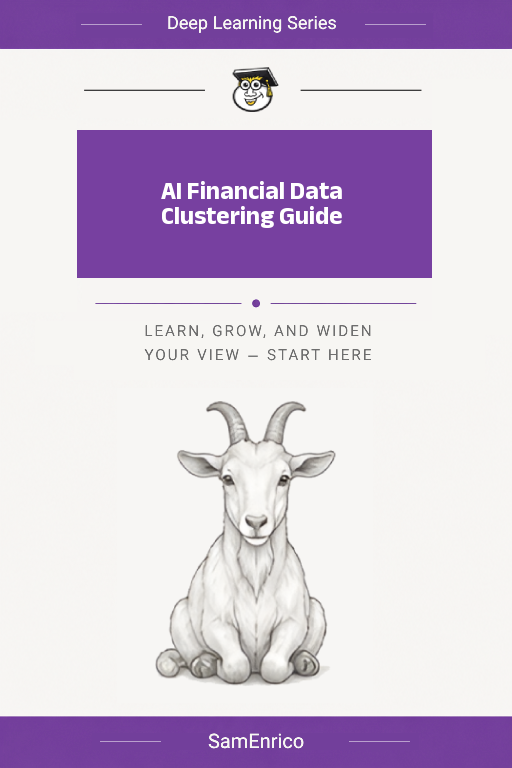
AI Financial Data Clustering Guide
Use AI clustering to segment customers transaction
Use AI clustering to segment customers transactions or cost centers for deeper analysis.
Formats
About this book
Free sample
Chapter 1: The Flat File Fallacy--–- The email arrived at 4:47 PM on a Friday, the kind of timestamp that signals desperation dressed as urgency. The CFO had three questions: Why were marketing expenses up 34% despite flat revenue? Which customers were quietly dying? And why did no one in finance have answers that went deeper than “IT says the data is in the system”?The analyst on the thread, Sarah, had spent the next six hours exporting seventeen Excel sheets, building five pivot tables, and applying twelve manual filters. She found the marketing spike—a single cost center labeled “MISC-PROJECTS” that had swallowed 470,000fromthreedifferentdepartments.Shefoundthedyingcustomers—theoneswhosepurchasefrequencyhaddropped80470,000 from three different departments.
She found the dying customers—the ones whose purchase frequency had dropped 80% but who still showed as “active” because they’d made a single 470,000fromthreedifferentdepartments.Shefoundthedyingcustomers—theoneswhosepurchasefrequencyhaddropped805 transaction in the last ninety days. And she found the answer to the CFO’s third question: the reason no one had deeper answers was that the entire financial analytics function was built on a foundation of flat files, manual categorization, and assumptions that no one had ever tested.This book is for Sarah. And for every financial analyst, FP&A professional, forensic accountant, and data scientist who has ever stared at a million-row Excel sheet and wondered what they were missing.The Flat Excel Sheet Syndrome Financial professionals drown in structured chaos. Every enterprise generates thousands of transactions daily—customer purchases, vendor payments, internal transfers, GL postings, cost center allocations. These transactions are meticulously recorded, timestamped, categorized, and stored.
Yet despite this richness, most financial analysis remains stubbornly two-dimensional.The typical workflow looks like this: export data to Excel, apply filters (“show me transactions over $10,000”), sort by some column (“largest to smallest”), and maybe, if the analyst is feeling adventurous, build a pivot table by month and category. This is not analysis. This is pattern confirmation—finding what you already suspect because you told the tool exactly what to look for.I call this the Flat Excel Sheet Syndrome: the condition where analysts have access to millions of rows of granular transaction data but only…
This is the end of the free sample. Get the eBook to keep going. Buy now
Contents
- Chapter 1
- Chapter 2
- Chapter 3
- Chapter 4
- Chapter 5
- Chapter 6
- Chapter 7
- Chapter 8
- Chapter 9
- Chapter 10
- Chapter 11
- Chapter 12
Details
- Author
- Bertrand Domitila
- Publisher
- SamEnrico
- Language
- English
- Genre
- Non-Fiction, AI Operator
- Released
- 2026-05-30
- Pages (approx.)
- 160
- Available as
- eBook, Audiobook

Read better in the ZLOADR app
Your eBooks on your phone or tablet. Sign in with your SamEnrico account and start reading.
More by Bertrand Domitila
 Empty Nest Stress GuideBertrand Domitila$11.99
 Drug Dependency and Legal IssuesBertrand Domitila$11.99
 TENS Unit NeuropathyBertrand Domitila$11.99
 EQ For Immigrants And RefugeesBertrand Domitila$11.99
 The Loci Overlay TechniqueBertrand Domitila$11.99
 The Backlog Recovery PlanBertrand Domitila$11.99
 Nordic Remote Tax GuideBertrand Domitila$11.99
 Bipolar Pregnancy GuideBertrand Domitila$11.99
 Legal Case Memory PalaceBertrand Domitila$11.99
 The Black Shuck's Howl: Britain's Hellhound of DoomBertrand Domitila$11.99
 The Vanishing of Amelia Earhart: The Lost IslandBertrand Domitila$11.99
 The Timbuktu Codebreakers: The Heist of the Lost AlgorithmsBertrand Domitila$11.99
You may also like
 Hong Kong Handover 1997Dunn Johnnie$11.99
 Zumba For Postnatal Recovery CourseNeal Christian$11.99
 Zumba for BeginnersLadner Nikia$11.99
 YouTube Comment Mining GuideHumes Pandora$12.99
 Worry Box MeditationCarlin Rudy$11.99
 Workplace Stress MeditationNguyen Lynn$11.99
 Workplace Stress and Sleep RepairHawley Ivory$11.99
 Workplace Perfectionism CureDelaney Jeffry$11.99
 Workplace Injustice Anger GuideWallen Isabelle$11.99
 Work Addiction and Burnout LinkGreenwood Ester$11.99
 Women in Yoga and WellnessBeattie Galina$11.99
 Women in Stand Up ComedyChun Evangeline$11.99