
Non-FictionAI OperatorData Archiving
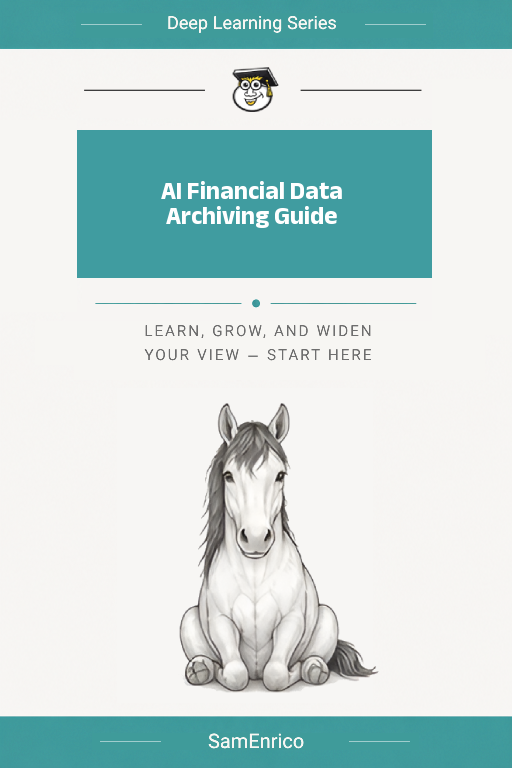
AI Financial Data Archiving Guide eBook
Automate retention policies, data aging, and archi
Automate retention policies, data aging, and archive retrieval for financial records using AI classification.
Formats
Free sample
Chapter 1: The Silent Crisis--–- Every financial institution has one. No one wants to talk about it. It sits in the corner of the IT landscape, gathering digital dust, consuming ever more resources, and quietly accumulating risk with every passing day. This is the silent crisis of the ungoverned archive—the vast, dark ocean of financial records that no one has looked at in years, but that everyone is terrified to touch.Walk through the data center of a typical global bank, and you will see row after row of storage arrays, tape libraries, and cloud infrastructure. Ask the storage administrator what actually lives on those drives, and you will receive a version of the same answer I have heard dozens of times: "Mostly old stuff.
Trade files, emails, statements. We keep it because… well, because we have always kept it."That answer should terrify you.The modern financial firm is drowning in its own history. A single mid-sized investment bank generates several petabytes of new data every month—trade confirmations, regulatory filings, chat logs from compliance-approved messaging platforms, scanned loan applications, call recordings, email threads spanning decades, and system logs from legacy mainframes that no one knows how to interpret anymore. By the time you finish reading this paragraph, another several gigabytes of financial records will have been created somewhere in the world, most of them destined for an archive that no one designed, fewer still that anyone understands, and almost none that are actively governed.This is not merely a storage problem. It is a compliance time bomb, a litigation nightmare, and a strategic failure all wrapped into one.
And yet, most financial institutions continue to operate as if the archive is simply where data goes to die—a passive repository rather than an active asset.The Exponential Tide Consider the sheer scale of the problem. In 1995, a typical bank might have managed a few terabytes of data. By 2005, that number had grown to petabytes. Today, the largest financial firms measure their archival storage in exabytes—that is one billion gigabytes. To put that in perspective, if you stored one exabyte of data on standard Blu-ray discs, the stack would reach from the Earth to the Moon and back again, twice over.But size alone is not the problem.
The problem is what lives inside those exabytes.Financial data is uniquely complex and uniquely regulated. Unlike a retail company's customer database or a manufacturer's inventory logs, financial records carry legal obligations that can last for decades. Every trade confirmation, every account statement, every loan application, every email discussing a potential merger—these are not just data points. They are potential evidence. They are subject to audit.
They can be subpoenaed. They can sink a firm if mishandled.Let me give you a concrete example. In 2018, a major global bank was fined over $200 million by US and UK regulators for failing to produce archived records during an investigation into foreign exchange manipulation. The bank had the records. They simply could not find them.
Their archive was so disorganized, so poorly indexed, and so overrun with what we will come to call Policy Orphans that when regulators came calling with a specific request for chat logs from a specific trading desk during a specific six-month period, the bank's e-discovery team spent months searching and still came up incomplete.Two hundred million dollars. Not because the data was missing. Because the archive was unintelligent.The Regulatory Maze To understand why financial data archiving has become so critical—and so dangerously neglected—you must first understand the web of regulations that govern it. These rules often conflict with one another, creating impossible-seeming demands that traditional archiving systems were never designed to handle.Let us start with the Securities and Exchange Commission's Rule 17a-4, which governs broker-dealers. This rule requires that certain records be preserved for a period of not less than six years.
That is straightforward enough. But here is where it gets complicated: the rule also requires that the records be stored in a non-erasable, non-rewritable format. In industry parlance, WORM—Write Once, Read Many. You cannot go back and modify a trade record from 2019. You cannot delete it before its time.
The record, once written, is immutable.Now consider the Financial Industry Regulatory Authority, or FINRA. Its rules require member firms to preserve records of all communications related to their business, including internal chat messages and emails. And unlike SEC 17a-4, which focuses on specific transaction records, FINRA's reach extends to almost any communication that might touch the firm's business activities. An email chain about what to order for lunch? Probably exempt.
An email chain that mentions a client's portfolio in passing? Preserve it.But wait. There is also the General Data Protection Regulation, or GDPR, which applies to any financial firm handling data of European Union residents. Under GDPR, individuals have the "right to be forgotten"—the right to demand that an organization delete their personal data under certain circumstances. This directly conflicts with SEC and FINRA rules that require retention.
If a EU client asks you to delete their data, but SEC rules say you must keep records of their trades for six years, what do you do?Most traditional archiving systems have no answer to that question. They simply keep everything forever, hoping that the conflict never arises or that no one will notice. This is not a strategy. It is a gamble with stakes that can reach hundreds of millions of dollars.And then there is Basel III, the international regulatory framework for banks, which imposes operational risk requirements that touch on data governance. Under Basel III, banks must demonstrate that they have robust systems for managing operational risk—including the risk that data might be lost, corrupted, or mishandled.
An ungoverned archive is, by definition, a black box of operational risk. No bank can honestly certify that its archive is well-managed if it cannot answer basic questions about what data resides there, why it is being kept, and when it will be deleted.The Unstructured Explosion If structured data—the neat rows and columns of trade records and account balances—were the only challenge, we might have solved this problem years ago. But structured data is only the beginning. The true explosion has been in unstructured data.Unstructured data is exactly what it sounds like: information that does not fit neatly into a database schema. Email messages.
PDF attachments. Scanned documents. Chat logs from Slack, Teams, or Symphony. Voicemail recordings transcribed to text. Call center audio files.
Social media screenshots. Internal wikis. Presentation decks. Spreadsheets with macros. Even video recordings of client meetings.By most estimates, unstructured data accounts for 80 to 90 percent of all data in modern financial firms.
And unlike structured data, which arrives with predictable fields and clear metadata, unstructured data arrives as a torrent of unlabeled, unclassified, frequently chaotic information.Consider the humble email. A single email might contain within it: personally identifiable information (PII) about a client, non-public information about a pending merger, a trade confirmation embedded as a PDF, an internal risk assessment marked "confidential," and a casual joke that could be misinterpreted in discovery. Traditional archiving systems treat the entire…
This is the end of the free sample. Get the eBook to keep going. Buy now
About this book
Details
- Author
- Hickman Sommer
- Publisher
- SamEnrico
- Language
- English
- Genre
- Non-Fiction, AI Operator, Data Archiving
- Released
- 2026-05-27
- Pages (approx.)
- 149
- Available as
- eBook, Audiobook

Read better in the ZLOADR app
Your eBooks on your phone or tablet. Sign in with your SamEnrico account and start reading.
More by Hickman Sommer
 LBO Termination Fee GuideHickman Sommer$11.99
 Holdco PIK Note DatabaseHickman Sommer$11.99
 Gluten Free Beer and Spirits GuideHickman Sommer$11.99
 Screenshot and Save Addiction WorkbookHickman Sommer$11.99
 Bariatric Surgery Kosher Halal GuideHickman Sommer$11.99
 Vanished at the Edge: The Mystery of the Lost Airmen of the Bermuda TriangleHickman Sommer$11.99
 The Frozen Pharaoh: Unlocking the Secrets of the Arctic's Forgotten TombHickman Sommer$11.99
 Head of SalesHickman Sommer$11.99
 Proposal Writing Software ToolsHickman Sommer$12.99
 Understanding Cdg Syndrome Type 1aHickman Sommer$17.99
 How to Start a Potassium Compounds Business (Beginners Guide)Hickman Sommer$11.99
You may also like
 Hong Kong Handover 1997Dunn Johnnie$11.99
 Zumba For Postnatal Recovery CourseNeal Christian$11.99
 Zumba for BeginnersLadner Nikia$11.99
 YouTube Comment Mining GuideHumes Pandora$12.99
 Worry Box MeditationCarlin Rudy$11.99
 Workplace Stress MeditationNguyen Lynn$11.99
 Workplace Stress and Sleep RepairHawley Ivory$11.99
 Workplace Perfectionism CureDelaney Jeffry$11.99
 Workplace Injustice Anger GuideWallen Isabelle$11.99
 Work Addiction and Burnout LinkGreenwood Ester$11.99
 Women in Yoga and WellnessBeattie Galina$11.99
 Women in Stand Up ComedyChun Evangeline$11.99