
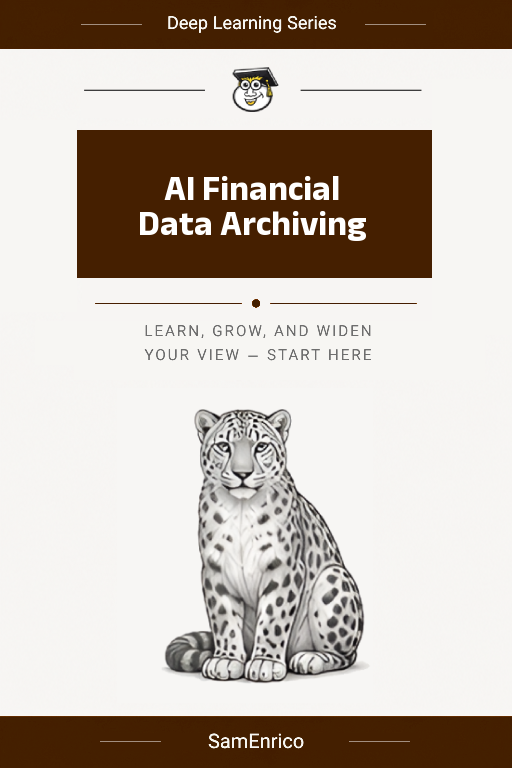
Non-FictionAI OperatorArchiving
AI Financial Data Archiving eBook
Archive financial data for AI analysis while maint
by Mattox Elza
Archive financial data for AI analysis while maintaining accessibility.
Formats
Free sample
Chapter 1: The $47 Million Tape...--–- The conference room on the 47th floor of 1251 Avenue of the Americas smelled of stale coffee and desperation. It was 3:47 PM on a Thursday, and Sarah Chen, the head of quantitative research at Monarch Capital, was staring at a spreadsheet that made no sense. Her best team had spent six weeks developing a volatility arbitrage strategy that backtested beautifully—on paper. The simulated returns showed a Sharpe ratio of 2.1, drawdowns under eight percent, and what her analysts called "compelling risk-adjusted alpha." But when they ran the live paper trade, the model performed worse than a random walk. The discrepancy was not small.
It was catastrophic.The problem, Sarah eventually discovered, was not her model. The problem was her archive.Somewhere in Monarch's sprawling data infrastructure, stored on LTO-6 tapes in a climate-controlled warehouse outside Salt Lake City, sat fifteen years of tick data from the CME and ICE exchanges. That data contained the exact market microstructure her model needed—every trade, every quote, every cancellation across hundreds of futures contracts. But the tape library was a mess. Labels had fallen off.
Cataloging systems from three mergers ago had been abandoned but never migrated. The engineer who understood the tape rotation schedule had left the firm in 2019 and was now running a goat farm in Vermont. When Sarah's team requested the 2008-2010 crude oil futures data for backtesting, the storage team quoted them a six-week lead time just to locate the tapes, plus another two weeks for restoration.Meanwhile, a competing fund—Renaissance Technologies, though no one would confirm it publicly—had built what insiders called the "Active Archive." They stored their historical market data on a tiered object storage system with deep integration into their AI training pipelines. When their quants wanted to test a hypothesis about the relationship between gold futures and Treasury yields during the 2008 crisis, they ran a query at 2:00 PM and had results by 2:10 PM. Not six weeks.
Ten minutes.By the time Monarch's tapes were found and restored, the volatility arbitrage opportunity had vanished. The market had moved on. Sarah's team estimated the missed profit at forty-seven million dollars. The managing director's response, delivered via a single-line email, was terse: "Explain how our data strategy cost us $47M."This book is the explanation. More importantly, it is the solution.The Archiving Blind Spot Every financial institution archives data.
Banks archive trade confirmations. Hedge funds archive tick data. Exchanges archive order books. Insurance companies archive claims. Wealth managers archive client statements.
But for the vast majority of these firms, archiving is an afterthought—a compliance checkbox, a "set it and forget it" batch job that runs at 2:00 AM, writes data to slow storage, and then never thinks about that data again until a regulator comes calling or a litigation hold is issued.This approach was defensible in the pre-AI era. When data was only ever used for annual audits and regulatory exams, storing it on cheap tape with forty-eight-hour retrieval times made perfect sense. Tape was cost-effective, durable, and compliant with SEC Rule 17a-4's requirement for non-rewriteable, non-erasable storage. The fact that it was slow did not matter because no one needed it quickly.That era is over.Artificial intelligence—particularly the recent explosion in large language models, retrieval-augmented generation, and time-series forecasting—has transformed historical data from a dormant liability into an active asset. Today, the firms that win are not necessarily the ones with the best models or the smartest quants.
They are the ones that can access, query, and learn from their full historical archive at the speed of AI training.Consider what is now possible. An LLM fine-tuned on ten years of earnings call transcripts can identify subtle shifts in executive sentiment that precede stock moves by weeks. A time-series model trained on millisecond-level order book data can predict intraday volatility spikes minutes before they happen. A knowledge graph constructed from fifteen years of trade blotters, regulatory filings, and news articles can surface hidden connections between seemingly unrelated market events. But none of this is possible if the underlying data is locked on tapes in a Utah warehouse, its metadata lost, its format obsolete, its retrieval measured in weeks rather than seconds.This book is for the Sarah Chens of the world—the data engineers, AI architects, quants, and compliance officers who need to bridge the gap between "archive as landfill" and "archive as competitive weapon." It will teach you how to build a financial data archive that is simultaneously immutable enough to satisfy SEC auditors and accessible enough to train next-generation AI models.
It will reconcile the apparent contradictions: immutability with GDPR deletion, time travel queries with cost-effective summarization, lossless precision with modern compression. And it will give you the practical tools—the code, the configurations, the decision matrices—to build this system yourself.The Three-Layer Problem That Breaks Most Archives Before we can build the solution, we must understand the problem in its full complexity. Financial data archives fail for one of three reasons—or more commonly, a toxic combination of all three.Layer One: Volume The sheer scale of modern financial data is difficult to overstate. A single exchange like Nasdaq processes roughly 100 billion messages per day when you include trades, quotes, order updates, and administrative messages. Over the course of a year, that is 36 trillion messages.
Even compressed efficiently, this represents multiple petabytes of raw data. And that is just one exchange. A global hedge fund might subscribe to forty different exchanges, plus alternative data feeds (satellite imagery, shipping data, credit card transactions), plus internal data (trade blotters, risk reports, compliance logs).The volume problem is not just about storage capacity—storage is cheap. The real challenge is queryability. When you have fifty petabytes of data spread across WORM tapes, standard object storage, and high-performance SSDs, how do you run a single SQL query that spans the entire dataset?
How do you train a model on data that is physically distributed across three cloud regions and two on-premises data centers? Most organizations answer these questions by simply not trying. They archive data to check a box, then never query it again because the query would take too long or cost too much. This is the volume paradox: the more data you keep, the less you use.Layer Two: Velocity Financial data does not arrive in neat, batch-oriented chunks. It arrives as a firehose—millions of events per second, each with nanosecond timestamps, each requiring accurate ordering and durability guarantees.
Traditional archiving systems, designed for nightly batch uploads, cannot keep up. By the time the batch job runs at 2:00 AM, the market has already moved, and the data's value for real-time or near-real-time AI has degraded.Consider a high-frequency trading firm that wants to archive order book snapshots for later training of a market impact model. The data arrives at 10 million messages per second. If the archiving pipeline cannot ingest, validate, compress, and store that data with sub-second latency, the pipeline backs up. Backlogs mean data loss.
Data loss means training sets with gaps. Gaps mean models that fail in production. The velocity problem is the reason many firms still rely on…
This is the end of the free sample. Get the eBook to keep going. Buy now
About this book
Details
- Author
- Mattox Elza
- Publisher
- SamEnrico
- Language
- English
- Genre
- Non-Fiction, AI Operator, Archiving
- Released
- 2026-05-29
- Pages (approx.)
- 146
- Available as
- eBook, Audiobook

Read better in the ZLOADR app
Your eBooks on your phone or tablet. Sign in with your SamEnrico account and start reading.
More by Mattox Elza
 Universal Flu Vaccine ResearchMattox Elza$11.99
 TM For College Students HandbookMattox Elza$11.99
 Fern Grotto PeaceMattox Elza$11.99
 The Self Esteem and Infidelity Fear GuideMattox Elza$11.99
 Emotional Intelligence for LawyersMattox Elza$11.99
 The Iron Bridge: The Battle That Shaped the Balkan Wars (1912-1913)Mattox Elza$11.99
 A 30-Day Exploration with a 12-Day Practice PeriodMattox Elza$11.99
 Understanding Myasthenia, FamilialMattox Elza$17.99
 LVMH SWOT Analysis GuideMattox Elza$12.99
 How to Start a Museums of All Kinds Business (Beginners Guide)Mattox Elza$11.99
You may also like
 Hong Kong Handover 1997Dunn Johnnie$11.99
 Zumba For Postnatal Recovery CourseNeal Christian$11.99
 Zumba for BeginnersLadner Nikia$11.99
 YouTube Comment Mining GuideHumes Pandora$12.99
 Worry Box MeditationCarlin Rudy$11.99
 Workplace Stress MeditationNguyen Lynn$11.99
 Workplace Stress and Sleep RepairHawley Ivory$11.99
 Workplace Perfectionism CureDelaney Jeffry$11.99
 Workplace Injustice Anger GuideWallen Isabelle$11.99
 Work Addiction and Burnout LinkGreenwood Ester$11.99
 Women in Yoga and WellnessBeattie Galina$11.99
 Women in Stand Up ComedyChun Evangeline$11.99