
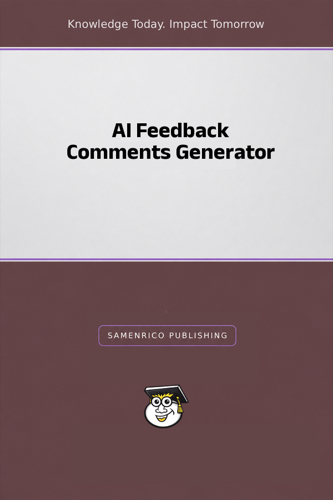
Non-FictionAI OperatorStudent Feedback
AI Feedback Comments Generator eBook
Produce personalized, constructive feedback for st
Produce personalized, constructive feedback for student work at scale.
Formats
Free sample
Chapter 1: The Scalability Paradox--–- The email arrived at 11:47 PM on a Sunday. Maria, a veteran high school English teacher of fourteen years, had spent her entire weekend grading 112 argumentative essays. Her fingers ached. Her eyes burned. And she had just typed the same comment—"Great point, but where's your evidence?"—for the thirty-seventh time.
She knew each student deserved individualized, thoughtful feedback. She also knew that if she wrote 112 unique, personalized responses, she would be grading until Wednesday. So she compromised. She used a mix of canned phrases, a few personalized sentences for the struggling students, and silent prayers that the rest would somehow figure it out on their own. Her compromise was not laziness.
It was survival.Maria's Sunday night ritual is not an exception. It is the rule. Across every subject, every grade level, and every type of institution, educators face an impossible choice. On one side of the scale sits pedagogical best practice: research shows that specific, timely, constructive feedback is one of the most powerful levers for student learning, with an effect size above 0.70 in John Hattie's meta-analyses—higher than reducing class size, higher than ability grouping, higher than almost any other intervention you can name. On the other side of the scale sits the brutal mathematics of a teacher's workload: 150 students, five classes, 10 minutes of quality feedback per paper, 1,500 minutes of grading, 25 hours of work, all due before next week's new pile arrives.Something has to give.
And for generations, what has given is either the quality of the feedback or the sanity of the teacher.The False Choice That Has Defined Grading for a Century Before we discuss any solution—before we mention artificial intelligence, automation, or prompts—we must first name the problem with uncomfortable precision. The problem is not that teachers are lazy. The problem is not that students don't want feedback. The problem is structural, mathematical, and deeply human.Let us define the two poles of this paradox clearly.Pole One: The Canned Comment Bank Most learning management systems (LMS) offer a feature called a "comment bank" or "quick feedback" library. A teacher types a few common phrases—"Good work," "Cite your sources," "Develop this idea further"—and saves them as clickable buttons.
When grading, the teacher clicks once, and the comment appears. Efficiency skyrockets. A set of 30 essays can be "commented" in under two hours.But at what cost? Canned comments are pedagogically hollow. Students learn nothing specific about their own writing.
"Good work" does not tell a student what was good. "Cite your sources" does not tell a student which claim needs a source or how to find one. Over time, students stop reading canned comments altogether because they have learned—correctly—that the comments contain no actionable information. The comment bank turns feedback into wallpaper: technically present, functionally invisible.Pole Two: The Bespoke Feedback Essay At the other extreme, some teachers—usually early in their careers or heroically committed to a fault—write individual paragraphs for every student. They reference specific sentences.
They ask Socratic questions tailored to each argument. They draw diagrams in the margins. This approach produces genuine learning gains. A student who receives bespoke feedback knows exactly where they stand and exactly what to do next.But bespoke feedback is not scalable. A single 500-word essay might receive 200 words of personalized feedback.
Multiply that by 150 students, and you have written 30,000 words of feedback—the equivalent of a novella—every single week. Add lesson planning, parent communication, meetings, and the other 47 responsibilities of a modern educator, and the math becomes a recipe for burnout. According to a 2022 RAND Corporation study, teachers work an average of 54 hours per week, with grading and feedback consuming the largest single chunk of after-hours work. Unsurprisingly, 44% of K-12 teachers report feeling burned out "always" or "very often"—a rate higher than any other profession in the United States.Between these two poles, there is no comfortable middle. There is only trade-off.
Speed or specificity. Volume or quality. Your sanity or their learning.Why More Time Is Not the Answer A well-meaning administrator might read the paragraphs above and propose a simple solution: give teachers more planning time. Reduce class sizes. Hire graders.
These interventions help at the margins, but they do not solve the structural problem because the problem is not merely one of time scarcity. It is a problem of attention scarcity.Here is what the research on feedback actually tells us, and why it makes the scalability paradox so cruel.John Hattie's seminal work, Visible Learning, synthesized over 800 meta-analyses covering millions of students. He found that feedback has an average effect size of 0.73, placing it among the top ten influences on student achievement. But Hattie also found something more nuanced: not all feedback is created equal. Feedback that simply tells students they are correct or incorrect (what he calls "task feedback") has a much lower effect than feedback that helps students monitor their own learning ("process feedback") or develop better strategies ("self-regulation feedback").In plain English: the most valuable feedback is also the most time-consuming to produce.
Telling a student "wrong" takes one second. Explaining why it is wrong, how to fix it, and what to watch for next time takes several minutes. The pedagogical imperative pushes teachers toward the bespoke pole. The practical reality pushes them toward the canned pole. And the person caught in the middle—the one who must choose between effectiveness and survival—is the teacher.Adding more time does not solve this because the demand for feedback is elastic.
If you give a teacher two hours of grading time, they will write two hours' worth of comments. If you give them four hours, they will write four hours' worth—because there is always another student, another paragraph, another nuance that could be addressed. The only ceiling is the teacher's own exhaustion.What we need is not more hours in the day. What we need is a different kind of assistant.The Core Insight: Separating Judgment from Composition Let us pause here and make a crucial distinction that will shape every subsequent chapter of this book. The act of giving feedback contains two fundamentally different cognitive tasks.The first task is judgment.
Judgment requires a human teacher. It asks: What does this student understand? Where is the gap between their current performance and the learning objective? What would help this particular student, at this particular moment, take the next step? Judgment draws on pedagogical knowledge, content expertise, empathy, and an understanding of the student as an individual.
Judgment cannot be fully automated. Any system that claims otherwise is selling you a fantasy.The second task is composition. Composition is the mechanical act of turning a judgment into sentences. It asks: How do I phrase this observation clearly? What word order will make the feedback easy to understand?
How do I avoid sounding harsh or dismissive? Composition draws on grammar, syntax, vocabulary, and basic writing fluency. Composition can be automated. In fact, it is the kind of task that large language models (LLMs) perform exceptionally well.Here is the insight that unlocks the scalability paradox: you are not automating teaching; you are automating the typing.The teacher…
This is the end of the free sample. Get the eBook to keep going. Buy now
About this book
Details
- Author
- Bittner Shelli
- Publisher
- SamEnrico
- Language
- English
- Genre
- Non-Fiction, AI Operator, Student Feedback
- Released
- 2026-06-06
- Pages (approx.)
- 137
- Available as
- eBook, Audiobook

Read better in the ZLOADR app
Your eBooks on your phone or tablet. Sign in with your SamEnrico account and start reading.
More by Bittner Shelli
 Polish Enigma Code MessengersBittner Shelli$11.99
 Bullying Led To Suicide Attempt StoryBittner Shelli$11.99
 Ghost Phobia Paranormal Reality TestBittner Shelli$11.99
 Stress and Respiratory Health GuideBittner Shelli$11.99
 The Last Flight of the Concorde: How the World’s Fastest Jet Fell from the SkyBittner Shelli$11.99
 Mobile AssociateBittner Shelli$11.99
 Understanding Marfan-like SyndromeBittner Shelli$17.99
 How to Start a Pencils (retail) Business (Beginners Guide)Bittner Shelli$11.99
 Remote Review Video Call TechniquesBittner Shelli$12.99
 Nearshore Software Development GuideBittner Shelli$12.99
You may also like
 Hong Kong Handover 1997Dunn Johnnie$11.99
 Zumba For Postnatal Recovery CourseNeal Christian$11.99
 Zumba for BeginnersLadner Nikia$11.99
 YouTube Comment Mining GuideHumes Pandora$12.99
 Worry Box MeditationCarlin Rudy$11.99
 Workplace Stress MeditationNguyen Lynn$11.99
 Workplace Stress and Sleep RepairHawley Ivory$11.99
 Workplace Perfectionism CureDelaney Jeffry$11.99
 Workplace Injustice Anger GuideWallen Isabelle$11.99
 Work Addiction and Burnout LinkGreenwood Ester$11.99
 Women in Yoga and WellnessBeattie Galina$11.99
 Women in Stand Up ComedyChun Evangeline$11.99