
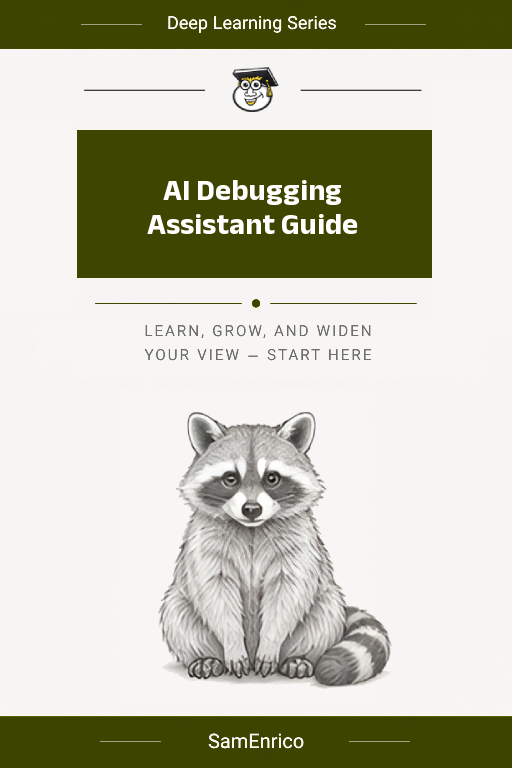
AI Debugging Assistant Guide eBook
Paste error messages and stack traces into AI. Get
Paste error messages and stack traces into AI. Get explanations, root causes, and fix suggestions instantly.
Formats
Free sample
Chapter 1: The 2AM Confession--It is 2:13 on a Tuesday morning. Your screen glows with the particular harshness that only comes when you have been staring at the same error for three hours. The stack trace is forty-seven lines long. You have read it eleven times. You have tried the first three suggestions from Google.
You have pasted the error into Chat GPT, received a response that sounded authoritative, followed its advice, and made things worse. Now the error has multiplied. What was once a single Null Pointer Exception is now a cascade of failures, like dominoes falling in slow motion. Your cursor blinks. Your coffee is cold.
And somewhere in the back of your mind, a quiet voice whispers: I have no idea what I am doing.If you have never felt this way, close this book and give it to someone who has. But if you recognize that feeling—the specific weight of being stuck, the slow realization that you are not debugging so much as wandering through a dark room hoping to bump into the solution—then you are in the right place.This book is not about becoming a better programmer in the abstract. It is not about design patterns or algorithms or the subtle superiority of functional programming over object-oriented paradigms. This book is about one thing, and one thing only: teaching you to use artificial intelligence as a systematic, reliable, and powerful debugging assistant. Not a magic wand.
Not a search engine that talks back. An assistant. A partner. A tool that, when wielded correctly, will turn hours of frustration into minutes of clarity.But before we can build that partnership, we have to talk about why copy-paste debugging fails. Because right now, most developers are using AI the same way they use Google—pasting an error, scanning the result, and hoping for the best.
And that approach, while understandable, is fundamentally broken.The Vibe Debugging Epidemic There is a term emerging in engineering circles, whispered in Slack channels and tweeted by frustrated staff engineers. It is not flattering. The term is vibe debugging.Vibe debugging is the practice of pasting an error message into an AI assistant, reading the response, and trying whatever it suggests without fully understanding why. The "vibe" part comes from the decision-making process: you are not reasoning through the problem. You are not forming hypotheses.
You are not testing assumptions. You are vibing—moving from suggestion to suggestion based on how plausible each one sounds, like a jury deciding a case based on which lawyer has the better haircut.Vibe debugging feels productive. You are typing. You are copying. You are pasting.
You are getting answers. But feeling productive and being productive are not the same thing. In fact, vibe debugging has three hidden costs that most developers never see until they have wasted a full day.The first cost is time debt. Every wrong suggestion you try is not just wasted minutes; it is a new state of your system that you must understand and potentially revert. The AI suggests changing a configuration file.
You change it. The error changes. Now you have two variables instead of one. You have dug yourself deeper.The second cost is trust erosion. After the third hallucinated fix, you start doubting everything.
You doubt the AI. You doubt your code. You doubt your own ability to recognize a reasonable answer. This is not paranoia; it is a rational response to an unreliable tool. But it is also exhausting.The third cost is learning prevention.
When the AI gives you an answer and you implement it without understanding, you have learned nothing except that copy-paste works sometimes. The next time a similar error appears, you will be just as lost. You have not built mental models. You have not added tools to your debugging toolkit. You have simply outsourced your confusion to a machine that is very good at sounding confident.Here is the hard truth: AI is not Google.
Google returns links to documents written by humans who (presumably) understood what they were writing. AI generates text based on patterns in its training data. It does not know your codebase. It does not know your constraints. It does not know what you are trying to build.
It knows what an error message usually means, based on millions of Git Hub repositories and Stack Overflow posts, most of which are themselves full of mistakes, outdated solutions, and context-free answers.When you paste an error into Chat GPT, you are asking a brilliant mimic to solve a problem it cannot see. And that is why it fails so often.The Hallucination Gap Let me introduce a concept that will appear throughout this book: the Hallucination Gap.A hallucination, in AI terminology, is when a model generates text that is confident, coherent, and completely wrong. Not slightly off. Not approximately correct. Wrong in ways that can range from amusing (suggesting you import a library that does not exist) to catastrophic (suggesting you delete a database table to fix a permission error).The Hallucination Gap is the space between what the AI thinks it knows and what is actually true about your specific situation.
This gap exists because AI models are trained on general knowledge. They know that Python exists. They know that Django has a settings.py file. They know that Null Pointer Exception in Java usually means you forgot to initialize an object.But they do not know that your Django project uses a custom user model. They do not know that your Java application runs on a restricted JVM with limited memory.
They do not know that your codebase has a specific pattern for handling null values that is different from the standard pattern.The AI fills the Hallucination Gap with plausible guesses. And because the guesses are plausible—because they sound like something a senior engineer might say—you trust them. That is the trap. The AI is not malicious. It is not stupid.
It is simply working with incomplete information. And you are the only person in the conversation who can provide that missing information.Consider this example. A developer pastes the following error into Chat GPT:text Copy Download Traceback (most recent call last): File "app.py", line 24, in process_payment result = gateway.charge(amount) Attribute Error: 'None Type' object has no attribute 'charge'Chat GPT responds: "This error means your gateway object is None. You likely forgot to initialize the payment gateway. Make sure you call initialize_gateway() before calling charge()."This sounds reasonable.
It is even correct in the abstract. But here is what the AI does not know: the developer did call initialize_gateway(). The problem is that initialize_gateway() fails silently when the API key is missing from environment variables. The gateway object is None because the initialization function returned None instead of raising an exception. The real fix is not calling initialize_gateway()—it is adding the API key to .env.The AI could not know this because the developer did not tell it.
The developer pasted the trace but not the code for initialize_gateway(). Not the environment variables. Not the fact that the error only happens in…
This is the end of the free sample. Get the eBook to keep going. Buy now
About this book
Details
- Author
- Irizarry Laronda
- Publisher
- SamEnrico
- Language
- English
- Genre
- Non-Fiction, AI Operator, Quality Assurance
- Released
- 2026-06-01
- Pages (approx.)
- 143
- Available as
- eBook, Audiobook

Read better in the ZLOADR app
Your eBooks on your phone or tablet. Sign in with your SamEnrico account and start reading.
More by Irizarry Laronda
 Empathic Listening NVC GuideIrizarry Laronda$11.99
 Tuskegee Airman StoryIrizarry Laronda$11.99
 Canva Brand Identity for GymsIrizarry Laronda$11.99
 The Dolchstosslegende MythIrizarry Laronda$11.99
 The Great Train Robbery of 1855: The First Modern HeistIrizarry Laronda$11.99
 Gardening (Forest Gardening Organic Gardening Wildlife Gardening Bonsai and Permaculture)Irizarry Laronda$11.99
 Learn to Play the Vibrandoneon (Instrument)Irizarry Laronda$11.99
 10 Ways to Use Feta (Recipe Book)Irizarry Laronda$11.99
You may also like
 Contract Abstraction Quality ControlMcelroy Hui$11.99
 AI Code Smell Detection GuideIrwin Shenita$12.99
 Quality Control Automation GuideCrider Weldon$12.99
 Prompt Validation for Business RulesThibodeaux Elane$12.99
 AI for Test Failure DebuggingCrider Garret$12.99
 AI for Security Vulnerability DetectionIrby Maya$12.99
 AI for Performance Issue DetectionMaurer Tawanda$12.99
 AI for Code Review AutomationLundy Vada$12.99
 AI Code Review Checklist GenerationCaron Glinda$12.99
 Content Quality Review AI GuideOrosco Nery$12.99
 AI for Log Analysis & DebuggingBoudreaux Shelby$12.99
 AI for Automated Code Fix SuggestionsIbarra Laurena$12.99