
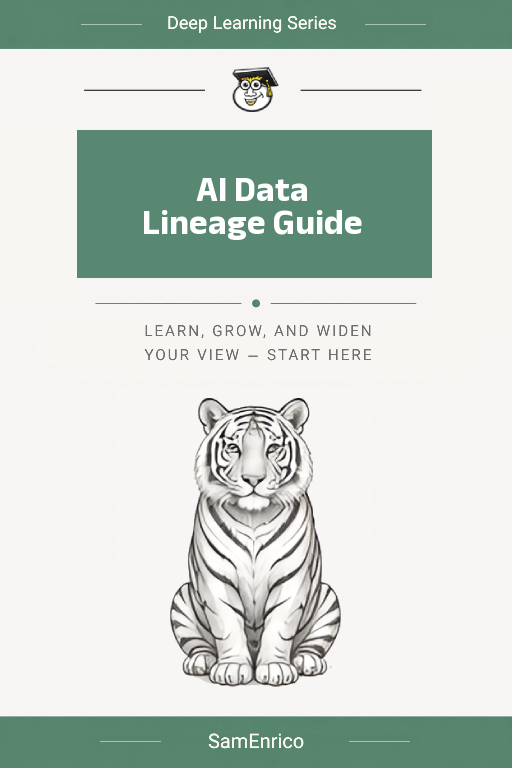
Non-FictionBusiness BriefLineage AI
AI Data Lineage Guide eBook
Track data from source to report using AI that map
Track data from source to report using AI that maps transformations and logic.
Formats
Free sample
Chapter 1: The Trust Deficit--–- On a Tuesday morning in March, a senior financial analyst at a regional bank opened her dashboard to find that the "Daily Loan Default Rate" had dropped to zero percent. She did not celebrate. She had been in banking long enough to know that zero defaults was not a miracle—it was a mistake. For the next seventeen hours, she and three data engineers traced through SQL queries, email threads, and a shared Excel file named "final_v3_FINAL_actual.xlsx." They eventually discovered that a junior engineer had renamed a column from is_default_flag to default_flag_clean in a transformation script six weeks earlier. No one documented the change.
No one knew which dashboards depended on that column. By the time they fixed it, the bank’s risk committee had already received an incorrect report, and a compliance review was triggered. The total cost of that single undocumented rename: $2.3 million in fines, overtime, and lost credibility.This story is not unusual. It is not even extreme. Across every industry—finance, healthcare, retail, technology—organizations are bleeding time, money, and trust because they cannot answer a deceptively simple question: Where did this data come from, and what happened to it along the way?Welcome to the trust deficit.
This book is about closing it.The Quiet Crisis of Modern Data Data has become the world’s most valuable raw material. Companies spend billions on cloud data warehouses, streaming platforms, and business intelligence tools. They hire armies of data engineers, analysts, and scientists. And yet, according to multiple industry surveys, data professionals spend between forty and sixty percent of their time not building new models or discovering insights, but simply trying to understand and debug existing data pipelines. They are archaeologists, not architects.
They dig through layers of undocumented transformations, hoping to find out why a number looks wrong.The problem is not a lack of effort. It is a lack of lineage.In the early days of data warehousing, lineage was a manageable problem. A typical organization had a handful of extract-transform-load (ETL) jobs, a single relational database, and a few static reports. Lineage could be drawn on a whiteboard. Changes were slow, deliberate, and documented in project management systems.
But those days are gone. Modern data stacks are dynamic, distributed, and constantly in motion. A single dashboard today might pull from a Snowflake table that joins data from a Kafka stream, a Postgres replica, and a third-party API—all processed through twenty lines of dbt (data build tool) code and a Python transformation written by an intern who left nine months ago.Manual lineage documentation cannot keep pace with this complexity. Yet most organizations still rely on it. They store data flow diagrams in Confluence pages that no one updates.
They maintain spreadsheets of column mappings that are obsolete the moment they are saved. They depend on the memory of senior engineers who, inevitably, leave for other jobs. This is not a process failure. It is a category error. You cannot solve a problem of scale and speed with manual tools any more than you can dig the Panama Canal with a shovel.What We Talk About When We Talk About Lineage Before we go further, we need to be precise about what lineage actually means.
In its simplest form, data lineage answers the question: From source to destination, what path did this data follow? But that simple question contains multitudes.Most people, when they say "lineage," really mean one of three distinct things:Technical lineage tells you which tables and columns a piece of data passed through. It answers: This report’s ‘revenue’ column came from the ‘orders’ table, which came from the ‘payments’ stream. This is the most common form of lineage, and it is what most tools provide. Technical lineage is necessary but not sufficient.Transformation lineage tells you not just where data went, but what changed at each step.
Did a column get renamed? Filtered? Aggregated? Joined with another table? Transformation lineage captures the logic—the actual code or operation—that turned source data into target data.
This is where most manual documentation fails catastrophically. People remember that data moved; they forget or never knew that a WHERE amount > 100 filter removed half the rows.Business lineage tells you why the data matters. It connects technical columns to business concepts. A column named cust_ltv_calc_v3 might represent "customer lifetime value according to the 2024 finance definition." Business lineage answers: What does this number mean, and who owns its definition?Here is the uncomfortable truth that most data professionals have learned through painful experience: you cannot have transformation lineage or business lineage without accurate, up-to-date technical lineage. And you cannot get accurate, up-to-date technical lineage at scale without automation.This book introduces a fourth type of lineage: AI-augmented lineage.
It sits on top of the other three. AI-augmented lineage uses machine learning and large language models to infer, explain, and validate lineage automatically. It does not replace deterministic methods—in fact, as we will see throughout this book, deterministic parsing is the foundation upon which AI must be built. But AI-augmented lineage solves problems that deterministic methods alone cannot: parsing legacy code with inconsistent syntax, inferring intent from ambiguous transformations, and generating human-readable explanations of complex logic.Why Manual Documentation Is a Trap Let me be direct. If your organization currently documents data lineage using any combination of spreadsheets, wikis, diagrams, or engineer memory, you are already operating with a deficit.
You just might not know how large it is yet.The problem is not that your team is lazy or undisciplined. The problem is that manual documentation has four structural flaws that make it impossible to sustain in modern data environments.First, manual documentation is always out of date. The moment you finish documenting a pipeline, someone changes it. A column is added. A join condition is modified.
A filter is removed. In high-velocity data teams, code changes happen multiple times per day. No human can update documentation at that speed. The result is documentation that diverges from reality, which is worse than no documentation at all because it actively misleads.Second, manual documentation does not scale. A data team with three pipelines and ten tables can maintain a reasonable diagram.
A data team with three hundred pipelines and ten thousand tables cannot. The number of dependencies in a data ecosystem grows exponentially with the number of assets. After a certain point, the documentation becomes so large and complex that no one can read it, let alone maintain it.Third, manual documentation does not capture logic. When a data engineer draws a line between "source table A" and "target table B," that line hides everything that happened in between. Did the transformation filter out nulls?
Did it apply a case statement? Did it join with three other tables? The line says nothing about any of this. Yet these details are often the most critical information for debugging a broken dashboard.Fourth, manual documentation is not executable. You cannot feed a spreadsheet into an impact analysis tool.
You cannot ask a diagram to tell you which dashboards will break if you rename a column. You cannot automate…
This is the end of the free sample. Get the eBook to keep going. Buy now
About this book
Details
- Author
- Calabrese Kristian
- Publisher
- SamEnrico
- Language
- English
- Genre
- Non-Fiction, Business Brief, Lineage AI
- Released
- 2026-06-01
- Pages (approx.)
- 144
- Available as
- eBook, Audiobook

Read better in the ZLOADR app
Your eBooks on your phone or tablet. Sign in with your SamEnrico account and start reading.
More by Calabrese Kristian
 Workaholism And Family EstrangementCalabrese Kristian$11.99
 Music Playing Neuroplasticity GuideCalabrese Kristian$11.99
 Carrie Underwood Idol Winner GuideCalabrese Kristian$11.99
 Failure Fear in DiplomacyCalabrese Kristian$11.99
 Women In Science Franklin Statue Campaign CourseCalabrese Kristian$11.99
 The Lost People of Doggerland: Europe's Drowned CivilizationCalabrese Kristian$11.99
 The Jade Dragon’s Last Roar: China’s Forgotten Celestial UprisingCalabrese Kristian$11.99
 Understanding Frias SyndromeCalabrese Kristian$17.99
 Automated Brand Monitoring Workflow ManualCalabrese Kristian$12.99
 ZookeeperCalabrese Kristian$11.99
 How to Become a Disc-pad-plate FillerCalabrese Kristian$11.99
You may also like
 Hong Kong Handover 1997Dunn Johnnie$11.99
 Zumba For Postnatal Recovery CourseNeal Christian$11.99
 Zumba for BeginnersLadner Nikia$11.99
 YouTube Comment Mining GuideHumes Pandora$12.99
 Worry Box MeditationCarlin Rudy$11.99
 Workplace Stress MeditationNguyen Lynn$11.99
 Workplace Stress and Sleep RepairHawley Ivory$11.99
 Workplace Perfectionism CureDelaney Jeffry$11.99
 Workplace Injustice Anger GuideWallen Isabelle$11.99
 Work Addiction and Burnout LinkGreenwood Ester$11.99
 Women in Yoga and WellnessBeattie Galina$11.99
 Women in Stand Up ComedyChun Evangeline$11.99