
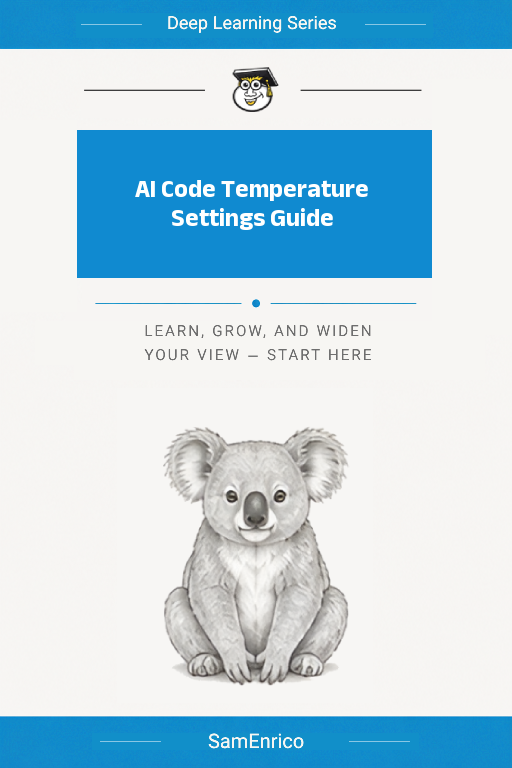
AI Code Temperature Settings Guide eBook
Adjust AI creativity vs determinism for different
Adjust AI creativity vs determinism for different coding tasks.
Formats
Free sample
Chapter 1: The Probability Mirage--–- The first time Jorge watched his AI code generator fail, he didn’t blame the temperature. He blamed himself. He had spent three hours crafting what he believed was the perfect prompt: detailed comments, edge cases enumerated, even a few example inputs and outputs. The AI returned a beautiful, elegant solution that passed all the unit tests on the first run. Jorge celebrated.
His lead developer, Mira, reviewed the code and nodded approvingly. It went to production that afternoon.The next morning, the on-call phone rang at 3:47 AM. A subtle bug in the AI-generated authentication logic had allowed a non-admin user to escalate privileges. No data was breached—thankfully—but the incident required a full security audit, cost the company forty-seven engineering hours, and damaged the team’s confidence in AI-assisted development. Jorge’s manager asked a simple question: “Why didn’t you catch this?”Jorge’s answer was honest but incomplete.
“I don’t know. The AI seemed so certain.”That word—certain—is the heart of the temperature trap.Jorge had left the AI’s temperature setting at its default value of 0.7, the same setting he used for everything from brainstorming API designs to writing database migrations. He had no reason to change it. The slider in the Open AI playground was labeled simply “Creativity,” and 0.7 was right in the middle. It felt safe.
It felt balanced. It felt, to Jorge, like the responsible choice.It was anything but.The Silent Saboteur Temperature is the single most misunderstood parameter in large language model (LLM) configuration. Developers and product managers alike treat it as a vague “creativity dial”—crank it down when you want conservative answers, crank it up when you want surprising ones. This intuitive model is not wrong, but it is dangerously incomplete. And because it is incomplete, teams like Jorge’s make the same mistake thousands of times every day: they assume that a single temperature setting can serve every coding task equally well.This chapter is not a gentle introduction.
It is an intervention.By the time you finish these pages, you will understand why the default temperature of 0.7 is rarely the right choice for any specific task. You will learn how temperature actually reshapes the landscape of possible outputs, why low temperatures do not guarantee determinism, and why high temperatures do not guarantee creativity in any useful sense. More importantly, you will begin to see temperature for what it truly is: not a dial but a probability distribution sculptor—a tool that changes the shape of uncertainty in ways that can either save your project or silently undermine it.Let us start with a simple experiment that Jorge wishes he had run.The Two-Prompt Test Open your preferred AI coding assistant—Chat GPT, Claude, Cursor, or any other. Give it the following prompt exactly as written:text Copy Download Write a Python function that takes a list of integers and returns the sum of all even numbers in the list.Run this prompt five times in a row without changing anything. If your AI assistant allows you to set temperature, make sure it is at the default (typically 0.7).
Write down the five responses.Now change the temperature to 0.1. Run the same prompt five more times.Compare the two sets of outputs. Most readers will observe a striking pattern:At temperature 0.7, the five outputs vary significantly. One version uses a simple for-loop with an if statement. Another uses a list comprehension.
A third uses the filter() function. A fourth might include type hints and a docstring. A fifth could add error handling for non-integer inputs. All are correct. All are different.
And all are, in some subtle way, surprising.At temperature 0.1, the five outputs are nearly identical. They converge on a single, predictable implementation—usually the simplest for-loop. Type hints may appear inconsistently. Error handling may be absent. The code is correct but minimal.Which set is better?The conventional answer—the one most developers would give—is that the temperature 0.7 outputs are superior because they demonstrate flexibility and awareness of different coding styles.
The temperature 0.1 outputs feel rigid, almost lazy.This conventional answer is dangerously wrong.The correct answer depends entirely on what you are trying to accomplish. If you are a senior engineer documenting best practices for a team of junior developers, the varied outputs at 0.7 are valuable—they expose beginners to multiple valid approaches. If you are generating production code that will run unattended, the consistency of 0.1 is far more valuable because predictability prevents bugs. And if you are generating test cases, neither extreme is optimal; you want enough variation to catch edge cases but enough consistency to avoid false positives.This is the core insight that transforms temperature from a mysterious slider into a precision instrument: There is no universally correct temperature. There is only the temperature appropriate to your task.The Mental Model That Fails Why do so many developers get this wrong?
The answer lies in a mental model that几乎所有 engineers share without realizing it: the interpolation fallacy.The interpolation fallacy is the belief that parameter settings exist on a linear continuum from “bad” to “good.” We see this everywhere. Volume knobs go from quiet (good for libraries) to loud (good for concerts). Brightness sliders go from dim (good for movie theaters) to bright (good for sunny days). In each case, the optimal setting is contextual, but the extremes are clearly recognizable as “less” and “more” of the same quality.Temperature does not work this way.When you decrease temperature, you are not making the AI “more conservative” in any simple sense. You are flattening the probability distribution of possible next tokens, making the most likely token overwhelmingly probable.
When you increase temperature, you are not making the AI “more creative.” You are sharpening the distribution in the opposite direction, making less likely tokens more probable. These are not opposite ends of a single spectrum. They are qualitatively different operations on the same mathematical object: a probability distribution over a vocabulary of fifty thousand tokens.To understand why this matters for code generation, we need to climb inside the AI’s decision-making process.The Token Prediction Engine At its core, a large language model is a machine for predicting the next token. A token is not quite a word and not quite a letter; it is a chunk of text that the model’s vocabulary recognizes. For example, the word “unbelievable” might be split into three tokens: “un”, “believe”, “able”.
The sentence “The capital of France is” will be tokenized into something like [“The”, “cap”, “ital”, “of”, “France”, “is”].After processing your prompt, the model produces a probability distribution over every token in its vocabulary. For the next token after “The capital of France is,” the distribution might look like this:Token Probability Paris0.45Lyon0.12Marseille0.08France0.06a0.04(thousands of others)...The most likely token is “Paris” with 45% probability. But note: the model is not certain. There is a 12% chance it will say “Lyon” and an 8% chance it will say “Marseille.” If you ask the model to complete this sentence once, it will probably say “Paris.” If you ask it one hundred times, it will say “Paris” about forty-five…
This is the end of the free sample. Get the eBook to keep going. Buy now
About this book
Details
- Author
- Bagwell Jenae
- Publisher
- SamEnrico
- Language
- English
- Genre
- Non-Fiction, AI Operator
- Released
- 2026-06-01
- Pages (approx.)
- 150
- Available as
- eBook, Audiobook

Read better in the ZLOADR app
Your eBooks on your phone or tablet. Sign in with your SamEnrico account and start reading.
More by Bagwell Jenae
 TM For PTSD RecoveryBagwell Jenae$11.99
 Itching and Discomfort in Breath PracticeBagwell Jenae$11.99Itching and Discomfort in Breath PracticeBagwell Jenae$11.99
 Gacy's Victim IdentificationBagwell Jenae$11.99
 Telepsychiatry In Rural Developing NationsBagwell Jenae$11.99
 The Addiction Cycle InterruptBagwell Jenae$11.99
 Employer Sponsored LTC GuideBagwell Jenae$11.99
 FCPA Compliance Program FailuresBagwell Jenae$11.99
 Morelos Jose MariaBagwell Jenae$11.99
 Emotionally Neglectful ParentsBagwell Jenae$11.99
 The Sleepwalker's Code: The Unsolved Mystery of the 1954 Dream Telepathy ExperimentsBagwell Jenae$11.99
 The Billionaire’s Bet: How One Man Gamed the AI Gold RushBagwell Jenae$11.99
You may also like
 Hong Kong Handover 1997Dunn Johnnie$11.99
 Zumba For Postnatal Recovery CourseNeal Christian$11.99
 Zumba for BeginnersLadner Nikia$11.99
 YouTube Comment Mining GuideHumes Pandora$12.99
 Worry Box MeditationCarlin Rudy$11.99
 Workplace Stress MeditationNguyen Lynn$11.99
 Workplace Stress and Sleep RepairHawley Ivory$11.99
 Workplace Perfectionism CureDelaney Jeffry$11.99
 Workplace Injustice Anger GuideWallen Isabelle$11.99
 Work Addiction and Burnout LinkGreenwood Ester$11.99
 Women in Yoga and WellnessBeattie Galina$11.99
 Women in Stand Up ComedyChun Evangeline$11.99