
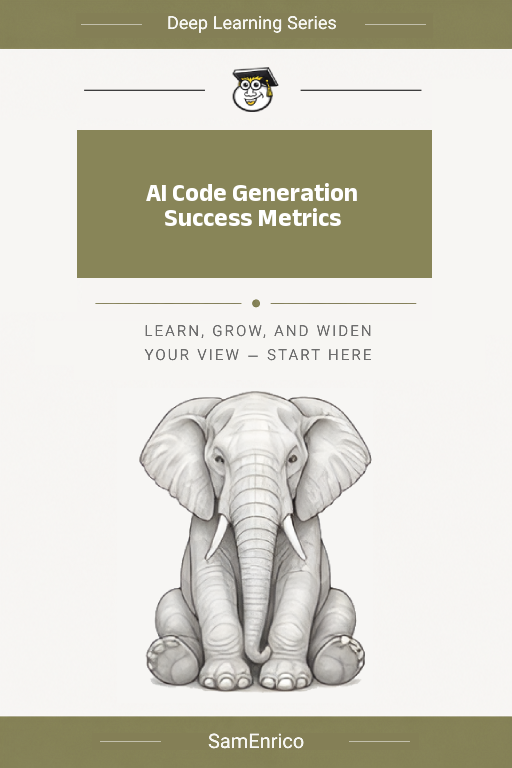
AI Code Generation Success Metrics Audiobook
Measure productivity gains and code quality improv
Measure productivity gains and code quality improvements from AI tools.
Formats
Free sample
Chapter 1: The Vibe Coding Epidemic--–- The first time Marcus saw a junior developer accept an AI-generated authentication middleware without reading a single line, he felt a chill that had nothing to do with the office air conditioning. The developer, three months out of a coding bootcamp, had typed "write me auth middleware for Express" into Cursor, watched the code appear line by line, clicked "Accept All," and opened a new pull request—all in under four minutes. Marcus, the team's staff engineer with fourteen years of experience, spent the next forty-five minutes reviewing that PR. He found four security vulnerabilities, two unnecessary database queries, and a race condition that would have surfaced in production after approximately 10,000 concurrent users. The junior developer learned nothing from the exchange.
The next day, he did the same thing with a payment processing endpoint.This was not an isolated incident. Across the software industry, a new pattern of development had emerged—one that promised speed but delivered technical debt, that felt productive but actually eroded the skill base of an entire generation of engineers. It had a name now, whispered in engineering slack channels and debated at CTO summits: Vibe Coding.The Definition of an Epidemic Vibe coding is the practice of accepting AI-generated code with minimal understanding, review, or modification. The term originated as a joke—a playful jab at developers who trusted the autocomplete a little too much—but it has since become the single biggest threat to software quality in the age of AI assistants. The epidemic has three distinct stages, each worse than the last.Stage One is Cargo Cult Acceptance.
The developer asks the AI for code, receives a response, and assumes it is correct because it looks plausible. They do not test edge cases. They do not refactor for clarity. They do not even read the entire function before committing. The AI has become a black box oracle, and the developer has become a passive conduit.Stage Two is Prompt Laziness.
The developer learns that the AI produces better results with detailed prompts, but they do not invest the time to write those prompts. Instead, they type the minimum possible query—"fix bug" or "add validation"—and accept whatever emerges. The quality of the output plummets, but the developer blames the AI rather than their own input. This creates a negative feedback loop: worse prompts lead to worse code, which…
This is the end of the free sample. Get the Audiobook to keep going. Buy now
About this book
Details
- Author
- Snead Refugio
- Publisher
- SamEnrico
- Language
- English
- Genre
- Non-Fiction, AI Operator
- Released
- 2026-05-26
- Pages (approx.)
- 135
- Available as
- eBook, Audiobook

Listen in the VoxFlicks app
Audiobooks and audio dramas wherever you go. Sign in with your SamEnrico account and press play.
More by Snead Refugio
 LTC Insurance Consumer GuideSnead Refugio$11.99
 FCPA Aviation Industry CasesSnead Refugio$11.99
 Gacy's Execution and Final WordsSnead Refugio$11.99
 Refugee Mental Health Low Cost InterventionsSnead Refugio$11.99
 Teen Breath Meditation GuideSnead Refugio$11.99
 Myanmar RohingyaSnead Refugio$11.99
 The Urge Surfing MethodSnead Refugio$11.99
 Sexually Abusive HouseholdSnead Refugio$11.99
 Rewiring Unrequited LoveSnead Refugio$11.99
 The Strategist: Alcibiades and the Art of Athenian PowerSnead Refugio$11.99
 Into the Abyss: The Grand Canyon’s Forgotten Mappers and Their Daring 1920s ExpeditionSnead Refugio$11.99
 The Last Witness: The Trial That Shook a NationSnead Refugio$11.99
You may also like
 AI Presentation WorkbookSommers Tonda$11.99
 PowerPoint Copilot MasteryConway Lanita$11.99
 Branded AI DecksWindham Loni$11.99
 AI Presentation CourseGrooms Olin$11.99
 AI Presentation CertificationBlank Dolly$11.99
 AI Deck Version ControlMedley Lorina$11.99
 AI Deck Update AutomationFraser Tresa$11.99
 AI Deck Myths DebunkedCrittenden Romelia$11.99
 AI Deck Customization GuideDove Hannelore$11.99
 AI Bullet to Slide ConverterKohn Eloisa$11.99
 AI Deck Notes CreatorBarela Sunday$11.99
 AI Deck Outline GeneratorAshmore Morgan$11.99