
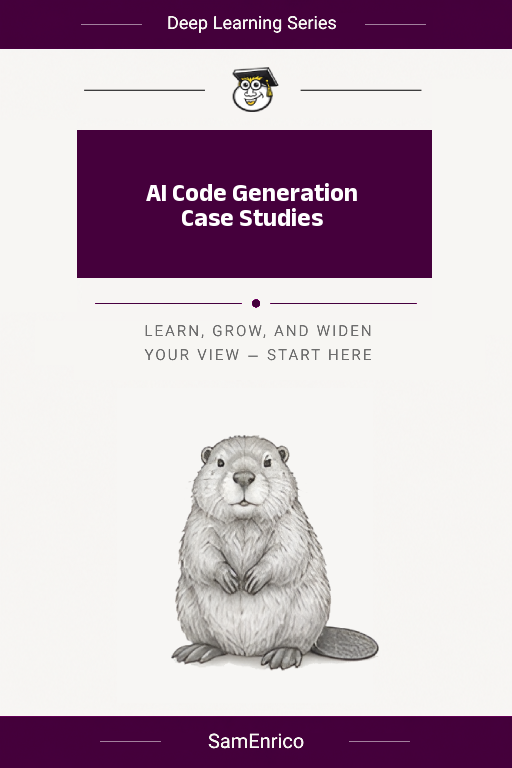
AI Code Generation Case Studies eBook
Learn from real teams that transformed productivit
Learn from real teams that transformed productivity with AI pair programming.
Formats
Free sample
Chapter 1: The 40% Lie...–- The conference room at Scania’s software headquarters in Södertälje, Sweden, smelled of stale coffee and quiet desperation. It was February 2024, and Marcus, a veteran engineering manager with twenty-three years of experience, had just finished presenting his quarterly numbers to the CTO. The slide that haunted him read: “Productivity Improvement Since AI Adoption: +11%.” His team had been using Git Hub Copilot for seven months. Developers reported feeling faster. Some claimed the AI cut their coding time in half.
And yet, the only metric that mattered to the business—shipped features that actually reached customers—had barely budged.Across the table, his CTO leaned forward. “Marcus, I have developers telling me they’re 10x faster. Why does it take us just as long to ship a feature as it did last year?”That question—simple, devastating, and universally unasked in public—is the reason this book exists.The gap between how AI coding tools feel to individual developers and how they perform for entire teams is the single most misunderstood phenomenon in software engineering today. This chapter dismantles the hype, introduces the empirical reality, and establishes the foundational case study—Scania’s “Mob AI” program—that will anchor the rest of this book.The Seduction of Speed Let us begin with an honest confession: AI coding tools are astonishing. When a developer types a comment like “fetch user data from the API and display it in a table,” and the editor instantly generates thirty lines of working React code, it feels like magic.
That feeling—call it the dopamine hit of instant code—is real. It is also dangerous.In the first quarter of 2024, a small Saa S company we’ll call Swift Stack ran an internal experiment. Twenty developers were given access to Copilot and told to build a new feature—a dashboard with real-time analytics—from scratch. They were also told to log their time meticulously. The results seemed miraculous: the AI-assisted developers wrote code 2.3 times faster by lines per hour.
One developer, a junior with only eight months of experience, completed her assigned subtasks in less than a third of the time estimated.The CTO celebrated. He announced at the all-hands meeting that AI had made his team “2x more productive.” He bought enterprise licenses for everyone.Three months later, Swift Stack’s feature velocity had actually decreased.What happened? The same thing that happens to nearly every team that adopts AI without changing how they work. The developers wrote code faster, yes. But they also wrote more code.
More code meant more bugs. More bugs meant more debugging. More debugging meant more context switching. More context switching meant more time lost to remembering what they were doing before the bug interrupted them. The 2.3x speedup in coding translated to a 0.85x slowdown in shipping.This is the 40% Lie: not that AI can’t help, but that individual speed reliably predicts team outcomes.
It cannot. And until engineering leaders understand why, they will continue to waste millions on tools that feel productive but deliver disappointment.Defining the Terms: Vibe Coding and Its Limits Before we go further, we need a shared vocabulary. Throughout this book, when we use the term vibe coding, we mean a specific style of AI-assisted development: low-discipline, high-velocity prototyping where developers issue loose natural language prompts—often whole paragraphs of speculation—and accept the AI’s output with minimal review. The term originated in online developer communities to describe a euphoric state where “you just vibe with the AI and code appears.”Vibe coding has a legitimate place. For greenfield exploration, throwaway prototypes, or any situation where correctness matters less than exploration, it is genuinely transformative.
A solo developer building a weekend project can vibe-code an entire MVP in days rather than weeks. A data scientist exploring a new dataset can vibe-code analysis scripts without worrying about production durability.But vibe coding has catastrophic failure modes in production environments. When code must be maintained, debugged at 2 AM, or audited for security compliance, vibe coding becomes a liability. The same looseness that enables speed also enables hallucinations, inconsistent patterns, and bugs that only manifest under production load.This book is not an attack on vibe coding. Chapter 6 will examine its legitimate uses in greenfield work.
But this book is fundamentally about teams building production software. And for that context, vibe coding is the enemy of reliability. We need discipline. We need validation gates. We need a vocabulary that distinguishes between “felt productivity” and “shipped value.”The Metrics That Actually Matter If lines of code and individual coding speed are misleading, what should we measure?
The organizations that successfully transformed their productivity with AI—Scania, Globo, Gate.io, and others we will study—all converged on three core metrics. We will use these metrics throughout the book.Cycle Time Cycle time measures the elapsed time from when work begins on a feature (the first commit, the first ticket assignment) to when that feature is deployed to production and verified as working. This is the closest proxy to “how fast do we deliver value?”In the Swift Stack example above, individual coding time improved by 2.3x, but cycle time worsened because debugging and integration took longer. The teams profiled in this book saw cycle time improvements of 30-50%—not 200%—but those improvements were sustainable because they accounted for the entire value stream, not just typing.Context-Switch Reduction Context switching is the silent killer of engineering productivity. Every time a developer interrupts their primary task to answer a question, debug a failing test, or look up documentation, they lose an average of twenty-three minutes to “resumption lag”—the time required to return to full focus.AI can either increase context switching (by generating buggy code that requires immediate debugging) or decrease it (by automating the small interruptions).
The teams in this book achieved the latter. They measured context-switch reduction by instrumenting developer IDEs and tracking how often developers switched between files, tools, or tasks. The best performers reduced context switches by 40-60%.Defect Escape Rate Defect escape rate measures the percentage of bugs that reach production. This is the most honest metric for code quality. Low escape rates mean your validation processes—testing, code review, static analysis—are catching problems before customers see them.AI has a complicated relationship with defect escape rates.
In the short term, AI often increases escape rates because it generates more code, and more code means more bugs. But in the medium term, AI can decrease escape rates by automating the boring parts of testing and validation. The teams we studied saw escape rates initially spike by 15-20% before falling to 30-50% below pre-AI baselines after six months of disciplined practice.Case Study Introduction: Scania’s Mob AIScania is not a technology company. It is a manufacturer of heavy trucks and buses—a hundred-year-old industrial giant with tens of thousands of employees, most of whom have never written a line of code. And yet, Scania’s software division became one of the most sophisticated adopters of AI pair programming in Europe.In early 2023, Scania faced a crisis.
They needed to modernize the embedded software that ran their vehicle telematics systems—the computers that monitor engine performance, predict maintenance…
This is the end of the free sample. Get the eBook to keep going. Buy now
About this book
Details
- Author
- Masterson Ayesha
- Publisher
- SamEnrico
- Language
- English
- Genre
- Non-Fiction, AI Operator
- Released
- 2026-06-01
- Pages (approx.)
- 110
- Available as
- eBook, Audiobook

Read better in the ZLOADR app
Your eBooks on your phone or tablet. Sign in with your SamEnrico account and start reading.
More by Masterson Ayesha
 LTC Insurance Premium Reduction GuideMasterson Ayesha$11.99
 War and Genocide MasterMasterson Ayesha$11.99
 Antidepressant Access In Poor Nations GuideMasterson Ayesha$11.99
 Breath Awareness for Labor PainMasterson Ayesha$11.99
 Gacy's Construction Business FrontMasterson Ayesha$11.99
 FCPA Defense Contractor CasesMasterson Ayesha$11.99
 The Sobriety Journal MethodMasterson Ayesha$11.99
 Hoarding Parent ChildhoodMasterson Ayesha$11.99
 San Martin JoseMasterson Ayesha$11.99
 The Last Dance of the Cosmos: How a Single Photo Changed Astronomy ForeverMasterson Ayesha$11.99
 Blood and Chromosomes: The Genetic Legacy of the Italian CampaignMasterson Ayesha$11.99
 The Sky Pioneers: Women Who Charted the Pacific's Secrets (1920s)Masterson Ayesha$11.99
You may also like
 AI Presentation WorkbookSommers Tonda$11.99
 PowerPoint Copilot MasteryConway Lanita$11.99
 Branded AI DecksWindham Loni$11.99
 AI Presentation CourseGrooms Olin$11.99
 AI Presentation CertificationBlank Dolly$11.99
 AI Deck Version ControlMedley Lorina$11.99
 AI Deck Update AutomationFraser Tresa$11.99
 AI Deck Myths DebunkedCrittenden Romelia$11.99
 AI Deck Customization GuideDove Hannelore$11.99
 AI Bullet to Slide ConverterKohn Eloisa$11.99
 AI Deck Notes CreatorBarela Sunday$11.99
 AI Deck Outline GeneratorAshmore Morgan$11.99