
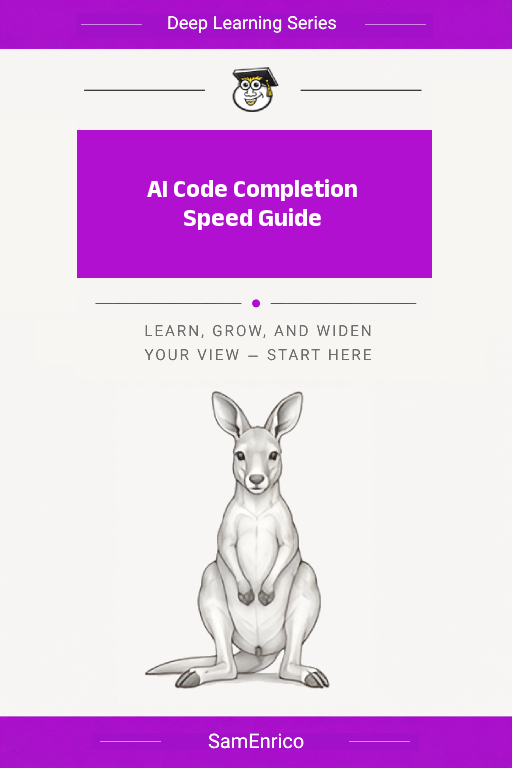
AI Code Completion Speed Guide
Optimize latency and accuracy of AI code completio
by Cowles Nicol
Optimize latency and accuracy of AI code completion tools.
Formats
About this book
Free sample
Chapter 1: The 300ms Wall...--The first time you felt it, you probably blamed yourself. Your fingers hovered over the keyboard, waiting. The AI suggested a completion. You waited. The spinner spun.
The gray text appeared—late, wrong, and exactly where you didn't want it. So you deleted it. You typed the line yourself. And you thought: Maybe AI just isn't there yet.You were wrong. AI is there.
Your latency budget wasn't.This book exists because that moment of waiting—that 600ms, 800ms, or 1.2 seconds of nothing—is the single biggest predictor of whether a developer adopts AI code completion or abandons it entirely. Not the model's size. Not its benchmark scores. Not how many parameters it has or how many Git Hub repos it was trained on. Latency.
Pure, simple, human-perceived latency.But here is the paradox that drives the entire field: when you optimize only for latency, you get garbage. Fast garbage is still garbage. When you optimize only for accuracy, you get slow perfection that no one waits for. The winning solution—the one this book teaches you to build—is the intersection where speed meets correctness. That intersection is not a compromise.
It is an engineering discipline.This chapter establishes the fundamental human and market constraints that make latency the primary product differentiator for AI code completion. You will learn why 300 milliseconds is a wall, not a recommendation. You will understand the three thresholds that determine whether a completion feels magical, annoying, or useless. You will confront the paradox that 44% of developers expect sub-500ms latency while 45% reject suggestions due to poor quality. And you will walk away with a new KPI—accepted characters per second—that will change how you measure your system's success.Let us start with a number: 100.The Three Thresholds That Define Flow In 1968, Robert B.
Miller at IBM published a study that would quietly shape every user interface for the next fifty years. He asked a simple question: how fast does a system need to be for a human to feel like it's instantaneous? His answer, refined by decades of human-computer…
This is the end of the free sample. Get the eBook to keep going. Buy now
Contents
- Chapter 1
- Chapter 2
- Chapter 3
- Chapter 4
- Chapter 5
- Chapter 6
- Chapter 7
- Chapter 8
- Chapter 9
- Chapter 10
- Chapter 11
- Chapter 12
Details
- Author
- Cowles Nicol
- Publisher
- SamEnrico
- Language
- English
- Genre
- Non-Fiction, AI Operator
- Released
- 2026-05-30
- Pages (approx.)
- 113
- Available as
- eBook, Audiobook

Read better in the ZLOADR app
Your eBooks on your phone or tablet. Sign in with your SamEnrico account and start reading.
More by Cowles Nicol
 Faith Based Counseling Integration GuideCowles Nicol$11.99Faith Based Counseling Integration GuideCowles Nicol$11.99
 Medicaid LTC Alternative GuideCowles Nicol$11.99
 Posture Tips for Breath MeditationCowles Nicol$11.99
 John Wayne Gacy's Double LifeCowles Nicol$11.99
 FCPA Self Disclosure LogCowles Nicol$11.99
 Betrayed Partner RecoveryCowles Nicol$11.99
 Two Minute Rule for ParentsCowles Nicol$11.99
 TM For High Blood PressureCowles Nicol$11.99
 Affirmations For Academic PressureCowles Nicol$11.99
 The Unlikely Champion: How a High School Dropout Became the Voice of a GenerationCowles Nicol$11.99
 The Skyward Spires: How Gothic Builders Defied GravityCowles Nicol$11.99
You may also like
 Hong Kong Handover 1997Dunn Johnnie$11.99
 Zumba For Postnatal Recovery CourseNeal Christian$11.99
 Zumba for BeginnersLadner Nikia$11.99
 YouTube Comment Mining GuideHumes Pandora$12.99
 Worry Box MeditationCarlin Rudy$11.99
 Workplace Stress MeditationNguyen Lynn$11.99
 Workplace Stress and Sleep RepairHawley Ivory$11.99
 Workplace Perfectionism CureDelaney Jeffry$11.99
 Workplace Injustice Anger GuideWallen Isabelle$11.99
 Work Addiction and Burnout LinkGreenwood Ester$11.99
 Women in Yoga and WellnessBeattie Galina$11.99
 Women in Stand Up ComedyChun Evangeline$11.99