
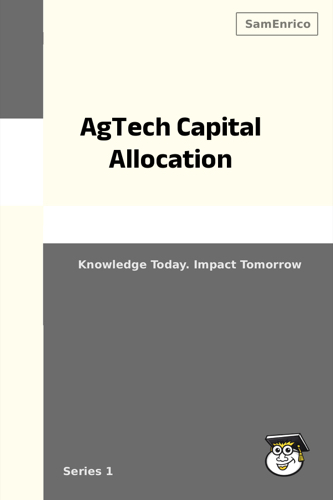
Non-FictionForecast & OutlookAgricultural Technology
AgTech Capital Allocation eBook
Invest in precision farming, vertical agriculture,
Invest in precision farming, vertical agriculture, and supply chain.
Formats
Free sample
Chapter 1: The Wicked Harvest--–- The farmer stood in the middle of a 10,000-acre cornfield in Iowa, smartphone in hand, watching a live dashboard of soil moisture, nutrient levels, and drone imagery. Every sensor worked perfectly. Every data point was beautiful. And his crop was still dying. Not because the technology failed, but because the capital that financed it had arrived with the wrong expectations, the wrong timeline, and the wrong understanding of what it means to grow food for a living.
That farmer's story is not an exception. It is the rule. And until capital allocators understand why, they will continue to lose billions of dollars in agricultural technology.The Silent Funeral of Good Ideas Over the past decade, more than $50 billion has flowed into agricultural technology startups. Billions more have been deployed by corporate venture arms, family offices, and institutional investors chasing the promise of feeding a growing planet while earning venture-style returns. Yet by most estimates, more than 70 percent of Ag Tech startups fail to return capital to their investors.
This is not because the technologies were bad. Many were brilliant. Autonomous tractors that could run 24 hours a day. Vertical farms that grew lettuce with 99 percent less water. Blockchain platforms that traced a head of cauliflower from seed to shopping cart.
The technologies worked. What failed was the capital allocation model applied to them.This book is not about the technology. It is about the money. Specifically, it is about the systematic mismatch between how capital is structured and how biological systems actually behave. Agriculture is not software.
A crop does not iterate on a two-week sprint cycle. A pest outbreak does not send a polite notification before it arrives. A regulatory approval for a gene-edited seed does not follow the same timeline as an FDA clearance for a medical device. And yet, again and again, investors have applied venture capital term sheets, private equity leverage ratios, and public market growth expectations to businesses that operate on entirely different physical and biological constraints.The result has been a graveyard of well-funded corpses. Startups that raised $100 million only to discover that their unit economics assumed free energy.
Vertical farms that built beautiful facilities in the wrong cities because the real estate was cheap, ignoring the logistics cost of getting basil to a premium market. Precision ag hardware companies that sold sensors at a loss, hoping to make it up on data subscription revenue, only to find that farmers would not pay for data they already felt they owned.This book exists because the top ten best-selling Ag Tech books of the past three years have all missed the central tension. They have focused on technical deep-dives into CRISPR or Io T sensors. They have offered SWOT analyses of individual companies. They have celebrated the innovators and lamented the failures.
But none have provided a systematic framework for capital allocation across the distinct technological horizons of modern agriculture. None have answered the question that actually matters to the person signing the check: given my risk profile, my time horizon, and my return expectations, how much should I put into precision farming versus vertical agriculture versus supply chain technology, and what specific financial instruments should I use for each?This chapter establishes the foundation for answering that question. It introduces the concept of agri-food investing as a "wicked problem" – a term borrowed from design theory to describe systems so complex, nonlinear, and resistant to simple solutions that standard optimization frameworks fail. It dissects three specific frictions that separate agriculture from every other sector that technology has disrupted: biological risk, regulatory asymmetry, and the capital timing paradox. And it introduces the two fundamental business model archetypes that will reappear throughout this book: disruption-first versus optimization-first.
By the end of this chapter, you will understand why most Ag Tech investments fail before the first seed is planted, and you will be prepared to engage with the four-horizon framework that structures the rest of this book.What Makes Agriculture a Wicked Problem The term "wicked problem" was first coined in the 1970s by design theorists Horst Rittel and Melvin Webber to distinguish problems that could be solved with linear, technical approaches from those that could not. A wicked problem has no stopping rule. Solutions are not true or false but better or worse. Every attempt to solve a wicked problem changes the problem itself. Climate change is a wicked problem.
Poverty is a wicked problem. And, as this book will demonstrate, allocating capital to agricultural technology is a wicked problem.Consider the difference between investing in a software company and investing in an Ag Tech startup. When a venture capitalist invests in a Saa S company, the variables are relatively contained. User acquisition cost, lifetime value, churn rate, gross margins, and runway. The product does not rot.
The code does not care about the weather. The regulatory environment is stable across most jurisdictions. The timeline from beta launch to series A to IPO is well understood, with decades of data to support valuation models.Now consider an Ag Tech investment. The product is biological. It grows or dies based on variables the investor cannot control.
A pest outbreak in a region 500 miles away can affect pollination patterns due to migratory bee paths. A trade war can close a market for gene-edited soybeans overnight. A single food safety recall can destroy a brand that took a decade to build. And the timeline from lab to field to grocery store is measured not in months but in seasons, and not in seasons but in regulatory cycles that can stretch to a decade or more.This is not a complaint about agriculture. It is a description of reality.
And the first step to becoming a successful capital allocator in this space is to stop pretending that agriculture will eventually behave like software. It will not. The laws of thermodynamics, biology, and politics do not yield to agile methodologies.The rest of this chapter unpacks the three specific frictions that make agri-food investing a wicked problem. Each friction has destroyed billions of dollars of investor capital. Each friction will be addressed in detail in later chapters.
And each friction must be internalized by anyone who hopes to build a durable portfolio in this sector.Friction One: Biological Risk Biology is not code. Code executes deterministically. Given the same inputs and the same environment, a software function will produce the same output every time. A crop does not. A seed planted in identical soil, with identical water and identical sunlight, will produce a different yield than the seed next to it.
That variability is not a bug. It is a feature of living systems. And it is the single greatest source of risk that Ag Tech investors systematically underestimate.Consider the difference between investing in a drone manufacturer and investing in a vertical farm. The drone manufacturer produces a physical asset. That asset can be tested, certified, and deployed.
Its failure modes are mechanical and electrical. They can be modeled, insured, and priced. The vertical farm produces a biological asset. That asset can fail in ways that have nothing to do with the technology. A waterborne pathogen can…
This is the end of the free sample. Get the eBook to keep going. Buy now
About this book
Details
- Author
- Anthony Marci
- Publisher
- SamEnrico
- Language
- English
- Genre
- Non-Fiction, Forecast & Outlook, Agricultural Technology
- Released
- 2026-06-07
- Pages (approx.)
- 146
- Available as
- eBook, Audiobook

Read better in the ZLOADR app
Your eBooks on your phone or tablet. Sign in with your SamEnrico account and start reading.
More by Anthony Marci
 Divorce and Moving HouseAnthony Marci$11.99
 Repetition Strategies for NamesAnthony Marci$11.99
 Body Image for Large BreastsAnthony Marci$11.99Body Image for Large BreastsAnthony Marci$11.99
 Flashbacks at SchoolAnthony Marci$11.99
 Coping Without CombustionAnthony Marci$11.99
 Social Proof MarketingAnthony Marci$11.99
 Mendeleev Petroleum ResearchAnthony Marci$11.99
 The Arsenic Widow: Mary Ann Cotton's Lethal LegacyAnthony Marci$11.99
 The Merchant Princes of Carthage: Wealth, Wisdom, and the Rise of African TradeAnthony Marci$11.99
 How to Setup and Launch a LectureAnthony Marci$11.99
 How to Produce Food Container CoversAnthony Marci$11.99
You may also like
 Hong Kong Handover 1997Dunn Johnnie$11.99
 Zumba For Postnatal Recovery CourseNeal Christian$11.99
 Zumba for BeginnersLadner Nikia$11.99
 YouTube Comment Mining GuideHumes Pandora$12.99
 Worry Box MeditationCarlin Rudy$11.99
 Workplace Stress MeditationNguyen Lynn$11.99
 Workplace Stress and Sleep RepairHawley Ivory$11.99
 Workplace Perfectionism CureDelaney Jeffry$11.99
 Workplace Injustice Anger GuideWallen Isabelle$11.99
 Work Addiction and Burnout LinkGreenwood Ester$11.99
 Women in Yoga and WellnessBeattie Galina$11.99
 Women in Stand Up ComedyChun Evangeline$11.99