
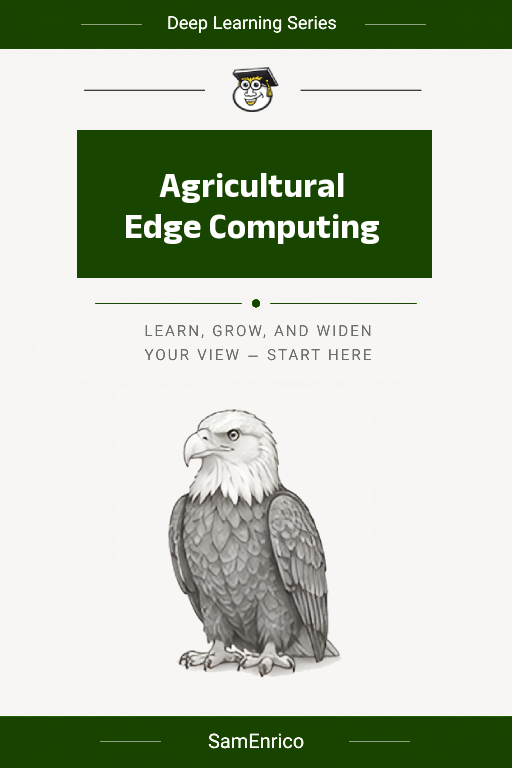
Non-FictionForecast & OutlookEdge Ag
Agricultural Edge Computing eBook
Explore on-farm data processing for real-time mach
Explore on-farm data processing for real-time machinery control without cloud latency.
Formats
Free sample
Chapter 1: The Combine That Cried Cloud--–- The first time Dale Harker’s combine tried to kill him, it wasn’t the machine’s fault. It was the internet’s.The August sun had baked the Kansas clay to concrete. Dale was running a late-model Case IH 9250 through a 400-acre cornfield, one of those 700,000machinesthatbristleswithmoresensorsthanahospital ICU.Theautosteerwasengaged.Theyieldmonitorwasstreamingdatatothecloud.Andthethreshingautomation—afeaturehe’dpaidanextra700,000 machines that bristles with more sensors than a hospital ICU. The autosteer was engaged. The yield monitor was streaming data to the cloud.
And the threshing automation—a feature he’d paid an extra 700,000machinesthatbristleswithmoresensorsthanahospital ICU.Theautosteerwasengaged.Theyieldmonitorwasstreamingdatatothecloud.Andthethreshingautomation—afeaturehe’dpaidanextra18,000 for—was adjusting rotor speed based on crop density models running on servers somewhere in Iowa.At 3:47 PM, the LTE signal dropped from three bars to one. Dale didn’t notice. The cab’s display showed no error. But the cloud-based algorithm, now receiving sensor updates every 800 milliseconds instead of every 100, began to lag. The combine entered a patch of downed corn—lodged from a previous storm—where crop density spiked.
The threshing rotor needed to speed up by 15% within 200 milliseconds to prevent wrapping and loss.The command arrived 620 milliseconds later.The rotor choked. The drive belt shredded with a sound like a gunshot. Corn stalks exploded out of the clean grain elevator. And the combine, still moving at 5 mph under autosteer, began to veer left because the steering controller—also cloud-dependent—had missed two position updates.Dale grabbed the wheel. He wrenched it right.
The rear duals lifted off the ground for a heart-stopping moment. Then the combine settled back, engine still running, belt smoking, 40 acres of corn left unharvested.He sat there for a full minute, hands shaking. Then he pulled out his phone and called his dealer.“Tom,” he said. “Come get this computer. Put the old levers back in.”Tom laughed.
“Dale, it’s not that simple.”And that is the problem this book exists to solve.The Silent Crisis in Smart Farming Every major agricultural equipment manufacturer has bet the farm—literally—on cloud computing. John Deere’s Operations Center. CNH’s Field Ops. AGCO’s Fuse. These platforms promise real-time insights, predictive maintenance, and autonomous operation.
They collect terabytes of data per machine per day, stream it to data centers, run machine learning models, and send commands back.It sounds futuristic. It sounds powerful. And under ideal conditions—perfect cellular coverage, low network congestion, no weather interference—it almost works.But farms are not data centers. Farms are where signals die, where dust blocks antennas, where the nearest cell tower is twelve miles away and serves a town of 400 people. In those conditions, cloud dependence isn’t a minor inconvenience.
It’s a safety hazard and an economic disaster.This chapter introduces the central problem that the remaining eleven chapters will solve: cloud latency—the delay between a sensor detecting a condition and a machine acting on that condition—is structurally incompatible with real-time agricultural machinery control. The latency taxonomy established here (safety-critical, performance-critical, and telemetry) will serve as the book’s foundation. The case of Dale’s combine is not an outlier. It is a warning.What Is Latency, Really?Before we can fix the problem, we need to measure it. Latency is not a single number.
It is a cascade of delays that compound like interest on a bad loan.For a farm machine to respond to its environment, data must travel from a sensor (say, a camera or a moisture probe) to a processor, where it is interpreted, then to a controller, which sends a command to an actuator (a spray nozzle, a steering valve, a rotor motor). In a cloud-dependent system, that path looks like this:Sensor → On-machine microcontroller → Cellular modem → Cell tower → Internet backbone → Cloud data center → Cloud application server → Machine learning model → Cloud application server → Internet backbone → Cell tower → Cellular modem → On-machine controller → Actuator.Each hop adds milliseconds. Under ideal conditions—a data center in the same region as the farm, a strong 5G signal, no competing traffic—this round trip takes 80 to 150 milliseconds. Under realistic farm conditions, it takes 200 to 800 milliseconds, with spikes above one second.Now consider what happens in 200 milliseconds on a combine traveling at 5 mph (2.2 meters per second). The machine moves nearly half a meter.
In that distance, a lodged crop condition can appear and be gone. A rock can enter the thresher. A drainage ditch can end a season.The problem is not that cloud computing is slow in absolute terms. The problem is that farming is fast in relative terms. And the gap between the two is measured in destroyed crops, broken equipment, and, as Dale nearly discovered, physical danger.The Latency Taxonomy: Three Speeds of Farming Not all farm tasks are created equal.
Some require sub-20ms response. Some can tolerate 100ms. Some can wait seconds. To design an edge computing system, you must first classify each task into one of three latency tiers. This taxonomy will appear in every subsequent chapter as the organizing principle for architectural decisions.Tier 1: Safety-Critical Control (100ms to Seconds)These tasks involve data that is useful for analysis, optimization, and record-keeping but does not require immediate action.
Cloud connectivity is acceptable, and in many cases preferred, because cloud enables aggregation across fleets, long-term storage, and complex analytics.Examples:Yield mapping: Recording bushels per acre every second. A 2-second delay is irrelevant.Soil moisture logging: Sensors reporting every 15 minutes. Latency of minutes is acceptable.Weather station data: No real-time control requirement.Video for post-hoc review: A camera monitoring a bin level or a field edge can upload clips every hour.Equipment health telemetry: Engine temperature, hydraulic pressure, fuel consumption—can be sent to the cloud every minute for predictive maintenance.Operator behavior logging: For training and insurance purposes, no real-time need.Architectural rule: Telemetry tasks are the only category suitable for pure cloud dependence. In fact, cloud is optimal for these tasks because it provides unlimited storage, powerful analytics, and fleet-wide learning. The book’s thesis is not “cloud is bad.” The thesis is “cloud is bad for real-time control, and the industry has confused telemetry with control.”The Cost of Misclassification Where things go wrong—and where this book will save you money—is when equipment vendors classify a performance-critical task as telemetry, or worse, when they design a safety-critical task to depend on the cloud.Let’s examine the real-world costs of latency misclassification.Scenario 1: The Late Seeder A cloud-based planter control system senses soil organic matter variation via an onboard spectrometer.
The algorithm determines that a section of the field requires 5% higher seeding rate. The command is sent to the cloud for processing. Round-trip latency: 220ms.In 220ms at 6 mph, the planter travels 59 cm. The higher seeding rate command reaches the row unit 59 cm past the zone boundary. The result: under-seeding in a high-yield zone and over-seeding in a low-yield zone.
Yield impact: 4-7% on that field. On 1,000 acres of corn at 5/busheland200bushel/acreaverage,that’s5/bushel and 200 bushel/acre average, that’s 5/busheland200bushel/acreaverage,that’s40,000 to $70,000 per season.Scenario 2: The Delayed Sprayer A cloud-based weed detection system identifies waterhemp in a soybean field. The spray nozzle command takes 180ms to return. At 15 mph, the…
This is the end of the free sample. Get the eBook to keep going. Buy now
About this book
Details
- Author
- Mcdonough Tasia
- Publisher
- SamEnrico
- Language
- English
- Genre
- Non-Fiction, Forecast & Outlook, Edge Ag
- Released
- 2026-06-01
- Pages (approx.)
- 145
- Available as
- eBook, Audiobook

Read better in the ZLOADR app
Your eBooks on your phone or tablet. Sign in with your SamEnrico account and start reading.
More by Mcdonough Tasia
 Rask AI Translation WorkflowMcdonough Tasia$11.99
 Understanding Kindling Effect in AlcoholismMcdonough Tasia$11.99
 Test Exam Dream Symbols GuideMcdonough Tasia$11.99
 Step Parent Self Worth GuideMcdonough Tasia$11.99
 OKRs for Board Game GroupMcdonough Tasia$11.99
 Billionaire Buccaneers: The Secret Wars of the Super-Rich on the High SeasMcdonough Tasia$11.99
 Hazard Communication GHS Update HandbookMcdonough Tasia$12.99
 How to Start a British Airports Authority Business (Beginners Guide)Mcdonough Tasia$11.99
 Understanding IminoglycinuriaMcdonough Tasia$17.99
 Table Tennis - Ping PongMcdonough Tasia$11.99
You may also like
 Hong Kong Handover 1997Dunn Johnnie$11.99
 Zumba For Postnatal Recovery CourseNeal Christian$11.99
 Zumba for BeginnersLadner Nikia$11.99
 YouTube Comment Mining GuideHumes Pandora$12.99
 Worry Box MeditationCarlin Rudy$11.99
 Workplace Stress MeditationNguyen Lynn$11.99
 Workplace Stress and Sleep RepairHawley Ivory$11.99
 Workplace Perfectionism CureDelaney Jeffry$11.99
 Workplace Injustice Anger GuideWallen Isabelle$11.99
 Work Addiction and Burnout LinkGreenwood Ester$11.99
 Women in Yoga and WellnessBeattie Galina$11.99
 Women in Stand Up ComedyChun Evangeline$11.99