
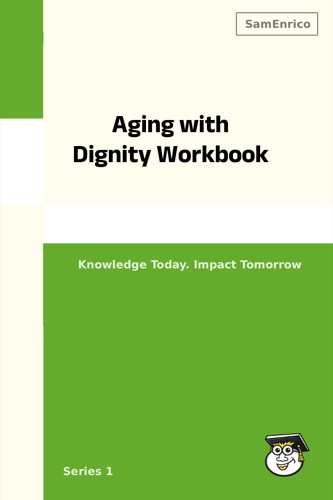
Aging with Dignity Workbook eBook
Maintain self respect through physical and cogniti
Maintain self respect through physical and cognitive changes.
Formats
Free sample
Chapter 1: The Stories We Carry--–- The first time Eleanor forgot her granddaughter’s name, she laughed it off. The second time, she apologized. The third time, she stopped answering the phone altogether. Not because she couldn’t remember—she could, most days—but because she had already decided what that memory lapse meant. It meant she was losing herself.
It meant she was becoming a burden. It meant people would now look at her with pity instead of respect. None of these things had happened yet. No one had called her a burden. No one had looked at her with anything other than love.
But the story was already playing in her head, and that story was doing more damage than any forgotten name ever could.Eleanor is not real, but she is everywhere. She is the retired professor who stops going to faculty lunches because she fears she can no longer keep up with the conversation. She is the widower who refuses to use a cane even after two falls because “that’s what old people do.” She is the grandmother who pretends she doesn’t hear the question so she doesn’t have to admit she forgot the answer. And she is you, perhaps, on the days when the cultural script about aging writes itself onto your skin before you have a chance to pick up a different pen.This chapter is about that script. Not the physical realities of aging—those are real, and they will be addressed with compassion and practicality in later chapters—but the story we tell ourselves about those realities.
The argument of this book, and the foundation of everything that follows, is simple and radical: The most significant threat to your dignity as you age is not arthritis, memory loss, or fatigue. It is the cultural myth that these changes mean you are becoming less of a person.If that sounds like an overstatement, consider the research. Psychologists have long studied something called “stereotype threat”—the phenomenon where people perform worse at a task when they are reminded of a negative stereotype about their group. Older adults who are primed with negative messages about aging and memory do significantly worse on memory tests than older adults who are not primed with those messages. The belief that you will decline actually accelerates decline.
The story doesn’t just describe reality; it helps create it.This is both terrifying and liberating. Terrifying because it means the ageist jokes, the pitying comments, the cultural assumption that aging is nothing but loss—these are not harmless. They are active forces shaping your experience. Liberating because it means you have more power than you think. If the story can harm you, a different story can heal you.
Not by denying reality, but by refusing to let a single, thin narrative be the only one you hear.The Four Stories That Steal Dignity Before you can rewrite a story, you have to know you are living inside one. Most of us do not recognize the cultural scripts about aging because they are so pervasive, so woven into the fabric of everyday language, that they feel like common sense. They are not common sense. They are a particular worldview, and like any worldview, it can be examined, questioned, and changed.Let us name the four most destructive stories that rob older adults of dignity. As you read them, notice if any of them feel familiar—not as something you believe about other people, but as something you fear about yourself.Story One: The Story of Irrelevance This story says that as you age, your opinions matter less, your experience becomes outdated, and your voice should make room for younger, more vital perspectives.
It shows up in the doctor who directs questions to your adult child instead of you. It shows up in the workplace where your years of expertise are suddenly treated as “out of touch.” It shows up in family conversations where you are spoken about rather than spoken to. The story whispers: You had your turn. Now step aside.Story Two: The Story of Burden This story says that needing help is shameful. It says that true dignity means doing everything yourself, and any request for assistance is an admission of failure.
It shows up in the elderly woman who struggles to open a jar for twenty minutes rather than ask her neighbor for help. It shows up in the man who refuses to use a walker even though he has fallen three times because he “doesn’t want to be a problem.” The story whispers: If you need help, you are taking more than you deserve.Story Three: The Story of Decline This story says that aging is nothing but loss—loss of memory, loss of strength, loss of beauty, loss of purpose. It reduces the complexity of growing older to a single downward slope. It shows up in the way we describe any mistake by an older person as a “senior moment.” It shows up in the assumption that an older adult cannot learn new technology, new skills, or new ways of thinking. The story whispers: Your best years are behind you.
Everything from here is diminishing returns.Story Four: The Story of Invisibility This story says that older bodies and older lives are not worth looking at, not worth celebrating, not worth representing in media, art, or culture. It shows up in the fashion industry that designs clothes for the young and then adds “adaptations” as an afterthought. It shows up in movies where older characters exist only as comic relief, wise mentors, or tragic figures. It shows up in the way strangers look through you rather than at you. The story whispers: You are becoming transparent.
Soon, no one will see you at all.These stories are not true. Or rather, they are not completely true. Yes, some abilities change. Yes, sometimes you will need help. Yes, culture often ignores older people.
But these stories take small truths and blow them up into totalizing narratives that erase everything else—the wisdom, the perspective, the emotional regulation, the joy, the love, the life that continues to happen inside an aging body.Your task in this chapter, and throughout this workbook, is not to pretend these stories don’t exist. They do. You cannot wish away ageism or cure your arthritis by thinking positively. But you can stop collaborating with the stories. You can stop rehearsing them in your own mind.
You can notice when they are playing and choose, deliberately, to play a different record.The Two-Column Log: Becoming an Anthropologist of Your Own Thoughts The first practical tool of this workbook is deceptively simple. It is called the Two-Column Log, and it is the foundation upon which all other exercises are built. Before you can change how you think, you have to know how you are thinking. Most of us swim in our thoughts the way fish swim in water—unaware of the medium because it is all we have ever known.The Two-Column Log makes the invisible visible.How it works: For one week, carry a small notebook or use the pages provided in this…
This is the end of the free sample. Get the eBook to keep going. Buy now
About this book
Details
- Author
- Mallory Sidney
- Publisher
- SamEnrico
- Language
- English
- Genre
- Non-Fiction, Self-Help, Dignity
- Released
- 2026-06-07
- Pages (approx.)
- 152
- Available as
- eBook, Audiobook

Read better in the ZLOADR app
Your eBooks on your phone or tablet. Sign in with your SamEnrico account and start reading.
More by Mallory Sidney
 Two Part Tariff EconomicsMallory Sidney$11.99
 The American Idol ContestantsMallory Sidney$11.99
 The Rhythms of the Unknown: Mansa Musa's Golden Caravan and the Birth of African Musical DiplomacyMallory Sidney$11.99
 How to Become a Magazine SupervisorMallory Sidney$11.99
 Personal Development Success StoriesMallory Sidney$12.99
 How to Produce Acupuncture SuppliesMallory Sidney$11.99
 Rational Turing Machine OperatorMallory Sidney$11.99
You may also like
 Hong Kong Handover 1997Dunn Johnnie$11.99
 Zumba For Postnatal Recovery CourseNeal Christian$11.99
 Zumba for BeginnersLadner Nikia$11.99
 YouTube Comment Mining GuideHumes Pandora$12.99
 Worry Box MeditationCarlin Rudy$11.99
 Workplace Stress MeditationNguyen Lynn$11.99
 Workplace Stress and Sleep RepairHawley Ivory$11.99
 Workplace Perfectionism CureDelaney Jeffry$11.99
 Workplace Injustice Anger GuideWallen Isabelle$11.99
 Work Addiction and Burnout LinkGreenwood Ester$11.99
 Women in Yoga and WellnessBeattie Galina$11.99
 Women in Stand Up ComedyChun Evangeline$11.99