
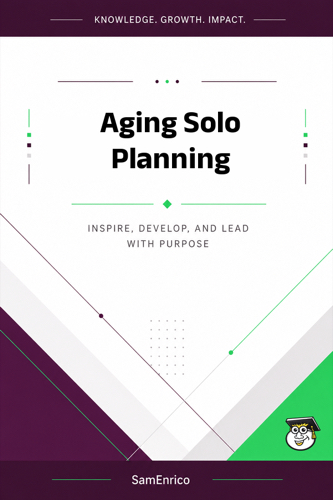
Non-FictionHealth & WellnessSolo Aging
Aging Solo Planning eBook
Prepare without family support or trusted partners
by Ward Mindy
Prepare without family support or trusted partners.
Formats
Free sample
Chapter 1: The Solo Awakening--The phone rang at 7:43 on a Tuesday evening. Margaret, sixty-eight, a retired graphic designer who had never married and had no children, was halfway through a frozen dinner when she saw the caller ID: Memorial Hospital. Her heart did not race. She had no spouse to glance at, no adult child to call out to. She set down her fork and answered.It was her younger brother, Robert.
He lived four states away. He was calling to tell her that their older sister, Ellen—the family’s designated matriarch, the one who kept the birthdays straight and the holidays coordinated—had suffered a massive stroke that morning. Ellen was alive, but she could no longer speak. She could no longer sign her name. She could no longer tell the doctors who should make decisions for her.Margaret listened.
She asked two questions: “Is she going to die?” and “Who is making the decisions?” The answers were: “We don’t know yet,” and “The hospital is trying to reach her ex-husband, who hasn’t spoken to her in fifteen years, because he is still legally her next of kin.”Margaret hung up. She looked at her frozen dinner. She looked at the empty chair across from her. And in that moment, she realized something that would change the rest of her life: If that had been me, there would be no one to call. And the hospital would have reached back fifteen years to find someone who no longer knew me at all.This book is for Margaret.
It is for the twenty-five million adults over fifty in the United States who are aging alone—not because they are tragic, not because they are failures, but because life is complicated. Some never married. Some married and divorced. Some outlived their spouses. Some have children who live on the other side of the world, or on the other side of an emotional chasm that cannot be bridged.
Some have family, but that family is a source of harm, not help. And some simply looked around one day and realized that the village they assumed would appear had never actually been built.The good news—and there is good news—is that you can build it now. Not someday. Now.The Myth of the Automatic Village Most retirement planning assumes a fundamental and often unspoken premise: someone will be there. Not necessarily a spouse, but someone.
A child who will check in. A niece who will handle the paperwork. A family network that will notice when the mail stops being opened or the fridge starts to smell. Traditional retirement books are filled with advice about maximizing your 401(k) and minimizing your tax burden, but they are conspicuously silent on the question that keeps solo agers awake at night: Who will take me to the emergency room at two in the morning?This silence is not accidental. It reflects a deep cultural assumption that aging is a family affair.
We have built an entire healthcare system, a legal system, and a social safety net around the idea that every older adult has a default decision-maker waiting in the wings. Hospitals require a “next of kin.” Courts appoint guardians when no family member steps forward. Nursing homes ask for an emergency contact. And when you have none of these, the machinery of aging grinds to a halt—or worse, it grinds forward with a stranger at the controls.Dr. Sara Zeff Geber, the leading researcher on solo aging, estimates that one in five adults over fifty is a “Solo Ager”—someone who will face the challenges of growing older without the support of a family caregiver.
That is twenty-five million people in the United States alone. Twenty-five million Margarets. And that number is growing rapidly as marriage rates decline, birth rates fall, and geographic mobility scatters families across continents.But here is what the data also shows: solo agers who plan do not just survive. They thrive. They report higher rates of life satisfaction than their peers who relied on reluctant family caregivers.
They maintain independence longer. They die with more dignity. Not because they are special, but because they did the work that most people assume they do not have to do.This book is that work.Your Solo Profile: Who You Are on This Journey Before you can build a plan, you need to know what you are building against. The challenges of solo aging are not the same for everyone. A sixty-year-old who never wanted children faces different hurdles than a seventy-year-old whose only son died of cancer.
A woman who became estranged from her family after years of abuse needs different legal protections than a man whose siblings simply live too far away to help.This chapter introduces the concept of the Solo Profile—a framework for understanding your specific vulnerabilities, strengths, and planning priorities. There are four primary profiles, though many solo agers will see themselves in more than one.The Childless Solo This is the largest and fastest-growing group. You never had children, whether by choice or by circumstance. You may have been married or partnered at some point, but you are now alone. Your primary challenge is not emotional—many childless solos report rich, fulfilling lives—but logistical.
You have never had to think about who will inherit your things or who will speak for you in a hospital, because there was never an obvious candidate. Your planning priority is building a proxy team from scratch, using friends, professionals, and community members.The Estranged Solo You have family, but that family is not safe, not willing, or not welcome. Perhaps you survived abuse and cut ties to protect yourself. Perhaps your children are addicts or have severe mental illness. Perhaps your siblings are simply unwilling to take on the responsibility.
Your primary challenge is legal and emotional. Legally, you must take aggressive steps to ensure that estranged family members cannot insert themselves into your care or your estate. Emotionally, you must navigate the grief of knowing that the people who should love you do not, or cannot. Your planning priority is airtight legal documents that explicitly name your chosen proxies and explicitly exclude family members.The Caregiver-Widow You were not always a solo ager. You had a partner, and you cared for that partner through a long illness or a sudden death.
Now you are alone, and you are exhausted. Your primary challenge is rebuilding. You spent years focused on someone else’s needs, and now you must learn to focus on your own. You may be isolated—friends drifted away during your caregiving years—and you may be financially depleted. Your planning priority is self-care first: rebuilding your health, your social network, and your financial reserves before you can plan for the longer term.The Geographically Distant Solo You have family, and you may even have good relationships with them.
But they live across the country, or across the world, or simply too far away to help with daily needs. Your primary challenge is proximity. Your siblings cannot drive you to a colonoscopy. Your adult children cannot let the paramedics in when you fall.…
This is the end of the free sample. Get the eBook to keep going. Buy now
About this book
Details
- Author
- Ward Mindy
- Publisher
- SamEnrico
- Language
- English
- Genre
- Non-Fiction, Health & Wellness, Solo Aging
- Released
- 2026-06-09
- Pages (approx.)
- 116
- Available as
- eBook, Audiobook

Read better in the ZLOADR app
Your eBooks on your phone or tablet. Sign in with your SamEnrico account and start reading.
More by Ward Mindy
 Men Body Image And Self Esteem WorkbookWard Mindy$11.99
 Capitol Reef MysteriesWard Mindy$11.99
 Anger Trigger Mapping WorkbookWard Mindy$11.99
 Small Business Owner WorkaholismWard Mindy$11.99
 Amazon Source to SeaWard Mindy$11.99
 The Last Words of Hypatia: A Scholar’s Defiance in FlamesWard Mindy$11.99
 Beginner Meditation Cushion GuideWard Mindy$11.99
 The Dragon’s Forge: How St. George’s Sword Was Crafted in FlamesWard Mindy$11.99
 Medical Exam for Chinese VisaWard Mindy$12.99
 JEE Advanced Semiconductor GuideWard Mindy$12.99
 The Mineral Guide to AlgodoniteWard Mindy$11.99
 Agile Portfolio ManagementWard Mindy$11.99
You may also like
 Hong Kong Handover 1997Dunn Johnnie$11.99
 Zumba For Postnatal Recovery CourseNeal Christian$11.99
 Zumba for BeginnersLadner Nikia$11.99
 YouTube Comment Mining GuideHumes Pandora$12.99
 Worry Box MeditationCarlin Rudy$11.99
 Workplace Stress MeditationNguyen Lynn$11.99
 Workplace Stress and Sleep RepairHawley Ivory$11.99
 Workplace Perfectionism CureDelaney Jeffry$11.99
 Workplace Injustice Anger GuideWallen Isabelle$11.99
 Work Addiction and Burnout LinkGreenwood Ester$11.99
 Women in Yoga and WellnessBeattie Galina$11.99
 Women in Stand Up ComedyChun Evangeline$11.99