
Non-FictionStudent's ShortcutAfrican MarketEmerging Tech
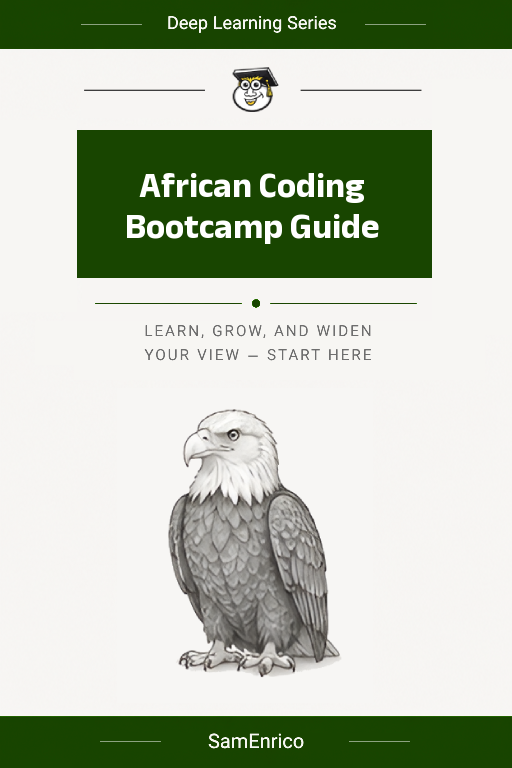
African Coding Bootcamp Guide eBook
Discover coding education in Nairobi Lagos and Cap
by Bunn Lavina
Discover coding education in Nairobi Lagos and Cape Town including affordable bootcamps and growing tech scenes.
Formats
Free sample
Chapter 1: The Three Kings...--–- The first mistake nearly every aspiring developer in Africa makes is opening a laptop and Googling “how to learn to code.” They are immediately buried under 47 million results—most of them written by Americans, for Americans, assuming reliable electricity, unlimited broadband, and a local job market that pays $80,000 to junior developers. If you are reading this from a Lagos cafe running on a generator, a Nairobi matatu with a phone hotspot, or a Cape Town flat during load-shedding, you have already discovered the uncomfortable truth: the standard advice does not work for you. This chapter shatters the myth that “Africa” is a single tech market and replaces it with a hard, data-driven truth. You do not need a CS degree from MIT. You need a hyper-local strategy tailored to one of three gateway cities: Lagos (scale and fintech), Nairobi (mobile-first innovation), or Cape Town (enterprise maturity).
Each city is a different kingdom. Each has its own language, its own employers, its own cost of living, and its own shortcuts to a six-figure salary. Choose the wrong one, and you will struggle for years. Choose the right one, and you can go from bootcamp graduate to remote hire in under six months. Let us begin with a story.The Student Who Chose Wrong Two years ago, a young developer we will call Tolu graduated from a well-regarded bootcamp in Lagos.
He was sharp, hungry, and had built a solid portfolio of React applications. But he made a critical error: he applied for remote jobs across the continent without understanding the specialization of each hub. He spent four months interviewing for a Cape Town-based enterprise company that required deep knowledge of unit testing, CI/CD pipelines, and cloud infrastructure. Tolu had never written a test in his life. He was rejected after the third round.
Then he applied for a Nairobi-based mobile fintech role that asked about M-Pesa APIs and USSD menus. He had never heard of either. Another rejection. Finally, in desperation, he applied for a Lagos logistics startup that needed someone to build internal dashboards. He got the job in two weeks.
When Tolu called me afterward, he said, “I wasted five months applying to the wrong cities. If I had just started in Lagos, I would have been hired in December instead of May.” That lost time cost him roughly $8,000 in salary. This chapter exists so you do not make Tolu’s mistake.Why Most Guides Treat Africa as One Country—And Why That Is Fatal The global tech media has a habit of lumping all of Africa into a single narrative. You will read headlines like “Africa’s Tech Boom” or “The Next Silicon Savannah” without any distinction between the 54 countries, hundreds of languages, and wildly different economies. This is lazy journalism, and it is deadly for your career planning.
The reality is that Lagos, Nairobi, and Cape Town have almost nothing in common when it comes to entry-level tech hiring.Start with the basics of labor economics. The average junior developer salary in Lagos is 7,500to7,500 to 7,500to18,000 per year. In Nairobi, it is 10,000to10,000 to 10,000to22,000. In Cape Town, it is 40,000to40,000 to 40,000to65,000. On the surface, this looks like an obvious choice: go to Cape Town.
But a 50,000salaryin Cape Townbuysyouamodestone−bedroomapartmentandoccasionaldinnersout,whilea50,000 salary in Cape Town buys you a modest one-bedroom apartment and occasional dinners out, while a 50,000salaryin Cape Townbuysyouamodestone−bedroomapartmentandoccasionaldinnersout,whilea15,000 salary in Lagos buys you a comfortable life with savings. More importantly, the cost of entry is dramatically different. To earn 50,000in Cape Town,youmustcompeteagainst Universityof Cape Towngraduateswhohavestudied Clean Code,SOLIDprinciples,andintegrationtestingforfouryears.Toearn50,000 in Cape Town, you must compete against University of Cape Town graduates who have studied Clean Code, SOLID principles, and integration testing for four years. To earn 50,000in Cape Town,youmustcompeteagainst Universityof Cape Towngraduateswhohavestudied Clean Code,SOLIDprinciples,andintegrationtestingforfouryears.Toearn15,000 in Lagos, you need to build a functional fintech dashboard and prove you can handle 1,000 transactions per second. The difficulty curve is not the same.Let us break down each city in brutal detail.Lagos, Nigeria: The Grit and the Gold Lagos is not beautiful.
It is loud, crowded, and chaotic in ways that visitors from Silicon Valley cannot comprehend. Over 20 million people squeeze into a coastal sprawl where traffic can turn a 10-kilometer commute into a three-hour ordeal. The power grid, operated by the infamous NEPA, goes out multiple times per day. Water is unreliable. The air smells of generator fumes and street food.
And yet, Lagos produces more tech startups than any other city in Africa. Flutterwave, Paystack, Moniepoint, and dozens of others have built billion-dollar businesses here because Lagos runs on hustle—the willingness to solve problems with whatever tools are available, no matter the conditions.For a bootcamp graduate, Lagos offers three distinct advantages. First, the volume of opportunities. There are hundreds of fintech startups, logistics companies, and API-driven businesses that need junior developers to build internal tools, customer dashboards, and payment integrations. You do not need to be the best coder in the city; you just need to be competent and reliable.
Second, the barrier to entry is lower. Lagos employers ask practical questions: “Can you handle 10,000 transactions per second during a sale?” “Can you fix this broken API integration by Friday?” “Can you work from a generator-powered laptop when NEPA fails?” These are not theoretical CS problems; they are real-world constraints that favor resourceful bootcamp graduates over theoretical computer scientists. Third, the cost of living is extremely low. A shared apartment near the tech hub of Yaba costs 400to400 to 400to600 per month. Food is 150permonth.Dataandpowerare150 per month.
Data and power are 150permonth.Dataandpowerare200 per month. You can live on 800permonthwhileearning800 per month while earning 800permonthwhileearning1,500 from a junior role, saving nearly half your income.However, Lagos has brutal downsides. The competition is fierce because everyone—university graduates, self-taught coders, and bootcamp alumni—is chasing the same roles. Networking is mandatory; approximately 70 percent of jobs are never advertised. You must attend meetups, send cold DMs on Linked In, and build a reputation before you ever apply.
And the infrastructure will test your patience. You will lose power in the middle of a coding session. Your internet will drop during a video interview. You will spend hours in traffic to attend a meetup that lasts 90 minutes. If you cannot handle chaos, Lagos will break you.
But if you can thrive here, you can work anywhere in the world.Nairobi, Kenya: Silicon Savannah’s Mobile Mastery Nairobi is different. It sits on a highland plateau with cool air and green hills. The traffic is bad but not Lagos-bad. The power is more reliable, though still prone to outages. And the tech scene is built on a single, towering pillar: M-Pesa, the mobile money platform used by over 30 million Kenyans.
M-Pesa is not just a payment app; it is the backbone of the Kenyan economy. Farmers use it to buy seeds. Taxi drivers use it to receive fares. Parents use it to pay school fees. And every single fintech, agritech, or logistics startup in Nairobi must integrate with M-Pesa’s APIs.This creates a unique specialization for developers in Nairobi.…
This is the end of the free sample. Get the eBook to keep going. Buy now
About this book
Details
- Author
- Bunn Lavina
- Publisher
- SamEnrico
- Language
- English
- Genre
- Non-Fiction, Student's Shortcut, African Market, Emerging Tech
- Released
- 2026-05-30
- Pages (approx.)
- 111
- Available as
- eBook, Audiobook

Read better in the ZLOADR app
Your eBooks on your phone or tablet. Sign in with your SamEnrico account and start reading.
More by Bunn Lavina
 The Maharam SchiffBunn Lavina$11.99
 The Parent Microbreak WorkbookBunn Lavina$11.99
 The Emotional Chain Reaction CourseBunn Lavina$11.99
 Single Dad Anger Management GuideBunn Lavina$11.99
 Self Hypnosis Breathing MethodBunn Lavina$11.99
 The Silk Road in the Sky: The First Aerial Survey of Central AsiaBunn Lavina$11.99
 Love Letters from the Pacific: The Secret Romance of WWII’s ‘Code Girls’Bunn Lavina$11.99
 Returns Management Five Year ViewBunn Lavina$12.99
 Understanding Brachydactyly Types B and E CombinedBunn Lavina$17.99
 How to Become a Insulation Cutter And FormerBunn Lavina$11.99
 Forensic EntomologyBunn Lavina$11.99
You may also like
 Hong Kong Handover 1997Dunn Johnnie$11.99
 Zumba For Postnatal Recovery CourseNeal Christian$11.99
 Zumba for BeginnersLadner Nikia$11.99
 YouTube Comment Mining GuideHumes Pandora$12.99
 Worry Box MeditationCarlin Rudy$11.99
 Workplace Stress MeditationNguyen Lynn$11.99
 Workplace Stress and Sleep RepairHawley Ivory$11.99
 Workplace Perfectionism CureDelaney Jeffry$11.99
 Workplace Injustice Anger GuideWallen Isabelle$11.99
 Work Addiction and Burnout LinkGreenwood Ester$11.99
 Women in Yoga and WellnessBeattie Galina$11.99
 Women in Stand Up ComedyChun Evangeline$11.99