
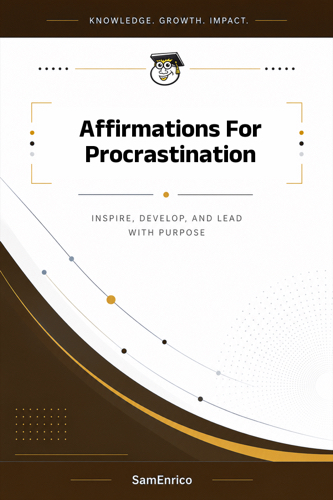
Non-FictionSelf-HelpProcrastination
Affirmations For Procrastination
Use statements that reduce task resistance and bui
Use statements that reduce task resistance and build momentum.
Formats
About this book
Free sample
Chapter 1: The "Try" Funeral--The word "try" has killed more dreams than failure ever will.Failure, at least, has the decency to show up. It arrives with a receipt, a lesson, a scar you can trace with your finger. Failure tells you what didn't work. It gives you data. It closes the loop.But "try"?
"Try" is a ghost. It lingers in your to-do list for months. It makes promises it never intends to keep. It lets you feel productive while producing nothing. And worst of all, "try" has convinced you that effort is the same as results.It is not.You have said "I'll try" thousands of times.
Maybe tens of thousands. Every time you said it, your brain quietly filed that task under "optional." Not "committed." Not "scheduled." Optional. And the brain, being an efficient machine, does not prioritize optional things.This chapter is the funeral for "try." By the time you finish reading, you will never use that word the same way again. And in its absence, you will find something you have been searching for your entire life: the ability to begin without negotiation.Let us dig up the body and see what "try" really is.The Linguistic Escape Hatch Consider these two sentences:"I will try to finish the report by Friday.""I finish the report by Friday."Read them aloud. Feel the difference in your chest.The first sentence has slack in it.
It has a back door. It whispers to your brain: "If I don't finish, well, at least I tried." The second sentence has no back door. It is not asking permission. It is not negotiating. It is a statement of fact, like "The sun rises in the east."Here is what the research shows: When people use conditional language like "try," "hopefully," "maybe," "I'll see," or "I'll do my best," their follow-through drops by approximately 40 percent compared to when they use declarative, present-tense language.
This is not a small effect. This is the difference between a book that gets written and a book that stays in your head for a decade.Why does…
This is the end of the free sample. Get the eBook to keep going. Buy now
Contents
- Chapter 1
- Chapter 2
- Chapter 3
- Chapter 4
- Chapter 5
- Chapter 6
- Chapter 7
- Chapter 8
- Chapter 9
- Chapter 10
- Chapter 11
- Chapter 12
Details
- Author
- Broussard Leandro
- Publisher
- SamEnrico
- Language
- English
- Genre
- Non-Fiction, Self-Help, Procrastination
- Released
- 2026-06-06
- Pages (approx.)
- 111
- Available as
- eBook, Audiobook

Read better in the ZLOADR app
Your eBooks on your phone or tablet. Sign in with your SamEnrico account and start reading.
More by Broussard Leandro
 The Dennis Banks MemoirBroussard Leandro$11.99
 Sober Dating and Sex GuideBroussard Leandro$11.99
 Athlete Morning Training GuideBroussard Leandro$11.99
 Two Minute Start Rule GuideBroussard Leandro$11.99
 Meditation for Sports Injury PainBroussard Leandro$11.99
 Caregiver Exercise GuideBroussard Leandro$11.99
 Daily Review for ResearchersBroussard Leandro$11.99
 The Kingpin’s Flight: Canada’s Bloodiest Prison BreakBroussard Leandro$11.99
 The Dream Code: The Unsolved Mystery of the 1960s Sleep ExperimentsBroussard Leandro$11.99
 How to Become a Honey ExtractorBroussard Leandro$11.99
 How to Produce Referee WalletsBroussard Leandro$11.99
 A Collector's Handbook to the AC Cobra 260Broussard Leandro$11.99
You may also like
 Hong Kong Handover 1997Dunn Johnnie$11.99
 Zumba For Postnatal Recovery CourseNeal Christian$11.99
 Zumba for BeginnersLadner Nikia$11.99
 YouTube Comment Mining GuideHumes Pandora$12.99
 Worry Box MeditationCarlin Rudy$11.99
 Workplace Stress MeditationNguyen Lynn$11.99
 Workplace Stress and Sleep RepairHawley Ivory$11.99
 Workplace Perfectionism CureDelaney Jeffry$11.99
 Workplace Injustice Anger GuideWallen Isabelle$11.99
 Work Addiction and Burnout LinkGreenwood Ester$11.99
 Women in Yoga and WellnessBeattie Galina$11.99
 Women in Stand Up ComedyChun Evangeline$11.99