
Non-FictionSelf-HelpRole ModelsPerspective Taking
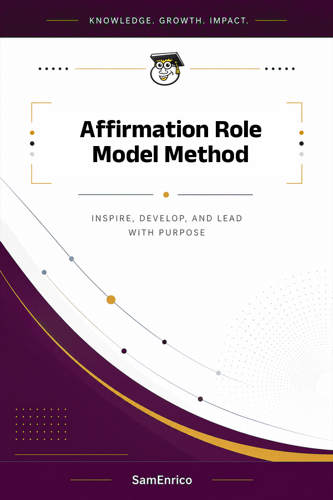
Affirmation Role Model Method
Ask what someone you admire would say to you.
Ask what someone you admire would say to you.
Formats
About this book
Free sample
Chapter 1: The Belief Bypass--–- Your inner critic has a faster neural pathway than your inner coach. That is not a metaphor. It is a neurological fact. The human brain processes self-generated criticism through the default mode network, a well-practiced highway of connections that has been reinforced since childhood. Every time you told yourself “I can’t do this” or “I’m not good enough,” you added another layer of asphalt to that road.
Meanwhile, self-encouragement travels along a narrower path, one that requires deliberate effort to access. This is why saying “I am confident” often triggers an immediate internal rebuttal: “No, you’re not.” Your brain is not being difficult. It is being efficient. It simply trusts the well-traveled road more than the overgrown trail.But here is what most self-help books get wrong. They tell you to replace negative thoughts with positive ones, as if your brain were a whiteboard waiting to be erased.
That approach ignores the fundamental architecture of belief formation. Your brain does not easily accept commands from itself. It evolved to learn socially, by observing and internalizing the voices of trusted others. A child does not learn to walk by telling themselves “I am a competent biped.” They learn by watching an adult, falling down, and trying again. The adult’s presence—their encouragement, their example—carries more weight than any internal pep talk ever could.This chapter reveals why borrowing a trusted external voice bypasses your brain’s natural resistance to self-praise, why shame dissolves when attributed to someone you respect, and how a single question—“What would [your hero] say to me right now?”—can rewire the same neural circuits that years of self-criticism have hardened.
By the end of this chapter, you will understand the science behind the method, and you will complete an exercise that proves to you, in real time, that a borrowed voice works better than your own.The Problem with “I Am” Statements In 2009, psychologist Joanne Wood and her colleagues published a landmark study that should have upended the self-help industry. They asked participants with low self-esteem…
This is the end of the free sample. Get the eBook to keep going. Buy now
Contents
- Chapter 1
- Chapter 2
- Chapter 3
- Chapter 4
- Chapter 5
- Chapter 6
- Chapter 7
- Chapter 8
- Chapter 9
- Chapter 10
- Chapter 11
- Chapter 12
Details
- Author
- Faber Lorenza
- Publisher
- SamEnrico
- Language
- English
- Genre
- Non-Fiction, Self-Help, Role Models, Perspective Taking
- Released
- 2026-06-09
- Pages (approx.)
- 137
- Available as
- eBook, Audiobook

Read better in the ZLOADR app
Your eBooks on your phone or tablet. Sign in with your SamEnrico account and start reading.
More by Faber Lorenza
 Self Talk for AddictionFaber Lorenza$11.99
 Sleep Sanctuary for ScholarsFaber Lorenza$11.99
 Comparison Shopping AddictionFaber Lorenza$11.99
 The PDE5 Inhibitor Medication GuideFaber Lorenza$11.99
 Scipio Africanus: The Strategist Who Defeated HannibalFaber Lorenza$11.99
 A Beginners Guide to Hang Gliding (Volume 1)Faber Lorenza$11.99
 Understanding Vaginiosis (Bacterial, Cytologic)Faber Lorenza$17.99
 Insurance Service ProfessionalFaber Lorenza$11.99
 Promotion Case Timing StrategyFaber Lorenza$12.99
 BOP Agriculture Product GuideFaber Lorenza$12.99
You may also like
 Hong Kong Handover 1997Dunn Johnnie$11.99
 Zumba For Postnatal Recovery CourseNeal Christian$11.99
 Zumba for BeginnersLadner Nikia$11.99
 YouTube Comment Mining GuideHumes Pandora$12.99
 Worry Box MeditationCarlin Rudy$11.99
 Workplace Stress MeditationNguyen Lynn$11.99
 Workplace Stress and Sleep RepairHawley Ivory$11.99
 Workplace Perfectionism CureDelaney Jeffry$11.99
 Workplace Injustice Anger GuideWallen Isabelle$11.99
 Work Addiction and Burnout LinkGreenwood Ester$11.99
 Women in Yoga and WellnessBeattie Galina$11.99
 Women in Stand Up ComedyChun Evangeline$11.99