
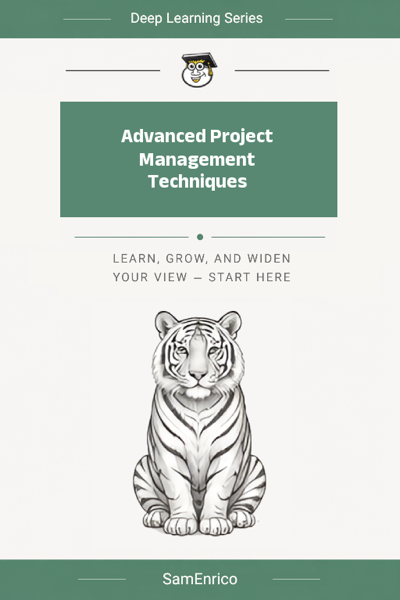
Non-FictionInformativeEducational
Advanced Project Management Techniques eBook
A Coursebook on Advanced Project Management Techni
A Coursebook on Advanced Project Management Techniques
Formats
Free sample
Chapter 1: The Strategy Mandate...–- On a Tuesday morning in March, a $47 million project went off the rails not because someone miscalculated a Gantt chart or misallocated a resource, but because no one in the room could answer a single question: Why are we doing this? The project had a sponsor, a charter, a budget, and a schedule. It had weekly status reports, risk registers, and a beautifully color-coded dashboard. What it did not have was a connection to anything the organization actually valued. Three months later, the project was quietly canceled.
The post-mortem cited "changing priorities." The truth was more embarrassing: no one had ever bothered to ask whether the project should exist in the first place.This book is not about becoming a better task manager. It is about becoming a strategic leader who knows which projects to start, which to kill, and how to extract every ounce of value from the ones that survive. Welcome to the Project Economy, where your ability to lead complex initiatives determines not just your career trajectory but the survival of your organization.The Great Illusion: On Time, On Budget, On Nothing For decades, the project management profession has worshipped a false idol. The mantra "on time and on budget" has been repeated so often that it has become synonymous with success itself. But consider this: a project can deliver exactly on schedule, exactly within budget, and still be a catastrophic failure if it delivers the wrong outcome.
Conversely, a project that runs late and over budget can be a stunning success if it creates genuine value that outweighs the overruns.The traditional metrics confuse efficiency with effectiveness. Efficiency asks: Did we use our resources as planned? Effectiveness asks: Did we achieve the intended business result? These are not the same question. A perfectly efficient project that builds a feature no customer uses is a waste.
A slightly inefficient project that captures a new market is a triumph.This chapter dismantles the old mindset and replaces it with a strategic framework. You will learn to see yourself not as a project manager but as a Strategic Enabler—someone who sits at the intersection of execution and strategy, translating organizational goals into action and ensuring that every dollar spent on projects moves the needle on what actually matters.The Project Economy: Why Your Role Has Changed Forever We live in what Antonio Nieto-Rodriguez has called the Project Economy. This is not marketing hype; it is a structural shift in how work gets done. A century ago, most work was operational—repetitive, predictable, optimized for efficiency. Henry Ford's assembly line was the model.
Today, the competitive advantage belongs to organizations that can execute non-repetitive, high-stakes initiatives: launching new products, entering new markets, implementing digital transformations, responding to regulatory changes.Consider these data points. In 1960, the average Fortune 500 company spent roughly 20 percent of its resources on project-based work. By 2020, that figure had climbed to over 60 percent. For technology companies, it is often above 80 percent. The implication is staggering: most of what your organization does is now project work, yet most organizations still manage projects with tools and mindsets designed for operations.This creates an enormous opportunity for the project leader who understands the difference.
Operational management is about optimizing existing processes. Project leadership is about creating new capabilities. One preserves value; the other generates it. The Chief Project Officer (CPO) role is emerging in forward-thinking organizations precisely because executives have realized that project execution is a core strategic competency, not a support function.The Strategic Enabler: A New Identity Let me be direct with you. If you see your job as updating schedules, chasing down status reports, and enforcing compliance with a project management methodology, you are replaceable.
Software can do most of that today, and artificial intelligence will do even more tomorrow. What software cannot do is navigate the messy, human, strategic dimensions of project leadership.The Strategic Enabler mindset rests on three pillars.First, you connect projects to strategy. Every project in your portfolio should be traceable to a specific strategic objective. If it is not, it does not belong in the portfolio. This sounds obvious, but in practice, most organizations tolerate a long tail of zombie projects—initiatives that continue indefinitely because no one has the courage to kill them, even though they no longer serve any strategic purpose.Second, you manage the portfolio, not just the project.
Traditional project management focuses on a single initiative in isolation. Strategic Enables understand that projects compete for scarce resources—money, people, attention, leadership bandwidth. A project that is perfectly managed in isolation can be a disaster for the portfolio if it starves more important work. You must learn to see the whole system.Third, you speak the language of business value, not project outputs. When you present to executives, do not lead with schedule variance or cost performance index.
Lead with business outcomes: revenue, market share, customer retention, operational efficiency, risk reduction. Translate your project's progress into terms that matter to the people who control resources.The Too Many Projects Dilemma Let me describe a situation that will be painfully familiar to many readers. Your organization has more projects than it can realistically execute. Every department head has pet initiatives. The executive team approves projects enthusiastically but never kills anything.
As a result, resources are spread thinner and thinner. People work on five or six projects simultaneously, spending more time context-switching than making progress. Projects take three times as long as they should because no one can focus. And the organization develops a learned helplessness: this is just how we work.This is the Too Many Projects dilemma, and it is the single greatest destroyer of value in modern organizations. The mathematics are relentless.
When a resource works on multiple projects simultaneously, the time lost to context switching is not linear; it is exponential. A developer assigned to three projects does not deliver one-third the output of a developer assigned to one project. They deliver closer to one-tenth, because each transition carries a cognitive overhead.The solution is counterintuitive. In a world of scarce resources, the answer is not to do more. The answer is to do less, but do it better.
This requires portfolio governance, a topic we will explore throughout this book. For now, understand the core principle: a smaller number of fully resourced projects will always outperform a larger number of under-resourced projects. Your job as a Strategic Enabler includes advocating for this truth, even when it makes you unpopular.The Queue Management Framework Lean manufacturing offers a powerful metaphor. In a factory, work-in-progress limits prevent overloading the production line. When too many jobs enter the system, queue times explode, quality collapses, and throughput actually decreases.
The same principles apply to project portfolios.Limit work in progress. Determine the maximum number of active projects your organization can realistically support given its resource constraints. This number is almost certainly lower than your current active project count. Commit to not starting a new project until an existing project completes.Visualize the queue. Create a simple board showing each project's status: not started, active, review, done.
Make this board visible to everyone. The transparency alone will create pressure to finish work rather than constantly starting new…
This is the end of the free sample. Get the eBook to keep going. Buy now
About this book
Details
- Author
- Swisher Carli
- Publisher
- SamEnrico
- Language
- English
- Genre
- Non-Fiction, Informative, Educational
- Released
- 2026-06-03
- Pages (approx.)
- 157
- Available as
- eBook, Audiobook

Read better in the ZLOADR app
Your eBooks on your phone or tablet. Sign in with your SamEnrico account and start reading.
More by Swisher Carli
 The Breath Loving Kindness ComboSwisher Carli$11.99
 Corporate Attorney Stress ReliefSwisher Carli$11.99
 Mountain Top Calm ScriptSwisher Carli$11.99
 Performance Review PalaceSwisher Carli$11.99
 North Sea Oil Rig StoriesSwisher Carli$11.99
 Non Standard Contract AI HandlingSwisher Carli$11.99
 Eye of Horus GuideSwisher Carli$11.99
 Couples Emotion RegulationSwisher Carli$11.99
 Rewiring Rejection SensitivitySwisher Carli$11.99
 The Silent Bridge: How a Forgotten Treaty Saved MillionsSwisher Carli$11.99
 Anansi Weaves the Stars: The Spider’s Grand DeceptionSwisher Carli$11.99
 Ratko Mladić: The Butcher of Bosnia and the Fall of YugoslaviaSwisher Carli$11.99
You may also like
 Hong Kong Handover 1997Dunn Johnnie$11.99
 Zumba For Postnatal Recovery CourseNeal Christian$11.99
 Zumba for BeginnersLadner Nikia$11.99
 YouTube Comment Mining GuideHumes Pandora$12.99
 Worry Box MeditationCarlin Rudy$11.99
 Workplace Stress MeditationNguyen Lynn$11.99
 Workplace Stress and Sleep RepairHawley Ivory$11.99
 Workplace Perfectionism CureDelaney Jeffry$11.99
 Workplace Injustice Anger GuideWallen Isabelle$11.99
 Work Addiction and Burnout LinkGreenwood Ester$11.99
 Women in Yoga and WellnessBeattie Galina$11.99
 Women in Stand Up ComedyChun Evangeline$11.99