
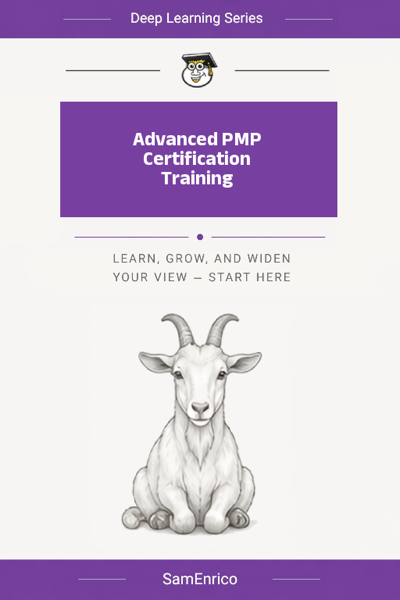
Non-FictionInformativeEducational
Advanced PMP Certification Training eBook
A Coursebook on Advanced PMP Certification Trainin
A Coursebook on Advanced PMP Certification Training
Formats
Free sample
Chapter 1: The Application Trap...--Most people begin their PMP journey exactly where I did – staring at a blank application form, convinced they haven't managed anything worth calling a "project." They see the 36-month requirement. They read the warnings about audits. And they freeze.I was a senior project coordinator at a mid-sized software company when I first applied. I had led five product launches, managed three cross-functional teams, and saved my department roughly $400,000 through a vendor consolidation initiative. None of that mattered when I sat down to describe my work in PMI's terminology.
I wrote things like "helped the team finish tasks" and "made sure everyone knew what to do" – honest, accurate, and completely useless to the auditors.My application was rejected within 48 hours.Not audited. Not flagged for clarification. Rejected.The notification email was polite, of course. "Your experience does not demonstrate the required level of project management responsibility." What they meant was: you don't know how to talk about your work in our language. You have the experience, but you cannot articulate it.
And until you can, you don't belong in this profession.That rejection changed everything for me. Not because it was unfair – looking back, it was entirely fair. I had submitted a sloppy, jargon-free, under-detailed application that could have described a particularly organized intern. The problem wasn't my experience. The problem was my translation.Over the next three years, I helped more than two hundred professionals navigate that same application.
Engineers, marketers, construction superintendents, healthcare administrators, military officers – all of them doing real project work, all of them struggling to translate their experience into PMI's framework. I watched people with twenty years of experience get rejected because they described their work as "operations." I watched people with barely three years get approved because they understood the hidden rules.This chapter will teach you those rules.Before you study a single formula, before you memorize a single process, before you spend a single dollar on exam prep materials – you must get your application approved. Everything else is irrelevant if you cannot sit for the exam. And here is the truth that most prep books won't tell you: the application is its own test. It tests your ability to think like PMI, to write like PMI, to structure experience in PMI's preferred narrative shape.Most people approach the application backward.
They write about what they did. PMI wants to read about what they delivered.Let me show you the difference.Why the Application Filters Out More Candidates Than the Exam Here is a statistic that should terrify you: approximately 15-20% of PMP applications are either rejected outright or returned for clarification. Among first-time applicants with exactly three years of experience, that number climbs to nearly 30%.The exam itself has a first-time pass rate around 70% for PMI members. Do the math. You are statistically more likely to fail the application than the actual test if you are on the lower end of the experience requirement.Why?Because PMI uses the application as a gatekeeping mechanism.
They are not trying to be cruel. They are trying to protect the certification's value. If every project coordinator with a loose understanding of "leadership" could qualify, the PMP would mean nothing. The application exists to force you to demonstrate that you understand project management as a discipline, not just as a job title.Here is what PMI looks for in every application submission:First, temporal separation. Your projects cannot overlap in time unless you can convincingly argue that you managed them simultaneously without diminishing your responsibility in either.
PMI prefers non-overlapping projects. Overlapping projects trigger manual review. Manual review increases your audit risk.Second, progressive responsibility. Your earliest projects should show foundational skills. Your later projects should show greater complexity, larger budgets, more stakeholders, or higher strategic visibility.
PMI wants to see growth. An application that shows the same level of responsibility across five years looks suspicious.Third, domain coverage. Across your projects, you must demonstrate experience in all three exam domains: People (leadership, team management), Process (planning, execution, monitoring), and Business Environment (compliance, strategy, value delivery). Missing an entire domain is a common reason for rejection.Fourth, the right language. You do not need to memorize the entire PMBOK® Glossary, but you need to use PMI's core terms correctly.
"Requirements," "deliverables," "stakeholders," "risk management," "quality control" – these words have specific meanings in PMI's world. Using them incorrectly signals that you are not ready.The Six-Week Application Timeline Do not rush your application.The single biggest mistake I see is the weekend warrior – someone who sits down on a Sunday afternoon, types furiously for six hours, and hits submit. That person almost always gets rejected or audited.A strong application requires six weeks. Here is the weekly breakdown:Week 1: Identify your projects. You need 36 months of non-overlapping project management experience if you have a four-year degree.
60 months if you do not. Most applicants over-report. They try to list every project they have ever touched. Do not do this. You need the minimum number of projects that cover 36 distinct months without overlap.
For most people, that is three to five projects lasting 8-12 months each.Week 2: Write the high-level descriptions. For each project, write one paragraph (150-200 words) answering three questions: What was the project's purpose? What was your role? What was the outcome? Do not include processes yet.
Just the story.Week 3: Map each project to the three domains. For each project, identify which domain was primary (usually Process for most projects) and which domains were secondary. Some projects will naturally cover all three. Some will miss one. If you have a domain gap across your entire application, you need to find a different project or rethink how you describe your experience.Week 4: Write the process descriptions.
For each project, write 4-6 sentences describing specific tasks you performed in each applicable domain. Use PMI verbs: "developed," "facilitated," "monitored," "controlled," "escalated," "authorized," "approved." Avoid passive voice. Avoid vague statements like "was responsible for."Week 5: Review, revise, and get feedback. Give your application to someone who has never worked in your industry. If they cannot understand what you did, rewrite it.
Give it to a certified PMP if you know one. Ask them to identify any language that sounds non-PMI.Week 6: Final polish and submit. Read every word aloud. Check for typos, inconsistent tense, and overlapping dates. Then wait.How to Select Your Projects The most common question I hear is: "How do I know if my experience counts?"Here is the official PMI definition of a project: a temporary endeavor undertaken to create a unique product, service, or result.Let me translate that into real-world language.A project has a start date and an end date.
Ongoing operational work – "I manage the customer support team" – is not a project. But "I led a three-month initiative to reduce customer support response time from 24 hours to 4 hours" is absolutely a project.A project produces something unique. Repeating the same task every week is not a project. But "I coordinated the annual company conference" is a project, even though you do it every year, because each conference is unique (different venue, different speakers, different…
This is the end of the free sample. Get the eBook to keep going. Buy now
About this book
Details
- Author
- Mcgrath Zachariah
- Publisher
- SamEnrico
- Language
- English
- Genre
- Non-Fiction, Informative, Educational
- Released
- 2026-05-23
- Pages (approx.)
- 149
- Available as
- eBook, Audiobook

Read better in the ZLOADR app
Your eBooks on your phone or tablet. Sign in with your SamEnrico account and start reading.
More by Mcgrath Zachariah
 Drug Dependency Mindfulness Based Relapse PreventionMcgrath Zachariah$11.99
 Self Loving Kindness Practice GuideMcgrath Zachariah$11.99
 Gym Anxiety MeditationMcgrath Zachariah$11.99
 Water Dream SymbolismMcgrath Zachariah$11.99
 Anapanasati for Test AnxietyMcgrath Zachariah$11.99
 The Water Cooler ComebackMcgrath Zachariah$11.99
 Financial Stress For AdopteesMcgrath Zachariah$11.99
 Parent Financial Planning GuideMcgrath Zachariah$11.99
 John Cleese PythonMcgrath Zachariah$11.99
 The Last Voyage of the MV Ever Given: A Canal Crisis That Shook the WorldMcgrath Zachariah$11.99
 The First to the Moon: The Untold Story of the Apollo 11 Backup CrewMcgrath Zachariah$11.99
 The Iron Horse: How the Transcontinental Railroad United a NationMcgrath Zachariah$11.99
You may also like
 Hong Kong Handover 1997Dunn Johnnie$11.99
 Zumba For Postnatal Recovery CourseNeal Christian$11.99
 Zumba for BeginnersLadner Nikia$11.99
 YouTube Comment Mining GuideHumes Pandora$12.99
 Worry Box MeditationCarlin Rudy$11.99
 Workplace Stress MeditationNguyen Lynn$11.99
 Workplace Stress and Sleep RepairHawley Ivory$11.99
 Workplace Perfectionism CureDelaney Jeffry$11.99
 Workplace Injustice Anger GuideWallen Isabelle$11.99
 Work Addiction and Burnout LinkGreenwood Ester$11.99
 Women in Yoga and WellnessBeattie Galina$11.99
 Women in Stand Up ComedyChun Evangeline$11.99