
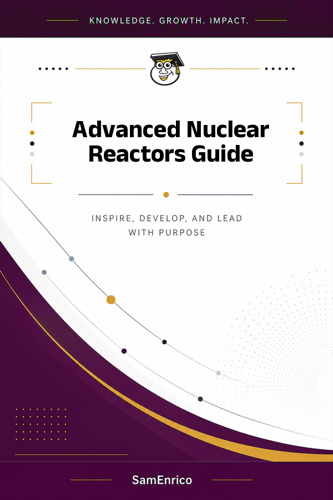
Advanced Nuclear Reactors Guide
Allocates capital to SMRs, microreactors, and adva
Allocates capital to SMRs, microreactors, and advanced fuel cycles.
Formats
About this book
Free sample
Chapter 1: The Capital Conundrum...–- When the largest infrastructure projects in the developed world fail not because the physics was wrong, but because the financing model was built for a different century, it is time to admit that the nuclear industry has been solving the wrong problem for forty years.The Vogtle Plant in Georgia, United States, broke ground in 2009 with a budget of approximately $14 billion and a scheduled completion date of 2016. When Unit 4 finally entered commercial service in April 2024—eight years late and $17 billion over budget—the two new reactors had accumulated more than $30 billion in total capitalized costs. The Vogtle expansion represented the last of a dying breed: the gigawatt-scale, custom-engineered, on-site constructed light-water reactor. Across the Atlantic, the Hinkley Point C project in Somerset, England, received a final investment decision in 2016 with a price tag of £18 billion. By 2024, the estimated cost had ballooned to £46 billion, with first power now expected no earlier than 2029—a decade after the original target.
These are not anomalies. They are the predictable outcomes of a project finance model that treats nuclear reactors the same way it treats hydroelectric dams or highway systems: as unique, site-specific, multi-billion-dollar mega-projects.But something fundamental has changed. The nuclear technologies now emerging from decades of research and development—small modular reactors, microreactors, molten salt designs, heat-pipe systems, and fast spectrum reactors—do not fit the mega-project mold. They are manufactured in factories, shipped on trucks, installed in months rather than years, and designed to operate with minimal on-site staffing. Yet the capital markets continue to evaluate them using the same frameworks developed for the Vogtles and Hinkleys of the world.
The result is a catastrophic mispricing of risk and a systematic under-allocation of capital to the only firm, dispatchable, zero-carbon energy source capable of complementing intermittent renewables on a grid scale.This chapter dismantles the legacy financial model of large-scale nuclear, exposes the specific mechanisms that have made gigawatt projects uninvestable, and introduces the new paradigm: scalable, modular, manufacturing-driven capital allocation. The argument is not that advanced reactors are cheaper per megawatt than their predecessors—that remains unproven. The…
This is the end of the free sample. Get the eBook to keep going. Buy now
Contents
- Chapter 1
- Chapter 2
- Chapter 3
- Chapter 4
- Chapter 5
- Chapter 6
- Chapter 7
- Chapter 8
- Chapter 9
- Chapter 10
- Chapter 11
- Chapter 12
Details
- Author
- Shumate Stephany
- Publisher
- SamEnrico
- Language
- English
- Genre
- Non-Fiction, Forecast & Outlook, Nuclear Finance
- Released
- 2026-06-07
- Pages (approx.)
- 130
- Available as
- eBook, Audiobook

Read better in the ZLOADR app
Your eBooks on your phone or tablet. Sign in with your SamEnrico account and start reading.
More by Shumate Stephany
 Scarcity as SpringboardShumate Stephany$11.99
 TM for Veterans GuideShumate Stephany$11.99
 Assertiveness for Passive AggressionShumate Stephany$11.99
 The Posture Correction Back HandbookShumate Stephany$11.99
 The Peanut Whisperer: George Washington Carver’s Green RevolutionShumate Stephany$11.99
 Understanding Perisylvian SyndromeShumate Stephany$17.99
 Payment Gateway Migration GuideShumate Stephany$12.99
 London Pop Up Real Estate PlatformsShumate Stephany$12.99
 How to Become a Tumbler-machine OperatorShumate Stephany$11.99
 Strategic Sales ConsultantShumate Stephany$11.99