
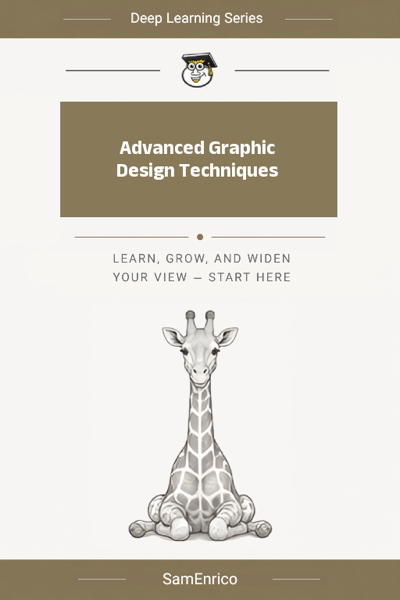
Non-FictionInformativeEducational
Advanced Graphic Design Techniques eBook
A Coursebook on Advanced Graphic Design Techniques
A Coursebook on Advanced Graphic Design Techniques
Formats
Free sample
Chapter 1: The System Behind Genius...--Every designer has stared at a masterpiece—a poster, a brand identity, a website, a magazine spread—and felt that uncomfortable mix of awe and inadequacy. How did they do that? Was it talent? Years of practice? A lucky spark of inspiration?The answer is none of the above.
Or rather, the answer is something far more useful than any of those.Great design is not the product of mysterious genius. It is the product of systems.This single realization separates designers who occasionally produce good work from designers who consistently produce excellent work. The former waits for inspiration to strike. The latter builds a machine that generates inspiration on demand.This chapter will tear down the myth of the lone creative genius and rebuild your understanding of design as a systematic, repeatable, teachable discipline. By the time you finish these pages, you will never look at a design—your own or anyone else’s—the same way again.
You will see the hidden architecture beneath the surface. And you will have the tools to build your own.The Myth of the Isolated Genius Walk into any design bookstore or scroll through any creative social media feed, and you will encounter a persistent narrative. The starving artist. The late-night breakthrough. The flash of insight that solves everything.
The designer who just feels when something is right.This narrative is romantic. It is also dangerous.Because when you believe that great design comes from mysterious, unreachable places—talent, inspiration, luck—you surrender control. You wait. You hope. And sometimes, on a good day, the muse visits.
But most days, she doesn’t.The truth, supported by decades of research into creative fields, is that professional designers work nothing like this. The most celebrated designers in history—from Paul Rand to Massimo Vignelli to Paula Scher—worked systematically. They had processes. They had rules. They had methods that could be taught, learned, and repeated.What looked like magic from the outside was, on the inside, meticulous engineering.Consider the difference between building a single birdhouse and manufacturing a thousand identical chairs.
The birdhouse requires individual attention, custom measurements, and intuition. The chairs require a system: jigs, templates, quality checks, repeatable steps. The birdhouse maker cannot scale. The chair manufacturer can produce consistently forever.Graphic design at an advanced level is chair manufacturing, not birdhouse building. You are not making one beautiful thing.
You are creating a system that produces beautiful things reliably, whether that system produces five assets or five thousand.Object-Based vs. System-Based Design Let us draw a critical distinction that will underpin every chapter of this book.Object-based design treats each project as a unique artifact. The designer opens a blank canvas and starts drawing. Every decision—color, typography, spacing, imagery—is made in isolation for this specific piece. When the project ends, those decisions die with it.
The next project starts from zero.System-based design treats each project as an expression of underlying rules. Before drawing anything, the designer defines the system: the color logic, the typographic hierarchy, the spacing units, the grid behavior, the component library. Every artifact then emerges from that system. When the project ends, the system lives on, ready to generate the next artifact.Here is a concrete example. An object-based designer asked to create a series of social media graphics for a brand will open Photoshop ten times and make ten different graphics.
They might share colors and fonts, but each one is hand-crafted individually. When the brand asks for twenty more, the designer starts over.A system-based designer asked for the same task will first build a template system: a master file with locked grids, predefined text styles, a color palette saved as global swatches, and component-based layouts. Then they will generate twenty graphics in the time it took the object-based designer to make two. And every single one will be visually consistent, on-brand, and professionally aligned.Object-based design is how beginners work. System-based design is how professionals work.The Cost of Object-Based Thinking You might be thinking: “But I’m creative.
I don’t want to be a machine. I want each project to feel fresh and unique.”This objection is common, and it misunderstands what systems enable.Systems do not eliminate creativity. They eliminate wasted creativity. They handle the predictable, repetitive decisions automatically, freeing your mental energy for the decisions that actually matter. The grid handles spacing so you don’t have to guess where to put the logo on every single page.
The color system maintains harmony so you don’t have to agonize over whether this shade of blue works with that shade of green every time you open a file.Consider the alternative. Every time you start a new project, you must decide:What font size should the headline be?How much space between the headline and the subhead?What color should the link text be?How wide should the margin be?What happens when the text wraps to two lines?What happens on mobile vs. desktop?Individually, each decision is small. But across twenty projects, with dozens of decisions each, the cumulative mental load is enormous. Object-based designers burn out because they make the same small decisions over and over and over again, each time pretending they are making them for the first time.System-based designers make each decision once.
Then the system remembers.Introducing Semiotics: How Meaning is Made Before we can build systems, we must understand what our systems are communicating. This is where semiotics—the study of signs and meaning—becomes essential.Semiotics sounds academic, but it is intensely practical. Every time you choose an icon, a color, a shape, or a font, you are sending a signal. Semiotics helps you understand what signal you are actually sending, versus what signal you intended to send.There are three fundamental types of signs in semiotic theory. Master these, and you will never be confused about why some symbols work and others fail.Icon: The Sign that Resembles An icon is a sign that looks like what it represents.
A photograph of a tree is an icon of that tree. A floppy disk symbolizing “save” is an icon of an actual floppy disk. A trash can icon for “delete” looks like a trash can.Icons are intuitive. Almost anyone, regardless of language or culture, can recognize a well-designed icon because it resembles its real-world referent. This is why icons dominate user interfaces, wayfinding systems, and international signage.The danger with icons is realism.
The more detailed an icon becomes, the harder it is to recognize at small sizes. The best icons are simplified, abstracted, reduced to essential visual features. A human face icon needs two eyes, a nose, and a mouth—but not eyelashes, wrinkles, or individual teeth.Index: The Sign that Points An index is a sign that has a direct, causal connection to what it represents. Smoke is an index of fire. A footprint is an index of a foot.
A pointing finger is an index of direction.In graphic design, indexes are powerful because they feel factual rather than arbitrary. A bar chart rising upward indexes growth. A thermometer…
This is the end of the free sample. Get the eBook to keep going. Buy now
About this book
Details
- Author
- Lake Charmaine
- Publisher
- SamEnrico
- Language
- English
- Genre
- Non-Fiction, Informative, Educational
- Released
- 2026-05-09
- Pages (approx.)
- 134
- Available as
- eBook, Audiobook

Read better in the ZLOADR app
Your eBooks on your phone or tablet. Sign in with your SamEnrico account and start reading.
More by Lake Charmaine
 The Glass EyeLake Charmaine$11.99
 Listening In Quality AssuranceLake Charmaine$11.99
 The Door to Door Sales TrapLake Charmaine$11.99
 Stress and In Laws BoundariesLake Charmaine$11.99
 Evening Wind Down BreathLake Charmaine$11.99
 Music Therapy Low CostLake Charmaine$11.99
 Joyful Eating Gratitude PracticeLake Charmaine$11.99
 Habit Stacking StudyLake Charmaine$11.99
 Nadia Comaneci PerfectLake Charmaine$11.99
 Sarajevo 1914: The Spark That Ignited the WorldLake Charmaine$11.99
 The Vanishing Hitchhiker: A Highway EnigmaLake Charmaine$11.99
 Silk Road Shadows: The Opium Wars and the Birth of Global TradeLake Charmaine$11.99
You may also like
 Hong Kong Handover 1997Dunn Johnnie$11.99
 Zumba For Postnatal Recovery CourseNeal Christian$11.99
 Zumba for BeginnersLadner Nikia$11.99
 YouTube Comment Mining GuideHumes Pandora$12.99
 Worry Box MeditationCarlin Rudy$11.99
 Workplace Stress MeditationNguyen Lynn$11.99
 Workplace Stress and Sleep RepairHawley Ivory$11.99
 Workplace Perfectionism CureDelaney Jeffry$11.99
 Workplace Injustice Anger GuideWallen Isabelle$11.99
 Work Addiction and Burnout LinkGreenwood Ester$11.99
 Women in Yoga and WellnessBeattie Galina$11.99
 Women in Stand Up ComedyChun Evangeline$11.99