
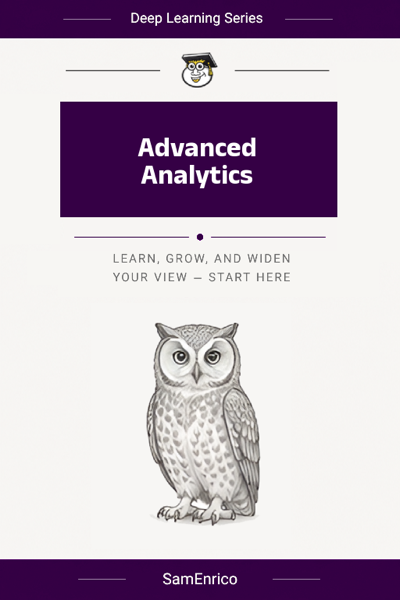
Non-FictionInformativeEducational
Advanced Analytics eBook
A Coursebook on Advanced Analytics
A Coursebook on Advanced Analytics
Formats
Free sample
Chapter 1: Beyond the Dashboard--– In a windowless conference room at the headquarters of Global Parcel Delivery, a director of operations named Marcus Chen was doing something unusual. He was ignoring his own dashboard.The wall-mounted screen displayed the usual cascade of green, yellow, and red metrics – on-time delivery rates, driver productivity scores, fuel efficiency per route, customer complaint volumes. It was a beautiful dashboard, actually. Marcus had personally approved every color choice and chart type during a series of exhausting meetings two years ago. The dashboard cost nearly half a million dollars to implement across the company's twelve regional hubs.And Marcus had not looked at it for three weeks.Instead, he was staring at a spreadsheet that his most junior analyst had cobbled together overnight.
The spreadsheet had no conditional formatting, no drill-down capabilities, no real-time updates. It was ugly. It was manual. It was, Marcus had come to believe, the most valuable analytical artifact his team had ever produced.The spreadsheet answered one simple question: which drivers were likely to quit in the next thirty days?Marcus had asked for this prediction after losing seven experienced drivers in a single week – each citing vague reasons about "better opportunities" and "work-life balance." The exit interviews were useless. The dashboard showed him turnover rates after they happened.
By then, the drivers were already gone, their routes were understaffed, and his remaining drivers were working mandatory overtime that made more of them want to leave.The junior analyst, a recent graduate named Priya, had no access to the company's expensive BI tools. So she had pulled raw data from three different systems – driver shift logs, GPS route records, and a survey that the HR team had forgotten to sunset. She joined them manually in Excel. She calculated simple averages: hours worked per week, route changes per month, weekend shifts per quarter. Then she sorted drivers by these averages and highlighted the top decile.Her model was not sophisticated.
It did not use machine learning. It did not even use a pivot table correctly. But when Marcus compared her list of high-risk drivers against the seven who had already quit, five of them were on her list. A 71% hit rate. From an Excel spreadsheet.Marcus closed the dashboard.
He opened Priya's spreadsheet. And he began calling drivers.This book exists because Marcus's story is not exceptional. It is the rule. Organizations have spent billions of dollars on Business Intelligence platforms that produce beautiful descriptions of the past. They have built data warehouses, deployed dashboards, and trained armies of analysts in SQL and Tableau.
Yet when leaders face a genuine predictive question – who will quit, which route will fail, what customer will defect – they find themselves cobbling together spreadsheets in the dark.The problem is not that BI tools are bad. They are excellent at what they were designed to do: answer "what happened?" and "what is happening right now?" The problem is that "what happened?" is no longer sufficient for competitive advantage. In a world where every competitor has dashboards, the ability to describe yesterday is table stakes. The ability to predict tomorrow is where value lives.This chapter is about that gap. It defines what advanced analytics really means – not as a marketing term or a job title, but as a fundamental shift from retrospective reporting to prospective decision-making.
You will learn why most organizations fail to make this shift, what it takes to succeed, and how this entire book will guide you through the journey. By the end of this chapter, you will understand why Marcus abandoned his dashboard and why you should be ready to abandon yours.What Advanced Analytics Actually Means Let me clear up a persistent confusion. The term "advanced analytics" has been used to describe everything from linear regression to artificial general intelligence. In some organizations, it means "analytics done by someone with a Ph D." In others, it means "analytics that costs more than $100,000." These definitions are not useful.Here is the definition that will guide this book: Advanced analytics is the use of data, statistical methods, and computational techniques to answer questions that cannot be answered by simple aggregation and reporting.Notice what this definition does not say. It does not say "advanced analytics requires deep learning." It does not say "advanced analytics requires big data." It does not say "advanced analytics requires a data science team of twenty people." Priya's Excel spreadsheet qualifies as advanced analytics under this definition because it answered a predictive question – "which drivers are likely to quit?" – that her dashboard could not answer.This definition rests on a taxonomy of analytical questions that you must internalize.
There are four types, and they form a hierarchy of difficulty and value.Descriptive analytics answers "what happened?" This is the domain of traditional BI. How many packages were delivered on time yesterday? What was the average driver overtime last quarter? Which region had the highest complaint volume? These questions are important, but they are also backward-looking.
They tell you about reality after reality has already occurred.Diagnostic analytics answers "why did it happen?" This is where descriptive analytics starts to become useful. Why did on-time delivery drop in the Northeast region? Why did driver overtime spike last Tuesday? These questions require more than aggregation; they require comparison, segmentation, and often experimental or quasi-experimental methods. Many organizations skip diagnostic analytics entirely, jumping from "what happened" straight to "what will happen." This is a mistake.
You cannot predict the future reliably if you do not understand the causes of the past.Predictive analytics answers "what will happen?" This is what most people imagine when they hear "advanced analytics." Will this driver quit in the next thirty days? Will this route experience a delay today? Will this customer file a complaint? Predictive analytics uses historical patterns to forecast future events. It is the domain of regression, classification, time series, and machine learning.
Priya's spreadsheet was predictive analytics, albeit in its simplest form.Prescriptive analytics answers "what should I do about it?" This is the highest level of analytical maturity. Given that a driver is likely to quit, should we offer a retention bonus, reduce their route difficulty, or do nothing and accept the turnover? Given that a route is likely to be delayed, should we reroute the truck, add a second driver, or notify customers of the expected delay? Prescriptive analytics often involves optimization, simulation, and decision theory. It is the ultimate goal of most analytical investments, but it is also the rarest in practice.Here is the key insight that most organizations miss: You cannot do prescriptive analytics without predictive analytics.
You cannot do predictive analytics without diagnostic analytics. You cannot do diagnostic analytics without descriptive analytics. The hierarchy is cumulative. When organizations skip levels, their analytical outputs are brittle and unreliable.Marcus's dashboard was stuck at descriptive. It could tell him that turnover increased, but it could not tell him why (diagnostic), who would quit next (predictive), or what to do about it (prescriptive).
Priya's spreadsheet, for all its crudeness, reached the predictive level. That is why Marcus found it valuable.The DIKW Pyramid and Why Organizations Get Stuck The relationship between data, information…
This is the end of the free sample. Get the eBook to keep going. Buy now
About this book
Details
- Author
- Castillo Rogelio
- Publisher
- SamEnrico
- Language
- English
- Genre
- Non-Fiction, Informative, Educational
- Released
- 2026-05-04
- Pages (approx.)
- 154
- Available as
- eBook, Audiobook

Read better in the ZLOADR app
Your eBooks on your phone or tablet. Sign in with your SamEnrico account and start reading.
More by Castillo Rogelio
 Meditation for Whiplash PainCastillo Rogelio$11.99
 Metta for Foster Care Alumni GuideCastillo Rogelio$11.99
 Calm Down Anger ToolkitCastillo Rogelio$11.99
 Loneliness After Religious DeconstructionCastillo Rogelio$11.99
 Beginner Fitness Holiday GuideCastillo Rogelio$11.99
 Wings Over the Pacific: The Balloon Pioneers Who Mapped the UnknownCastillo Rogelio$11.99
 Burning Secrets: The Great Chicago Fire’s Hidden ArsonistCastillo Rogelio$11.99
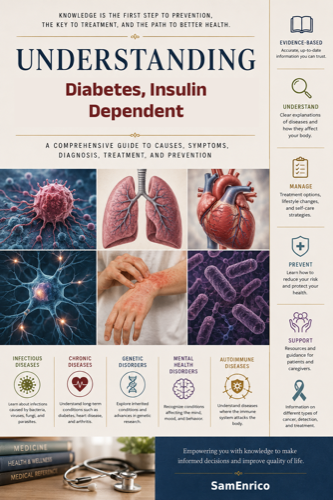 Understanding Diabetes, Insulin DependentCastillo Rogelio$17.99
 CTA Enforcement UpdateCastillo Rogelio$12.99
 Subsidiary Exemption CTACastillo Rogelio$12.99
 How to Start a Hobby in Jiu JitsuCastillo Rogelio$11.99
You may also like
 Hong Kong Handover 1997Dunn Johnnie$11.99
 Zumba For Postnatal Recovery CourseNeal Christian$11.99
 Zumba for BeginnersLadner Nikia$11.99
 YouTube Comment Mining GuideHumes Pandora$12.99
 Worry Box MeditationCarlin Rudy$11.99
 Workplace Stress MeditationNguyen Lynn$11.99
 Workplace Stress and Sleep RepairHawley Ivory$11.99
 Workplace Perfectionism CureDelaney Jeffry$11.99
 Workplace Injustice Anger GuideWallen Isabelle$11.99
 Work Addiction and Burnout LinkGreenwood Ester$11.99
 Women in Yoga and WellnessBeattie Galina$11.99
 Women in Stand Up ComedyChun Evangeline$11.99