
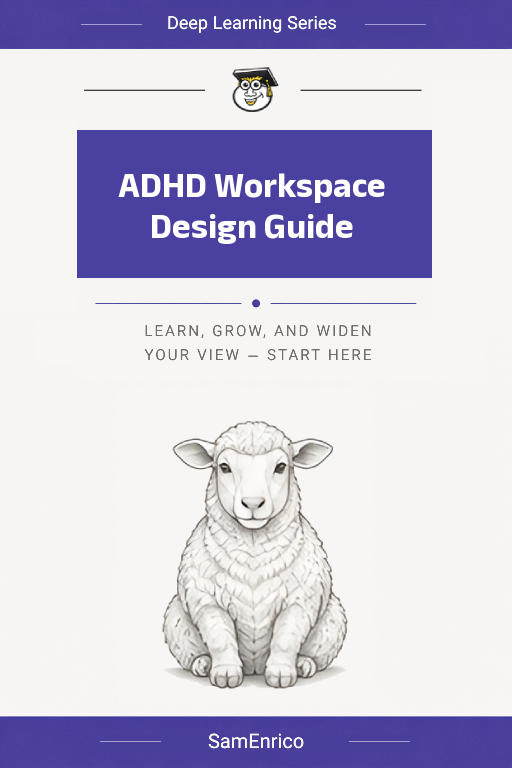
Non-FictionMental WealthNeurodivergent ToolsMindset Blueprint
ADHD Workspace Design Guide eBook
Arrange your desk, screen, and tools to reduce dis
by Kolb Rutha
Arrange your desk, screen, and tools to reduce distractions and trigger focus. Covers dual monitor management, notification elimination, and visual noise reduction for open offices.
Formats
Free sample
Chapter 1: The Distraction Autopsy--–- You are not lazy. You are not undisciplined. And you are definitely not broken.But somewhere between the moment you sat down to work and now—whatever “now” means for you, whether it’s fifteen minutes ago or three hours ago—something happened. Your attention left the building. It didn't storm out dramatically.
It just... drifted. A notification buzzed. Your eyes caught movement across the room. A thought about laundry appeared from nowhere.
Then another thought about that email you should have sent yesterday. Then a quick check of the news. Then a Wikipedia article about the history of the paperclip. Then shame.That last part—the shame—is the real productivity killer. Not the distraction itself.
The spiral that follows.Most ADHD advice starts with solutions. "Buy this timer." "Use this app." "Try this planner." But here’s what those books don’t tell you: if you don't understand exactly how your attention derailed in the first place, you’ll just end up with a very organized desk and the same scattered brain sitting behind it.This chapter is different. Before you move a single object on your desk, before you change a single setting on your computer, before you buy anything—you are going to perform a distraction autopsy.Yes, autopsy. Like a medical examiner, you are going to open up your last failed work session and identify exactly what killed your focus. Not in a shameful, self-flagellating way.
In a cold, curious, forensic way. Because you cannot design a workspace that works for your ADHD brain until you know what that brain is actually fighting.Why Willpower Is a Trap (And Why You Keep Falling Into It)Let’s name the elephant in the room right now. Every ADHD adult has been told, at some point, some version of “Just focus.” “Just try harder.” “Just ignore the distractions.” As if attention were a muscle you could flex harder, and your failure to do so was simply a lack of effort.That advice is not just unhelpful. It’s actively harmful.Here’s what the research—and the lived experience of millions of ADHD adults—actually shows: willpower is a limited, unreliable, and exhaustible resource for everyone. For the ADHD brain, it’s even more fragile.
The prefrontal cortex, which governs executive functions like impulse control, sustained attention, and task initiation, operates differently in ADHD brains. It’s not that you have less willpower. It’s that your willpower burns faster, depletes more easily, and recovers more slowly.Think of willpower as matches. A neurotypical person might have a box of fifty matches to get through a workday. You have ten.
And every time you force yourself to ignore a distraction, you strike one of those matches. Every time you drag your attention back to your task, another match. Every time you suppress the urge to check your phone, another match. By 10:30 AM, your box is empty. Now you’re not fighting distractions with willpower anymore—you’re fighting them with nothing.
And shame rushes in to fill the gap.This is not a moral failure. It is a biological and environmental one.The only sustainable solution is not more willpower. It’s less friction. You don’t need to become a monk of concentration. You need to redesign your workspace so that distractions never reach your depleted willpower in the first place.
You need to build a cockpit, not a battlefield.But first, you need to know exactly what you’re fighting.The Four Distraction Villains Over the next week, you will track your attention. But before you do, let’s name the four categories of distraction that routinely hijack ADHD brains. Every single trigger you experience will fall into one of these four buckets.Villain 1: Visual Noise This is anything your eyes can see that is not your current task. Visual noise can be loud (a cluttered desk, a pile of unopened mail, fifteen browser tabs) or quiet (a single blinking cursor, a badge on your taskbar, a plant swaying in the breeze from the HVAC vent). The ADHD brain processes visual information differently than the neurotypical brain.
Where a neurotypical person might glance at a sticky note and ignore it, your brain registers it as relevant—every single time. The sticky note on the edge of your monitor isn't just sitting there. It is competing for your attention, constantly, at a low but persistent level. Over the course of a day, that low-level competition adds up to a significant cognitive tax.Villain 2: Auditory Intruders Sudden, intermittent sounds are uniquely disruptive to the ADHD brain. A consistent, predictable sound (a fan, brown noise, the hum of an HVAC system) can fade into the background.
But a sudden sneeze, a phone buzz, a conversation starting two desks away, a notification chime—these trigger an orientation response. Your brain stops what it’s doing and asks, “What was that? Do I need to pay attention to that?” By the time you’ve answered the question (you usually don’t), you’ve lost your flow. And regaining that flow takes an average of twenty-three minutes. Not seconds.
Minutes.Villain 3: Digital Quicksand This category includes everything on your screens that pulls you away from your intended task. It’s the infinite scroll of social media, the rabbit hole of recommended videos, the email inbox that never ends, the Slack channel with six unread threads, the browser tab you opened “just for a second” that is now a museum of fifteen open tabs. Digital quicksand is especially dangerous because it feels productive. You tell yourself you’re just checking something quickly. You tell yourself you’re multitasking.
But the research is unequivocal: the human brain cannot multitask. It can only task-switch, and each switch costs time, mental energy, and focus residue (the lingering thoughts from the previous task that continue to occupy working memory).Villain 4: Social Interruptions These come from other people—colleagues stopping by your desk, a teammate messaging you “quick question,” a family member walking into your home office. Social interruptions are the hardest to manage because they carry an emotional charge. Saying “not now” feels rude. Ignoring someone feels hostile.
And for many ADHD adults, the fear of social rejection makes them say “yes” to every interruption, even when they’re in the middle of deep work. The result is a workday that feels like being a pinball—pinging from one person’s request to another’s, never completing anything, and ending the day exhausted without knowing what you actually accomplished.The Shame Spiral: Your Real Enemy Before we move to the tracking exercise, we need to talk about what happens after distraction. Because the distraction itself is rarely the main problem. What happens next is.Here’s a typical sequence for an ADHD brain:Distraction arrives (a notification, a sound, a wandering thought).You follow it (usually without conscious choice—your attention is pulled before you can resist).You surface (minutes or hours later) and realize you’ve lost time.Shame arrives (“Why can’t I just focus? Everyone else can.
What’s wrong with me?”).Avoidance follows (you feel so bad about being off track that you don’t want to look at…
This is the end of the free sample. Get the eBook to keep going. Buy now
About this book
Details
- Author
- Kolb Rutha
- Publisher
- SamEnrico
- Language
- English
- Genre
- Non-Fiction, Mental Wealth, Neurodivergent Tools, Mindset Blueprint
- Released
- 2026-06-01
- Pages (approx.)
- 151
- Available as
- eBook, Audiobook

Read better in the ZLOADR app
Your eBooks on your phone or tablet. Sign in with your SamEnrico account and start reading.
More by Kolb Rutha
 Pinterest Perfect Life FallacyKolb Rutha$11.99
 Ben Franklin Influence MethodKolb Rutha$11.99
 Influencer Disclosure For FashionKolb Rutha$11.99
 Self Talk for Anger ManagementKolb Rutha$11.99
 Menopause Nutrition for Bone HealthKolb Rutha$11.99
 The Djinn’s Veiled Heart: A Love Forged in Smoke and SandKolb Rutha$11.99
 Understanding Job SyndromeKolb Rutha$17.99
 Venture Capital Regional GuideKolb Rutha$12.99
 Loan Documentation SpecialistKolb Rutha$11.99
 How to Become a Noodle-press OperatorKolb Rutha$11.99
You may also like
 Hong Kong Handover 1997Dunn Johnnie$11.99
 Zumba For Postnatal Recovery CourseNeal Christian$11.99
 Zumba for BeginnersLadner Nikia$11.99
 YouTube Comment Mining GuideHumes Pandora$12.99
 Worry Box MeditationCarlin Rudy$11.99
 Workplace Stress MeditationNguyen Lynn$11.99
 Workplace Stress and Sleep RepairHawley Ivory$11.99
 Workplace Perfectionism CureDelaney Jeffry$11.99
 Workplace Injustice Anger GuideWallen Isabelle$11.99
 Work Addiction and Burnout LinkGreenwood Ester$11.99
 Women in Yoga and WellnessBeattie Galina$11.99
 Women in Stand Up ComedyChun Evangeline$11.99