
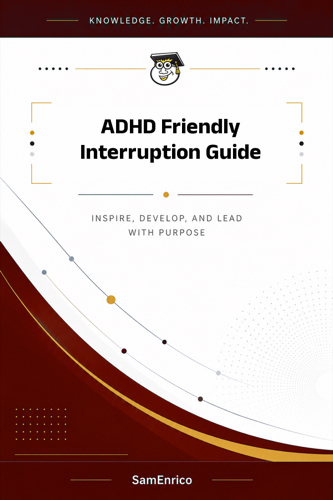
ADHD Friendly Interruption Guide eBook
Manage distractions when you have attention differ
by Card Sherie
Manage distractions when you have attention differences using this practical neurodivergent productivity handbook.
Formats
Free sample
Chapter 1: The Dopamine Detour...--–- You have been trying to fix the wrong problem.That is not an accusation. It is not a critique of your effort, your intelligence, or your character. It is simply the most important fact you will read in this entire book. For years—perhaps decades—you have been told that distraction is a habit to break, a weakness to strengthen, or a moral failing to overcome. You have been given planners that gather dust, apps that get deleted, and advice that sounds reasonable but leaves you feeling like a broken version of a normal person.
The reason none of it has worked is not because you haven't tried hard enough. It is because you have been fighting against the architecture of your own brain using tools designed for a different kind of mind.This chapter will dismantle that old framework and replace it with something that actually fits. You will learn why the ADHD brain does not respond to importance, consequence, or simple to-do lists the way neurotypical brains do. You will discover the concept of the Interest-Based Nervous System—a framework that explains almost every frustrating pattern in your work life. And you will begin to understand that what you have called "laziness," "procrastination," or "lack of discipline" is actually a predictable neurological response to a specific set of conditions.
By the end of this chapter, you will have permission to stop trying harder and start working smarter.The 9 AM Trap Let us begin with a scene that will feel uncomfortably familiar.It is 9:00 on a Tuesday morning. You have a deadline in three days. The project is important—not just for your job or your grades, but for your self-respect. You have been thinking about this deadline for weeks, carrying it around like a weight in your chest. Last night, you promised yourself that today would be different.
You set an alarm. You laid out your materials. You went to bed early.Now you are sitting at your desk. Your computer is open. The document is blank.
And somehow, impossibly, you are watching a video about how to build a custom bookshelf. Or you are reorganizing your spice rack by color. Or you have opened seventeen browser tabs, none of which have anything to do with the project. At 11:30 AM, you will look up, realize that two and a half hours have vanished, and feel a wave of shame so heavy it makes your chest tight. You will promise yourself that tomorrow will be different.
And tomorrow, the same thing will happen.This is not a character flaw. This is not laziness. This is the predictable result of asking an ADHD brain to perform a task that lacks the one thing it needs to engage.The Four Engines of Attention To understand why this keeps happening, you need to understand something that most productivity books get spectacularly wrong. They assume that all human brains are motivated by the same things: importance, consequences, and rewards. If a task matters, the thinking goes, you should be able to do it.
If there is a deadline, the pressure should push you to work. If there is a reward at the end, you should be able to delay gratification long enough to earn it.This assumption is false for approximately 5 to 8 percent of the population—the people with ADHD brains. And it is partially false for millions more who do not meet the full diagnostic criteria but still share the same neurological tendencies.The ADHD brain does not run on importance. It does not run on consequences. It does not even run on rewards, at least not in the way neurotypical brains process them.
Instead, the ADHD brain runs on a different fuel entirely: the Interest-Based Nervous System.This system has four triggers. Think of them as four different engines that can start the car of your attention. They are Challenge, Novelty, Urgency, and Interest. I will refer to them by the acronym CNUI (pronounced "see-new-eye"), which you can remember as the eyes through which your brain sees what matters.Challenge means the task feels like a game, a puzzle, or a competition. The ADHD brain lights up when there is a risk to be managed, a problem to solve, or a score to beat.
This is why some people with ADHD perform brilliantly in crisis situations but cannot fold their laundry. A pile of clothes has no challenge. A burning deadline has plenty.Novelty means the task is new, different, or unexpected. The ADHD brain is wired to seek out what is changing in the environment because that is where the evolutionary payoff lies. This is why you can spend four hours learning about a completely irrelevant topic that you just discovered.
It is new. Your brain rewards new. Old tasks—even important ones—get ignored.Urgency means the task has a ticking clock, a looming consequence, or a last-minute panic. The ADHD brain does not process "important but distant" as important at all. It only processes "important and on fire." This is why you cannot start the report until the night before it is due.
The urgency engine only engages when the deadline is close enough to feel real.Interest means the task is genuinely engaging to you as a person. This is the most obvious trigger, but also the most misunderstood. Interest is not the same as importance. You can know that filing your taxes is extremely important without feeling one shred of interest in it. The ADHD brain does not care about importance.
It cares about interest.Here is the brutal truth that every productivity book hides from you: if a task does not trigger at least one of these four engines, your brain will resist it the same way it resists touching a hot stove. Not because you are weak. Because the task does not meet the minimum activation requirements for your nervous system.Why Neurotypical Advice Backfires Now you can begin to see why the standard advice has failed you."Just make a to-do list." A to-do list is a catalog of tasks that lack Challenge, Novelty, Urgency, and Interest. Writing them down does not add CNUI. It just reminds you of all the things your brain is already ignoring.
This is why to-do lists often trigger paralysis instead of action. You are looking at a menu of food you do not want to eat."Break it into smaller steps." This advice is not wrong, but it is incomplete. Smaller steps often have even less CNUI than the original task. "Open the document" is less challenging, less novel, less urgent, and less interesting than "write the report." Breaking a task down can strip away what little activation energy the task had. The result is a list of tiny, boring actions that your brain has zero motivation to begin."Use the Pomodoro technique." A rigid timer that forces you to work for twenty-five minutes and then rest for five works beautifully for some brains.
For the ADHD brain, it often feels like being punished with a stopwatch. The timer creates a sense of external control that triggers resistance. Your brain rebels…
This is the end of the free sample. Get the eBook to keep going. Buy now
About this book
Details
- Author
- Card Sherie
- Publisher
- SamEnrico
- Language
- English
- Genre
- Non-Fiction, Self-Help, ADHD
- Released
- 2026-06-07
- Pages (approx.)
- 148
- Available as
- eBook, Audiobook

Read better in the ZLOADR app
Your eBooks on your phone or tablet. Sign in with your SamEnrico account and start reading.
More by Card Sherie
 Personal Ing For Success Career ChangersCard Sherie$11.99
 Food Addiction Recovery Meal Planning GuideCard Sherie$11.99
 Bedtime Self Hypnosis Sleep GuideCard Sherie$11.99
 Cortisol Detox Evening RoutineCard Sherie$11.99
 The Unseen Path: How Magellan's Crew Charted the Unknown in Central AsiaCard Sherie$11.99
 Boardroom Bloodbath: The Cutthroat Rise of the Monopoly TycoonCard Sherie$11.99
 Biometric Data Breach GuideCard Sherie$12.99
 Voiceover Feedback HandlingCard Sherie$12.99
 How to Start a Fat Splitting and Distilling Business (Beginners Guide)Card Sherie$11.99
 Understanding Ectrodactyly Dominant FormCard Sherie$17.99
 Editor In ChiefCard Sherie$11.99
You may also like
 Hong Kong Handover 1997Dunn Johnnie$11.99
 Zumba For Postnatal Recovery CourseNeal Christian$11.99
 Zumba for BeginnersLadner Nikia$11.99
 YouTube Comment Mining GuideHumes Pandora$12.99
 Worry Box MeditationCarlin Rudy$11.99
 Workplace Stress MeditationNguyen Lynn$11.99
 Workplace Stress and Sleep RepairHawley Ivory$11.99
 Workplace Perfectionism CureDelaney Jeffry$11.99
 Workplace Injustice Anger GuideWallen Isabelle$11.99
 Work Addiction and Burnout LinkGreenwood Ester$11.99
 Women in Yoga and WellnessBeattie Galina$11.99
 Women in Stand Up ComedyChun Evangeline$11.99