
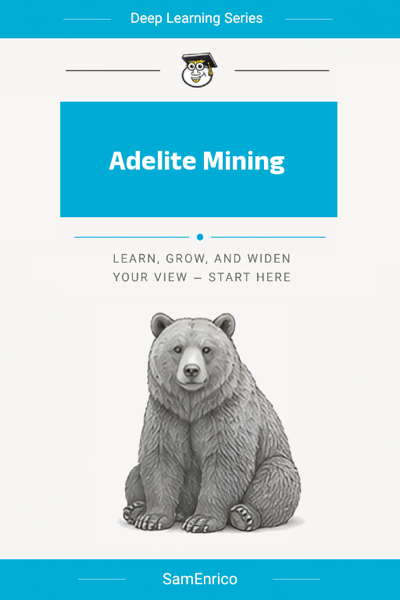
Non-FictionInformativeEducational
Adelite Mining eBook
A Coursebook on Adelite Mining
A Coursebook on Adelite Mining
Formats
Free sample
Chapter 1: The Arsenate Key--–- In the mining world, there is a quiet truth that separates those who build fortunes from those who lose them: knowing a mineral's chemical identity is not academic pedantry—it is survival. This book opens with that truth because Adelite has been misidentified, ignored, and mishandled by more exploration teams than any other mineral you will encounter. And that is precisely why understanding it now gives you an advantage that most professionals will never have.The story begins in the rugged Sierra Madre Occidental of Sonora, Mexico, where a junior exploration geologist named Elena Vasquez was logging drill core on a hot April afternoon. The core she held was beautiful—bands of dark green and brown, with flashes of copper oxide staining. Her X-ray fluorescence (XRF) gun had just returned a reading of 2.3% copper and 4.1 grams per tonne gold.
Her supervisor, a man with thirty years of experience in porphyry copper systems, glanced at the core and said four words that nearly cost the company eight million dollars: "That's just skarn waste."Elena looked again. The density felt wrong for typical skarn—heavier in her hand than garnet-dominant rock should be. She insisted on sending samples for full mineralogical analysis. The results came back: the dark green bands were not garnet at all. They were adelite, a calcium-magnesium arsenate that had been entirely overlooked in the company's geological model.
The "skarn waste" was actually a high-grade copper-gold-arsenate system that became the foundation of a producing mine.This chapter exists because Elena's story is not exceptional. It is repeated in exploration offices and mine sites around the world, sometimes with happy endings, often without. Adelite is what mineralogists call a "confuser mineral"—it looks like other minerals, it hides in plain sight, and its economic significance depends entirely on understanding what it actually is, not what it appears to be.The Definitive Identity: What Adelite Actually Is Let us settle the ambiguity immediately. Adelite is a rare arsenate mineral with the chemical formula Ca Mg(As O₄)(OH). It is never a silicate, never a sulfide, and never an oxide.
The confusion in some outdated textbooks comes from two sources: first, adelite sometimes occurs alongside silicate minerals in skarn environments; second, its physical appearance can mimic certain silicates. But the chemistry is unambiguous.The International Mineralogical Association (IMA) recognizes adelite as a member of the adelite-descloizite group, a family of arsenates and vanadates with similar crystal structures. Its unit cell is orthorhombic, meaning its crystal axes are at right angles but of different lengths, creating a distinctive prismatic habit when crystals are well-formed. In nature, well-formed adelite crystals are rare; more commonly, it appears as massive aggregates, granular masses, or as coatings on fracture surfaces in skarn deposits.Let us put numbers to these properties because numbers are what separate ore from waste:Hardness: 5 on the Mohs scale. This is softer than quartz (7), harder than calcite (3), and roughly equivalent to apatite.
Practically, this means adelite will scratch a steel pocketknife blade (hardness ~5.5) with difficulty, and will be scratched by quartz. In drilling, adelite-bearing zones tend to have moderate penetration rates—faster than hard quartzites, slower than soft clay-altered rocks.Specific gravity: 3.73. This is the number that saved Elena's project. Compare it to common gangue minerals: quartz (2.65), calcite (2.71), dolomite (2.85), and even garnet (3.5–4.2, but typically around 3.7 for the grossular-andradite series common in skarns). Adelite's density is at the high end of the garnet range, which means it feels "heavy" but not dramatically so.
The practical implication, which we will return to in Chapter 8, is that gravity separation is possible but not guaranteed; the density contrast with garnet may be as low as 0.2 specific gravity units, which is insufficient for most gravity circuits.Cleavage: Perfect on {101} and good on {010}. In plain English, adelite breaks along two preferred planes, creating splintery fragments. Under a hand lens, fresh fractures show a vitreous (glassy) to greasy luster. Weathered surfaces often become dull or earthy. This cleavage matters because it affects liberation—adelite tends to break along these planes during crushing, producing elongated or acicular particles that behave differently in flotation circuits than equant grains.Color: In its pure form, adelite is colorless to white.
But pure adelite is almost never found in nature. Trace elements produce a spectrum: iron gives green to dark green shades; manganese produces pink to rose-red; cobalt creates deep blues. Most economic adelite occurrences are green to brownish-green, the color coming from iron substituting for magnesium in the crystal lattice. This color is a useful field indicator but cannot be relied upon for identification—many other minerals share these colors.Chemical reactivity: Here is where the confusion has cost the most money. Because adelite is an arsenate, not a sulfide, it does not respond to standard xanthate collectors in flotation (Chapter 9).
Because it is not a silicate, it does not respond to hydrofluoric acid digestion. Because it is not a simple oxide, it does not readily dissolve in sulfuric acid or cyanide solutions (Chapter 10). The arsenate ion (As O₄³⁻) is chemically stable under neutral and mildly acidic conditions. Breaking that bond requires either highly alkaline conditions (sodium hydroxide) or reductive roasting. Companies that have assumed adelite behaves like copper sulfide have built flotation plants that never worked.
Companies that assumed it leaches like copper oxide have spent millions on acid that dissolved nothing.The System Concept: Specimen vs. Orebody A beautiful mineral specimen of adelite might be worth fifty dollars to a collector. An adelite orebody capable of supporting a mine is worth—depending on grade, tonnage, and metal prices—hundreds of millions of dollars. The difference is not in the mineral itself but in what mining engineers call the "system concept": the understanding that an orebody is not just a concentration of a valuable mineral but a three-dimensional body with specific geometric, grade, and geotechnical properties that make extraction economically viable.Let us define the terms that will echo through every chapter of this book:Cutoff grade is the minimum grade at which a tonne of ore can be extracted, processed, and sold at a profit. Not a nickel less.
If the grade falls below cutoff, that tonne remains in the ground—it is not ore, it is waste. Cutoff grade is not a fixed number handed down by geology; it is a dynamic calculation that changes with metal prices, operating costs, and recovery rates. In Chapter 6, you will learn to recalculate cutoff grade as these variables change. For now, understand this: a deposit that is economic at $4.00 copper may be worthless at $3.00 copper. That is not theory; it is the difference between a producing mine and an abandoned project.Dilution is waste material that becomes mixed with ore during mining.
In an open pit, dilution might come from overbreaking the pit wall or from including low-grade rock at the ore contact. In underground mining, dilution comes from sloughing of the back or from including waste between narrow veins. Dilution matters because every tonne sent to the mill must be paid for—crushed, ground, processed—whether it contains value or not. A mine with 20% dilution is paying to process 1.2 tonnes for every tonne of ore it thought…
This is the end of the free sample. Get the eBook to keep going. Buy now
About this book
Details
- Author
- Duckworth Eulalia
- Publisher
- SamEnrico
- Language
- English
- Genre
- Non-Fiction, Informative, Educational
- Released
- 2026-06-02
- Pages (approx.)
- 131
- Available as
- eBook, Audiobook

Read better in the ZLOADR app
Your eBooks on your phone or tablet. Sign in with your SamEnrico account and start reading.
More by Duckworth Eulalia
 Yoga Nidra for AnxietyDuckworth Eulalia$11.99
 The Underdog InventorDuckworth Eulalia$11.99
 The Assertiveness for Chefs GuideDuckworth Eulalia$11.99
 The Postpartum Wound Healing GuideDuckworth Eulalia$11.99
 Performance Review AngerDuckworth Eulalia$11.99
 The Golden Voices of Axum: Africa's Forgotten Opera LegendsDuckworth Eulalia$11.99
 Kenyan Virtual Assistant Hiring GuideDuckworth Eulalia$12.99
 Food Delivery MapDuckworth Eulalia$12.99
 Understanding Phosphoglucomutase DeficiencyDuckworth Eulalia$17.99
 How to Start a Hobby in UltimateDuckworth Eulalia$11.99
You may also like
 Hong Kong Handover 1997Dunn Johnnie$11.99
 Zumba For Postnatal Recovery CourseNeal Christian$11.99
 Zumba for BeginnersLadner Nikia$11.99
 YouTube Comment Mining GuideHumes Pandora$12.99
 Worry Box MeditationCarlin Rudy$11.99
 Workplace Stress MeditationNguyen Lynn$11.99
 Workplace Stress and Sleep RepairHawley Ivory$11.99
 Workplace Perfectionism CureDelaney Jeffry$11.99
 Workplace Injustice Anger GuideWallen Isabelle$11.99
 Work Addiction and Burnout LinkGreenwood Ester$11.99
 Women in Yoga and WellnessBeattie Galina$11.99
 Women in Stand Up ComedyChun Evangeline$11.99