
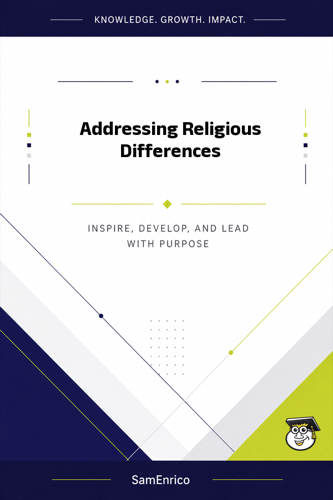
Addressing Religious Differences eBook
Teaches navigating interfaith relationships and ho
Teaches navigating interfaith relationships and holiday conflicts.
Formats
Free sample
Chapter 1: The Baggage We Carry--–- Every interfaith relationship begins with a lie. Not a malicious lie, not even a conscious one, but a lie nonetheless. The lie is this: My faith is just about God. The truth, which this chapter will unpack, is far messier. Your religion—or your rejection of religion—is also about your mother's approval, your grandmother's kitchen, your childhood fears of hell, your cultural pride, your political tribe, and a hundred other threads you have never bothered to untangle.
Until you do, you are not bringing faith into your relationship. You are bringing a suitcase full of unexploded ordnance.If you are reading this book, you are likely in love with someone who prays differently than you do—or does not pray at all. You may be convinced that love conquers all, that your connection is strong enough to paper over any difference. And you may be right. But love alone does not navigate the December Dilemma, or explain to your mother why her grandchildren will not be baptized, or sit shiva with you when your father dies.
Love is the engine. What you are about to build in this chapter is the map.The entire premise of The Third Path rests on a single, non-negotiable starting point: you cannot navigate someone else's religious landscape until you have surveyed your own. Most interfaith couples spend years arguing about the other person's traditions while remaining willfully ignorant of their own unconscious commitments. A Catholic who insists on infant baptism but has not been to Mass in a decade is not arguing about theology. She is arguing about belonging.
A Jew who demands a bris but never lights Shabbat candles is not arguing about covenant. He is arguing about his father's ghost. A Muslim who insists on halal but prays only on Eid is not arguing about divine law. She is arguing about identity.This chapter is an archaeological dig. We are going to excavate your religious baggage—piece by piece, layer by layer—until you can hold each item in the light and say, This belongs to my family, not to my soul, or This is non-negotiable, or I have never examined this until now.
Only then can you enter the conversations in Chapters 3 and 4 without destroying what you are trying to build. Only then can you co-create the Third Path that honors both of you without erasing either of you.Part One: The Difference Between Spirituality and Religious Identity Let us begin with a distinction that sounds academic but will save your relationship. Spirituality is what you actually believe about the nature of existence, the divine, and your place in the cosmos when no one is watching. Religious identity is the tribe you belong to—its rituals, holidays, dietary rules, and social expectations. These two things often overlap, but they are not the same.
And conflating them is the first mistake interfaith couples make.Consider David, a lapsed Catholic who married a practicing Muslim woman named Aisha. When asked about his spirituality, David said, "I don't really believe in a personal God. I think there's something bigger than us—maybe just the universe, maybe a kind of energy. I don't know." When asked about his religious identity, he said, "I'm Catholic. I was born Catholic, I was baptized Catholic, my whole family is Catholic.
I'll always be Catholic." Notice the contradiction: he does not believe Catholic theology, but he claims Catholic identity. This is not hypocrisy. It is the normal, human messiness of religious inheritance.Aisha, by contrast, had a tight alignment between her spirituality and her religious identity. She believed in Allah, the prophethood of Muhammad, the five pillars, and the Quran as revealed text. Her private prayers matched her public practices.
When David and Aisha argued about raising children, David said, "I don't even believe in God, so why would we do Muslim prayers?" He was speaking from spirituality. Aisha heard, "You are abandoning your identity." They were speaking different languages.The solution, which you will practice in this chapter, is to map your own territory before negotiating theirs. Using the journaling exercise at the end of this chapter, you will answer two separate questions:Spiritual Inventory: What do I actually believe about God, the afterlife, prayer, sin, and salvation? (Answer this as if no one will ever see it.)Identity Inventory: What community do I belong to? What rituals would I miss if they disappeared?
What would my parents say I am? What would I say I am at a doctor's intake form?For most people, these two lists are not identical. That is not a problem to be solved. It is data to be used. When you know where you are flexible (spiritually) and where you are attached (tribally), you can negotiate with your partner from a place of honesty rather than confusion.Part Two: The Origins of Religious Baggage Why do seemingly rational adults burst into tears over a Christmas tree?
Why does a grown man who never attends synagogue feel visceral rage when his partner suggests a baptism? The answer lies in the difference between chosen and inherited religion.Chosen religion is the faith you adopt as an adult after study, reflection, and conversion. It tends to be theological, intellectual, and flexible because you chose it freely. Inherited religion is the faith you were born into—whether you practice it or not. It is wrapped in childhood memories, family holidays, ancestral trauma, and the gravitational pull of "what we do." Inherited religion is almost never theological.
It is emotional. And it is far more powerful.Consider the following sources of inherited religious baggage, drawn from decades of interfaith counseling:The Grandparent Factor. Many people who are indifferent to their own religious practice become ferocious when a grandchild is involved. Why? Because grandparents carry the weight of continuity.
A Jewish grandmother who never kept kosher may demand a bris because her grandmother survived the Holocaust by clinging to Jewish identity. A Catholic grandfather who has not confessed in fifty years may insist on baptism because his mother prayed the rosary for him every day. When you reject a ritual, you are not rejecting a theological proposition. You are rejecting a dead grandparent's tears. This is not irrational.
It is love in its most complicated form.The Persecution Trauma. Every major religion has a history of persecution, and that history lives in the body of its adherents. For Jews, the memory of the Spanish Inquisition, the pogroms, and the Holocaust creates a zero-sum logic: if a child is not raised Jewish, Hitler wins. For Muslims in the West, post-9/11 surveillance and Islamophobia create a defensiveness around even moderate practice. For Armenians, the genocide memory inflects Christian identity.
For Irish Catholics, the long history of British oppression makes Protestantism feel not like another denomination but like the enemy. You may not personally feel this trauma. But your parents do. And your partner's family does. And if you dismiss it as "ancient history," you will lose.The Cultural-Secular Divide.
For many people, religious identity has nothing to do with God. A secular Jew who eats bacon on Yom Kippur will still light Hanukkah…
This is the end of the free sample. Get the eBook to keep going. Buy now
About this book
Details
- Author
- Hutchens Edyth
- Publisher
- SamEnrico
- Language
- English
- Genre
- Non-Fiction, Self-Help, Religion
- Released
- 2026-06-08
- Pages (approx.)
- 142
- Available as
- eBook, Audiobook

Read better in the ZLOADR app
Your eBooks on your phone or tablet. Sign in with your SamEnrico account and start reading.
More by Hutchens Edyth
 Financial Stress First Aid HandbookHutchens Edyth$11.99
 Multivariate Validation TestingHutchens Edyth$11.99
 MILD Lucid Dreaming ProtocolHutchens Edyth$11.99
 Thunberg Climate Strikes BookHutchens Edyth$11.99
 Orrin HatchHutchens Edyth$11.99
 Prevent Defense Caution GuideHutchens Edyth$11.99
 Hustle Culture RejectionHutchens Edyth$11.99
 Habit Cheat SheetHutchens Edyth$11.99
 The Silk Road Spice Masters: Jan Huyghen van Linschoten and the Secrets of the EastHutchens Edyth$11.99
 The Siege of Hara: The Last Stand of the HashashinHutchens Edyth$11.99
 The Dancer's Guide to PentozalisHutchens Edyth$11.99
 Quality Estimation and Rework HandbookHutchens Edyth$12.99
You may also like
 The Church Pew PostureMagee Migdalia$11.99
 Outsourcing for Church LeadersSpellman Rosalva$11.99
 Financial Stress for ClergyBisson Alane$11.99
 Navigating Religious DeconstructionCaruso Shavonda$11.99
 Assertiveness In Faith CommunitiesPatterson Abel$11.99
 Church Anger Triggers GuideLerma Shaquita$11.99
 Assertive Communication in Faith CommunitiesChong Major$11.99
 Small Talk for Religious GatheringsMayes Margo$11.99
 NVC for Religious GroupsBritt Lelah$11.99
 Chunking Bible Verses GuideHuff Danny$11.99
 The Religious Difficult TalkDailey Reed$11.99
 Letting Go of Religious GuiltBuss Maryam$11.99