
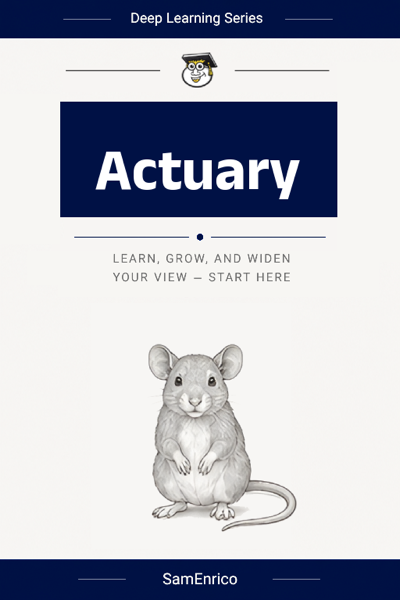
Non-FictionInformativeEducational
Actuary eBook
A Coursebook on Actuary
by Falkner Nyla
A Coursebook on Actuary
Formats
Free sample
Chapter 1: The Numbered Life--–- Every morning, before the first cup of coffee, before the email inbox floods with claims data and regulatory filings, an actuary somewhere makes a decision that will affect the financial security of ten thousand families. She does not wear a cape. She does not appear on television. She has never been the subject of a Hollywood biopic. But when a hurricane makes landfall in Florida, when a pandemic sweeps through a nursing home chain, when a factory explosion injures three dozen workers, her calculations determine whether those families receive a check or a denial letter.
Whether a pension fund survives or collapses. Whether an insurance company remains solvent or joins the graveyard of failed promises.This book is about that person. And more importantly, this book is about becoming that person.The actuary occupies a strange position in the modern economy. On one hand, the profession consistently ranks among the top jobs in America—high pay, low stress, excellent work-life balance, and near-zero unemployment. U.S.
News & World Report has repeatedly placed actuary in its top ten careers. The Bureau of Labor Statistics projects twenty percent growth over the next decade, faster than almost any other occupation. Starting salaries for newly credentialed actuaries regularly exceed six figures, and experienced fellows at major insurers earn multiples of that.On the other hand, most people cannot define the word. Ask a stranger on the street what an actuary does, and you will hear guesses involving accountants, auditors, or "something to do with insurance." The word itself sounds vaguely ceremonial, like a medieval guild title. Actuaries know this.
They have learned to smile politely at cocktail parties when someone asks, "So you're like an accountant?" and then explain, for the hundredth time, that no, they are not accountants. They are something else entirely.They are the mathematicians of uncertainty. The architects of financial security. The people who look at a world full of random death, disease, disaster, and litigation, and find patterns in the chaos. They transform the terrifying unpredictability of individual life into the comforting predictability of aggregated statistics.
They answer questions that seem impossible: How much money should a life insurer set aside today to guarantee it can pay a death benefit to a thirty-year-old who might die at eighty-five? What premium should an auto insurer charge a teenage driver who has never had an accident but statistically will? How much capital must a health insurer hold to survive a pandemic that occurs once every hundred years?These are not academic exercises. When actuaries get these answers wrong, people lose their homes. Companies go bankrupt.
Retirees discover that their pensions have evaporated. When actuaries get them right, the economy hums along quietly, and no one notices. That is the paradox of the profession: success is invisible. When an actuary does her job perfectly, nothing dramatic happens. Premiums get paid.
Claims get processed. Retirees receive their monthly checks. The silence is the scorecard.But the silence has been broken repeatedly throughout history by actuarial failures. The Equitable Life scandal in the United Kingdom, where actuaries underestimated how many policyholders would exercise guaranteed annuity options, cost policyholders billions and nearly destroyed a two-hundred-year-old institution. The savings and loan crisis in the United States, where mismatched durations between assets and liabilities—a problem actuaries are trained to solve—led to a taxpayer bailout exceeding one hundred billion dollars.
The 2008 financial crisis, where insurance giant AIG sold credit default swaps without adequately capitalizing them, required a one hundred eighty billion dollar government rescue because the company's risk models were fatally flawed. In every case, the failure was not a failure of greed alone. It was a failure of mathematics. Someone misestimated a probability. Someone mispriced a risk.
Someone forgot that the future does not always resemble the past.This chapter begins the journey of understanding how actuaries prevent those failures. It establishes the foundational framework that will guide every subsequent chapter: the Actuarial Control Cycle. It introduces the two major professional bodies that credential actuaries—the Society of Actuaries (SOA) and the Casualty Actuarial Society (CAS)—and explains how their domains differ. It traces the history of the profession from seventeenth-century mortality tables to twenty-first-century climate models. And it ends with the ethical obligations that separate a good actuary from a dangerous one.
By the time you finish this chapter, you will understand not just what actuaries do, but why their work matters to every person who has ever bought insurance, saved for retirement, or worried about the future.The Birth of a Profession: From Graunt to Gompertz The story of actuarial science begins with a haberdasher. John Graunt, a London shopkeeper in the 1600s, had an unusual hobby: collecting and analyzing death records. In 1662, he published "Natural and Political Observations Made upon the Bills of Mortality," a pamphlet that changed the world. Graunt noticed patterns in the data. He observed that more boys than girls were born (a ratio of about fourteen to thirteen), that urban mortality exceeded rural mortality, and that plagues caused spikes that obscured underlying trends.
Most importantly, he constructed one of the first life tables—a systematic accounting of how many people survive from one age to the next.Graunt's life table was crude by modern standards. He had no sophisticated mathematics, no probability theory, no concept of statistical significance. But he had something more important: the insight that human mortality, while unpredictable for any individual, was remarkably stable for large groups. This is the first principle of actuarial science, and it remains the foundation of everything that follows. The Law of Large Numbers, formalized a century later by Jacob Bernoulli, states that as the number of independent observations increases, the sample mean converges to the population mean.
In insurance terms: while no one can predict whether a specific thirty-year-old will die in the next twelve months, an actuary can predict with extraordinary precision how many of ten thousand thirty-year-olds will die. The randomness averages out. The noise becomes signal.Graunt's work caught the attention of Edmond Halley—yes, the comet Halley—who published a more sophisticated life table in 1693 based on data from the city of Breslau (now Wroclaw, Poland). Halley's table included not just survival counts but mortality rates at each age, allowing users to calculate the probability that a person of a given age would survive to any other age. This was the first practical tool for pricing life annuities, and it launched the insurance industry.But the true father of actuarial science is James Dodson, a London mathematician who in 1762 founded the Equitable Life Assurance Society.
Dodson realized that previous insurers had made a fundamental error: they charged the same premium to all policyholders regardless of age. A twenty-year-old and a sixty-year-old paid the same amount for life insurance. This was not merely unfair; it was financially suicidal. Younger policyholders subsidized older ones until the older ones died, at which point the pool of younger policyholders shrank and premiums had to rise, driving away the healthy and leaving only the sick. This death spiral, known today as adverse selection, killed every insurer that ignored it.Dodson's innovation was to charge premiums based…
This is the end of the free sample. Get the eBook to keep going. Buy now
About this book
Details
- Author
- Falkner Nyla
- Publisher
- SamEnrico
- Language
- English
- Genre
- Non-Fiction, Informative, Educational
- Released
- 2026-06-02
- Pages (approx.)
- 145
- Available as
- eBook, Audiobook

Read better in the ZLOADR app
Your eBooks on your phone or tablet. Sign in with your SamEnrico account and start reading.
More by Falkner Nyla
 Child Protective Services StressFalkner Nyla$11.99
 The Ashes DividedFalkner Nyla$11.99
 NVC For Jealousy ResolutionFalkner Nyla$11.99
 Self Hypnosis for BurnoutFalkner Nyla$11.99
 Blood on the Bleachers: The Birth of Football Hooliganism in the Middle East (1920s-1940s)Falkner Nyla$11.99
 Rural Freemium Pricing GuideFalkner Nyla$12.99
 How to Produce Billiard Table Parts and AccessoriesFalkner Nyla$11.99
 Ultimate Handbook Guide to Cochabamba : (Bolivia) Travel GuideFalkner Nyla$11.99
You may also like
 Hong Kong Handover 1997Dunn Johnnie$11.99
 Zumba For Postnatal Recovery CourseNeal Christian$11.99
 Zumba for BeginnersLadner Nikia$11.99
 YouTube Comment Mining GuideHumes Pandora$12.99
 Worry Box MeditationCarlin Rudy$11.99
 Workplace Stress MeditationNguyen Lynn$11.99
 Workplace Stress and Sleep RepairHawley Ivory$11.99
 Workplace Perfectionism CureDelaney Jeffry$11.99
 Workplace Injustice Anger GuideWallen Isabelle$11.99
 Work Addiction and Burnout LinkGreenwood Ester$11.99
 Women in Yoga and WellnessBeattie Galina$11.99
 Women in Stand Up ComedyChun Evangeline$11.99