
Non-FictionSelf-HelpStudy Skills
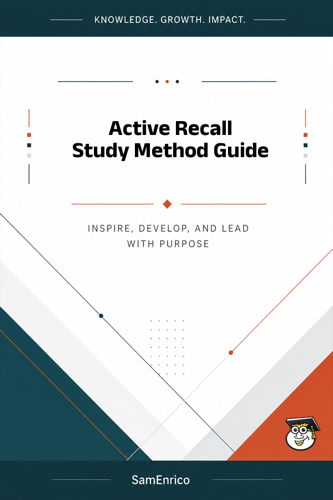
Active Recall Study Method Guide eBook
Teaches how to use active recall testing to double
Teaches how to use active recall testing to double retention compared to passive review.
Formats
Free sample
Chapter 1: The 4,000-Hour Lie--Imagine, for a moment, that you have just finished reading a chapter in your textbook. You read slowly, carefully. You used a yellow highlighter to mark what seemed important. You even went back and read your highlights a second time. When you closed the book, you felt that familiar sense of satisfaction—that comfortable hum of I know this now.
You turned the page and moved on.Now, cover this paragraph with your hand. Do not look at the text below. Out loud, answer this question: What are the three main problems with rereading as a study strategy?If you cannot answer that question immediately and completely, you have just experienced the central problem this entire book exists to solve. You read the information seconds ago. It felt familiar.
But you could not produce it. And if you cannot produce it, you do not yet know it.This is the illusion of competence—the single most destructive force in the life of a student. It is the reason millions of learners spend thousands of hours studying and still walk into exams feeling unprepared. It is the reason why highlighting feels productive but delivers almost nothing. It is the reason why re-reading is the most common study strategy in the world and also one of the least effective.This chapter will dismantle that illusion.
By the time you finish reading, you will understand why your current study habits are failing you, what the cognitive science of memory actually requires, and why the solution—active recall—will feel harder but work better than anything you have tried before.The Anatomy of a Broken Study Habit Let us begin with a simple experiment conducted by the psychologist Jeffrey Karpicke and his colleague Henry Roediger at Washington University in 2006. They took a group of students and gave them a passage to study. One group read the passage once. Another group read it three times. A third group read it once and then tested themselves on it once.When asked immediately after studying, the students who had read three times were the most confident.
They rated their learning as highest. They felt prepared. They had spent the most time with the material. Surely, they thought, that investment would pay off.One week later, they were tested for real. The results were devastating.
The students who had read three times remembered barely more than those who had read once. The extra two readings had produced almost no measurable benefit. Meanwhile, the students who had read once and tested once—who had spent the least time with the material—outperformed both groups by more than fifty percent.Let that land. Fifty percent more retention from less study time. The only difference was how they used that time.This is not an isolated finding.
In the decades since, dozens of studies have replicated this result across every subject imaginable: medical students learning anatomy, law students memorizing precedents, language learners acquiring vocabulary, pilots studying emergency procedures. In every case, the pattern holds. Passive review—re-reading, highlighting, summarizing, watching videos—creates high confidence but low retention. Active retrieval creates low confidence but high retention.The gap between how you feel about your learning and how much you have actually learned is the illusion of competence. And it is expensive.Why Highlighting Is Not Studying Let me be direct about something most study guides dance around: highlighting is not studying.
It is coloring.When you highlight a sentence, you are not encoding that sentence into memory. You are simply marking it for later. The physical act of moving a marker across a page feels productive because it requires effort and leaves a visible trace. But that trace exists on the page, not in your brain.Research on highlighting is remarkably consistent. In a comprehensive review of study strategies published in 2013, the psychologists John Dunlosky and his colleagues rated highlighting as having "low utility"—one of the lowest ratings possible.
Their analysis showed that highlighting produces negligible benefits for retention unless combined with something else, and even then, the highlighting itself adds almost nothing.Why? Because highlighting is a form of recognition. You look at a sentence and decide, "Yes, this seems important." But recognition is the shallowest form of memory. It requires only familiarity, not recall. You can recognize a face without remembering the person's name.
You can recognize a highlighted sentence without remembering what it means. Recognition feels like knowing. It is not.The students in Karpicke and Roediger's study who re-read three times were experiencing exactly this illusion. Each time they saw the passage, it became more familiar. That familiarity felt like learning.
But when asked to produce the information—to retrieve it without the text in front of them—they had nothing. Familiarity without retrieval is a ghost. It looks real until you try to touch it.The Two Systems of Memory To understand why active recall works and passive review fails, you need to understand a basic fact about how your brain processes information. You have two fundamentally different memory systems, and they operate almost entirely independently.The first system is recognition. This is handled by the perirhinal cortex, a region near the bottom of your temporal lobe.
Recognition is fast, automatic, and effortless. When you see a familiar face on the street, your recognition system fires instantly. You do not have to work at it. You just know that you have seen that person before. What you cannot always do is recall their name, where you met them, or what you talked about.
Recognition gives you a feeling of familiarity without any of the details.The second system is recall. This is handled by the hippocampus, a seahorse-shaped structure deep in your brain. Recall is slow, effortful, and demanding. It requires you to reconstruct information from scratch, like rebuilding a house from blueprints rather than just recognizing that you have seen the house before. When someone asks you a question and you have to search your memory for the answer, that is recall.
It burns energy. It takes time. It often fails. But when it succeeds, the memory is durable, detailed, and usable.Here is the critical point: Recognition does not strengthen recall. You can recognize a fact a hundred times and still be unable to recall it once.
The perirhinal cortex and the hippocampus are largely separate systems. Familiarity is not a stepping stone to memory. It is a detour.Every time you re-read a sentence, you are exercising recognition. Every time you highlight a passage, you are exercising recognition. Every time you watch a video and think "I got that," you are exercising recognition.
You are building the wrong system. You are becoming excellent at recognizing information you cannot produce.Active recall forces you to exercise the hippocampus. When you cover your notes and try to recite the answer from memory, you are doing the hard work of reconstruction. That work is exactly what builds durable memory. There is no shortcut.
There is no substitute. And there is no way to feel like you are learning while you are doing it, because the process is genuinely difficult.The Price of Passive Review…
This is the end of the free sample. Get the eBook to keep going. Buy now
About this book
Details
- Author
- Carder Kimbery
- Publisher
- SamEnrico
- Language
- English
- Genre
- Non-Fiction, Self-Help, Study Skills
- Released
- 2026-06-08
- Pages (approx.)
- 150
- Available as
- eBook, Audiobook

Read better in the ZLOADR app
Your eBooks on your phone or tablet. Sign in with your SamEnrico account and start reading.
More by Carder Kimbery
 Uberman Sleep ScheduleCarder Kimbery$11.99
 The Tech Tutor for SeniorsCarder Kimbery$11.99
 Name To Place AssociationCarder Kimbery$11.99
 Marriage Crisis Stress GuideCarder Kimbery$11.99
 Stop Buying For Future YouCarder Kimbery$11.99
 SMART Goals for FitnessCarder Kimbery$11.99
 Whispers of the Marid: The Djinn King’s Lost HeirCarder Kimbery$11.99
 The Cannons of Trafalgar: Nelson’s Gambit and the Fate of EmpiresCarder Kimbery$11.99
 How to Start a Cock Made of Wood Business (Beginners Guide)Carder Kimbery$11.99
 Service Providers Guide to MarinasCarder Kimbery$11.99
 A Collector's Handbook to the Lagonda 16-80Carder Kimbery$11.99
 Wise Business Export GuideCarder Kimbery$12.99
You may also like
 Hong Kong Handover 1997Dunn Johnnie$11.99
 Zumba For Postnatal Recovery CourseNeal Christian$11.99
 Zumba for BeginnersLadner Nikia$11.99
 YouTube Comment Mining GuideHumes Pandora$12.99
 Worry Box MeditationCarlin Rudy$11.99
 Workplace Stress MeditationNguyen Lynn$11.99
 Workplace Stress and Sleep RepairHawley Ivory$11.99
 Workplace Perfectionism CureDelaney Jeffry$11.99
 Workplace Injustice Anger GuideWallen Isabelle$11.99
 Work Addiction and Burnout LinkGreenwood Ester$11.99
 Women in Yoga and WellnessBeattie Galina$11.99
 Women in Stand Up ComedyChun Evangeline$11.99