
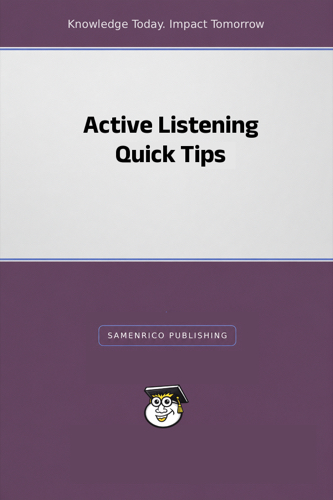
Active Listening Quick Tips eBook
Master five minute micro practices for immediate l
by Meeker Marya
Master five minute micro practices for immediate listening improvement.
Formats
Free sample
Chapter 1: The Listening Debt--–- My wife once told me she felt like a ghost in our own kitchen. She had been standing three feet away, telling me about a health scare involving her mother. I nodded. I said “uh-huh.” I was also scrolling through my phone, planning what to say next about a work deadline that felt, in that moment, more urgent than anything else in the world. Three days later, I asked her how her mother was doing.
She looked at me with an expression I had never seen before—not anger, not sadness, but a quiet, exhausted resignation. “I told you,” she said. “She’s fine. You weren’t listening.” She was right. I wasn’t.
And worse, I hadn’t even noticed I wasn’t listening. I had performed listening while actually doing something else. That performance cost me more than I understood at the time. It cost her the belief that I was someone she could turn to in a moment of fear. That is the hidden cost of pretending to listen.
And it is everywhere.The Statistic That Should Terrify You Let me start with a number that should unsettle you as much as it unsettled me when I first encountered it. Human beings forget up to seventy-five percent of what they hear within minutes of hearing it. Let that land. You retain, at best, one quarter of any conversation that lasts longer than a few minutes. If someone speaks to you for ten minutes, you will remember less than two and a half minutes of what they said.
The rest evaporates like morning fog.But the problem is actually worse than the forgetting. The real damage is not in the forgetting itself—it is that the person speaking to you notices that you forgot. And when they notice, something inside them shifts. They stop trusting you with important information. They stop bringing you early warnings.
They stop sharing their fears, their half-formed ideas, their vulnerable questions. They learn to protect themselves by giving you only what you need to know in that moment, nothing more. Over time, you become the last person to hear bad news, not the first. That is not a communication problem. That is a relationship failure masquerading as a skill gap.Research in organizational psychology has quantified this.
We spend forty-five percent of our communication time listening—nearly half of every workday, every family dinner, every friendship. Yet studies consistently show that people retain less than half of a ten-minute message. The gap between what is said and what is heard is not a small margin of error. It is a chasm.Consider what this means for a typical workday. You attend a thirty-minute meeting.
In that meeting, decisions are made, action items are assigned, deadlines are set. By the time you walk back to your desk, you have already forgotten nearly twenty-two minutes of what was discussed. By the time you sit down to work, you are operating on a fragmented, incomplete version of reality. You send follow-up emails asking for clarification. You misinterpret instructions.
You miss nuance. You make mistakes that require rework. Then you have another meeting to clean up the confusion from the first meeting. This is not inefficiency. This is listening debt.The Concept of Listening Debt Listening debt is the accumulated cost of every conversation where you were present in body but absent in attention.
It is the interest that accrues on unpaid listening—the misunderstandings that multiply, the resentments that compound, the trust that erodes one missed moment at a time.Think about the last time someone said to you, “I already told you that.” That phrase—so common, so seemingly harmless—is the sound of listening debt coming due. Someone gave you information. You did not truly receive it. Now they have to repeat themselves, and they are irritated about it. But the irritation is not about the repetition.
The irritation is about the message that their words were not important enough for you to hold onto.Listening debt shows up in predictable ways. Missed deadlines because someone did not hear a key requirement. Resentful team members who have stopped volunteering ideas because their last three suggestions were met with blank stares. Partners who have stopped sharing their inner lives because they have learned that “uh-huh” does not mean “I hear you,” it means “I am waiting for you to stop talking so I can say what I want to say.” Children who stop telling you about their day because you checked your phone one too many times while they were speaking.In leadership contexts, listening debt is even more costly. When leaders talk too much—and most leaders do—teams stop bringing early warnings.
They stop saying “I think we have a problem.” Instead, they wait for the problem to become undeniable. By then, it is often too late to prevent disaster. The 2008 financial crisis, the Challenger space shuttle disaster, the Volkswagen emissions scandal—all of these had moments where someone tried to raise a warning and was not truly heard. The listening debt was paid in lives and billions of dollars.This book exists because listening debt is not inevitable. It is reversible.
But reversing it requires more than good intentions. It requires a different model of skill development than the one most of us have been taught.Why One-Hour Workshops Don't Work You have probably attended a listening workshop before. It was likely two or three hours long, maybe a full day. There were role-playing exercises, handouts with bullet points, a video of a bad listener being contrasted with a good listener. You left feeling motivated.
You told yourself you would listen better. And then, by the next morning, you were right back to your old habits. The workshop changed nothing.This is not because you lack discipline or because the workshop was poorly designed. It is because human brains do not learn complex social skills through intensity. They learn through frequency.The science of habit formation has been studied extensively over the past two decades.
Researchers have found that the most reliable predictor of whether a behavior becomes automatic is not how long you practice in a single session. It is how many sessions you practice. Frequency trumps duration every time.Consider how you learned to type, or drive, or play an instrument. You did not become proficient by spending eight hours at a keyboard one day and then ignoring it for a month. You became proficient by practicing a little bit, every day or nearly every day.
Your brain built myelin—the fatty insulation around your nerve fibers—each time you repeated the movement. Over time, those neural pathways became faster and more reliable. The skill moved from conscious effort to unconscious competence.Listening is exactly the same. It is a motor skill of the mind. Each time you catch yourself planning a response instead of hearing the other person, and you gently return your attention to their words, you are building myelin.
Each time you resist the urge to interrupt, you are strengthening the neural circuit for response inhibition. Each time you repeat back what…
This is the end of the free sample. Get the eBook to keep going. Buy now
About this book
Details
- Author
- Meeker Marya
- Publisher
- SamEnrico
- Language
- English
- Genre
- Non-Fiction, Self-Help, Quick Tips, Micro Practice
- Released
- 2026-06-09
- Pages (approx.)
- 147
- Available as
- eBook, Audiobook

Read better in the ZLOADR app
Your eBooks on your phone or tablet. Sign in with your SamEnrico account and start reading.
More by Meeker Marya
 The Jealousy Management WorkbookMeeker Marya$11.99
 Envy FAQ GuideMeeker Marya$11.99
 TM for Near Death ExperiencesMeeker Marya$11.99
 Affirmations for Habit ChangeMeeker Marya$11.99
 The Winged Hussars: Poland's Thunder at Vienna (1683)Meeker Marya$11.99
 Understanding Torch SyndromeMeeker Marya$17.99
 How to Start a Canal Cruiser Business (Beginners Guide)Meeker Marya$11.99
 Factoring vs Bank Loans GuideMeeker Marya$12.99
 Trello Replaces Jira GuideMeeker Marya$12.99
 Staffing SpecialistMeeker Marya$11.99