
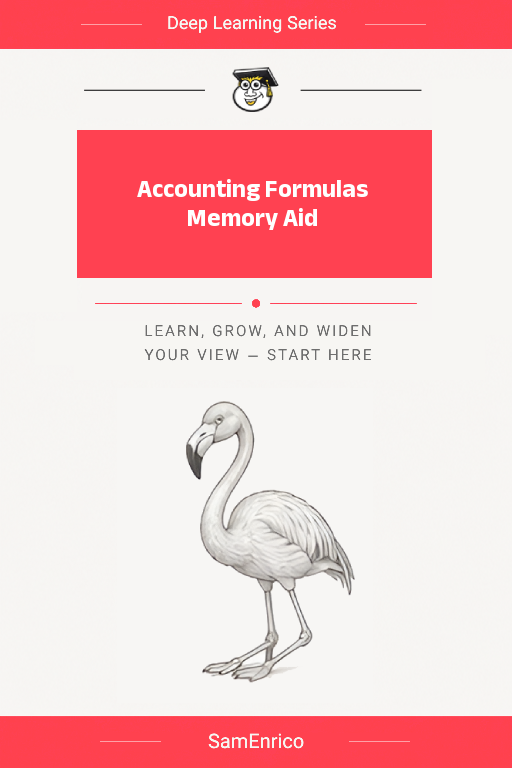
Non-FictionStudent's ShortcutMemory
Accounting Formulas Memory Aid
Use mnemonics and visual cues to remember key acco
Use mnemonics and visual cues to remember key accounting formulas for exams.
Formats
About this book
Free sample
Chapter 1: The Castle Wall...--–- Maria had been staring at the same practice exam for forty-seven minutes. She knew the company was profitable. She knew the balance sheet was supposed to balance. But when she added up the assets on her scratch paper, they refused to equal the liabilities plus equity—not by a small rounding error, but by nearly two million dollars. Her heart began to race.
Had she misread the question? Transposed a number? For the third time, she erased everything and started over, but the same sinking feeling returned: she had memorized the formula Assets = Liabilities + Equity like a mantra, but she had never truly seen it.This chapter exists to ensure that you never experience Maria’s panic. The fundamental accounting equation—Assets = Liabilities + Equity—is not merely a rule to recite. It is the gravitational center of every financial statement, the unbreakable foundation upon which all other formulas rest.
By the time you finish this chapter, you will not only remember the equation for the rest of your career, but you will also be able to visualize it, defend it, and use it to catch errors instinctively. You will build a Castle Wall in your mind that no exam stress can breach.The Forgetting Curve and Why Simple Repetition Fails Before we construct our mnemonic fortress, we must understand why most students forget the accounting equation within weeks of learning it. In the 1880s, German psychologist Hermann Ebbinghaus discovered what he called the Forgetting Curve: humans lose approximately 50% of newly learned information within one hour and up to 80% within 24 hours when they rely on passive repetition alone. This is why reading your textbook three times or chanting “A equals L plus OE” like a prayer produces such dismal results. Your brain is not designed to retain abstract symbols; it is designed to retain stories, images, and spatial relationships.Consider this: you can probably describe the layout of your childhood home in vivid detail—the color of the kitchen walls, the creaky floorboard in the hallway, the way the morning light came through the living…
This is the end of the free sample. Get the eBook to keep going. Buy now
Contents
- Chapter 1
- Chapter 2
- Chapter 3
- Chapter 4
- Chapter 5
- Chapter 6
- Chapter 7
- Chapter 8
- Chapter 9
- Chapter 10
- Chapter 11
- Chapter 12
Details
- Author
- Shipley Coralie
- Publisher
- SamEnrico
- Language
- English
- Genre
- Non-Fiction, Student's Shortcut, Memory
- Released
- 2026-05-30
- Pages (approx.)
- 152
- Available as
- eBook, Audiobook

Read better in the ZLOADR app
Your eBooks on your phone or tablet. Sign in with your SamEnrico account and start reading.
More by Shipley Coralie
 Uber EV Transition PlaybookShipley Coralie$11.99
 Nightmare Processing For BullyingShipley Coralie$11.99
 Emotional Regulation ResilienceShipley Coralie$11.99
 H1B To IPO JourneyShipley Coralie$11.99
 The Instant Self InductionShipley Coralie$11.99
 Podium Technique GuideShipley Coralie$11.99
 NamUs Long Term UnidentifiedShipley Coralie$11.99
 Mammogram GuideShipley Coralie$11.99
 The Golden Voices of Black Opera: Triumph on the World StageShipley Coralie$11.99
 Frozen Echoes of the Lost Expedition: The Vanishing of the *Franklin's Ghost*Shipley Coralie$11.99
 A Beginners Guide to Hexball (Volume 1)Shipley Coralie$11.99
 How to Produce Architecture MembraneShipley Coralie$11.99
You may also like
 Hong Kong Handover 1997Dunn Johnnie$11.99
 Zumba For Postnatal Recovery CourseNeal Christian$11.99
 Zumba for BeginnersLadner Nikia$11.99
 YouTube Comment Mining GuideHumes Pandora$12.99
 Worry Box MeditationCarlin Rudy$11.99
 Workplace Stress MeditationNguyen Lynn$11.99
 Workplace Stress and Sleep RepairHawley Ivory$11.99
 Workplace Perfectionism CureDelaney Jeffry$11.99
 Workplace Injustice Anger GuideWallen Isabelle$11.99
 Work Addiction and Burnout LinkGreenwood Ester$11.99
 Women in Yoga and WellnessBeattie Galina$11.99
 Women in Stand Up ComedyChun Evangeline$11.99