
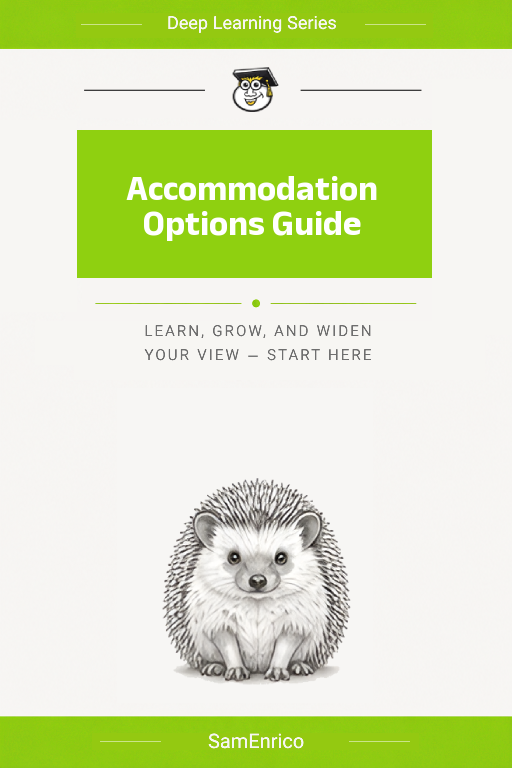
Accommodation Options Guide eBook
Compare university dorms (US), private halls (UK),
by Hogan Mike
Compare university dorms (US), private halls (UK), and shared apartments (Australia) for students.
Formats
Free sample
Chapter 1: The Housing Crossroads--– In the weeks after your university acceptance letter arrives, a question will surface that has nothing to do with academics but will shape your daily life more than any course selection. Where will you sleep, eat, and call home for the next year? The answer you choose affects your budget, your friendships, your commute, your privacy, and even your grades. Yet most students spend more time researching laptop models than they spend researching housing options. They compare processor speeds and screen resolutions for hours, but when it comes to where they will live for nine months—a decision that impacts every single day of their university experience—they make a rushed choice based on a single factor: price.
This book is designed to change that.Consider two students. Maria, from Brazil, chose the cheapest accommodation she could find near her university in Sydney: a share house advertised at AUD 180 per week. She saved money on rent but spent AUD 50 weekly on public transport, AUD 40 on utilities, and three hours each day commuting. She arrived to find no furniture in the common areas, a landlord who spoke only English (which she was still learning), and housemates who worked night shifts while she attended morning classes. By the end of her first semester, Maria was exhausted, isolated, and considering transferring to a different university.James, from India, chose the most expensive option he could find in London: a PBSA studio at £450 per week.
He loved the private kitchen, the en-suite bathroom, and the rooftop terrace. But he spent his first month alone in his studio, eating meals by himself, and struggling to meet other students. The social events organized by the PBSA building were infrequent, and his flatmates in the shared kitchen never seemed to be around when he was. By December, James had spent £11,700 on rent and had made exactly two friends. He regretted not choosing a cheaper, more social option.Priya, from Malaysia, used a framework.
She asked herself four questions before she even started looking at listings. How predictable does my budget need to be? How much privacy do I actually need? What is my tolerance for rules? How comfortable am I with administrative complexity?
Her answers led her to a UK PBSA en-suite room at £220 per week. She shared a kitchen with five flatmates, had her own bathroom, and lived a ten-minute walk from campus. She paid a predictable bill each month, made friends within the first week, and never missed a deadline because she was too tired from commuting. By the end of her first year, Priya had a 2:1 average, a close group of friends, and a clear plan for second-year housing.This book is the framework Priya used.Why This Comparison Matters Now The student accommodation landscape has transformed dramatically since the pandemic. Rents have risen by 8 to 10 percent annually in most major student cities since 2024, with further increases of 6 to 8 percent expected through 2026.
In London, weekly PBSA rents now range from £280 to £350. In Sydney and Melbourne, purpose-built student accommodation costs AUD 250 to AUD 500 per week. In major US cities, on-campus room and board packages exceed USD 18,000 per academic year at private universities.Beyond costs, the booking process has become more competitive than ever. University dormitories in the US and Australia often require applications submitted within days of receiving an offer. UK PBSA providers open bookings 10 to 12 months in advance, with early-bird rates saving students £15 to £25 per week.
Waiting until summer to decide means accepting whatever remains—typically the most expensive options in the least convenient locations.The pandemic also changed what students expect from housing. After years of lockdowns and remote learning, students are more aware of the importance of social connection, private space, and outdoor amenities. A room with a window that opens, a common area large enough to host friends, and a location near a park are no longer nice-to-haves; they are requirements for mental health. Accommodation providers have responded by adding gyms, study lounges, and social programming, but these amenities come at a cost. Understanding which amenities matter to you—and which you are paying for but will never use—is essential to making a smart choice.The Three Models Defined Before diving into detailed comparisons, this chapter establishes clear definitions of each accommodation type.
These definitions will be referenced throughout the book without being repeated in full.University Dorms (United States): University-owned and operated housing, typically located on or immediately adjacent to campus. First-year students are often required to live in dorms, which range from traditional shared rooms with floor bathrooms to suite-style configurations and apartment-style units for upperclassmen. Room and board packages bundle housing with meal plans, creating a single predictable bill. Annual costs for a nine-month academic year range from USD 12,000 to USD 18,000, which equates to USD 1,333 to USD 2,000 per month.The defining feature of US dorms is the mandatory meal plan. You do not cook; you eat in dining halls.
You do not grocery shop; you use meal swipes. For some students, this is liberating. For others, it is expensive and restrictive. The quality of dining hall food varies enormously between universities, and dietary restrictions can be difficult to accommodate. The meal plan also ties you to campus; you have already paid for your food, so eating off-campus feels like wasting money.The second defining feature is the resident advisor (RA) system.
RAs are upperclassman students who live on each floor, enforce rules, mediate conflicts, and organize social events. They are trained to support students through everything from roommate disagreements to mental health crises. For international students, RAs can be a lifeline—someone who speaks fluent English, understands university systems, and can connect you with resources. But RAs also enforce quiet hours, guest limits, and alcohol policies. If you value autonomy, the RA system may feel intrusive.Purpose-Built Student Accommodation (United Kingdom): Known as PBSA, these are professionally managed buildings designed specifically for students, operated by companies like Unite Students, i Q, and Scape.
Unlike US dorms, PBSA is not university-owned, though universities often maintain preferred provider lists. PBSA features all-inclusive billing: rent covers utilities, Wi-Fi, and contents insurance. Buildings offer 24/7 security and reception, study spaces, gyms, and social areas. Weekly costs range from £150 to £500 depending on city and room type, with 44 to 51-week contracts.The defining feature of PBSA is the "bills included" model. You pay one weekly amount, and everything except food is covered.
No electricity bills, no arguments about heating, no internet installation fees. This predictability is invaluable for international students who do not want to manage multiple utility accounts in a foreign country.The second defining feature is the range of room types. Standard rooms (shared bathroom, shared kitchen) are the most affordable and social. En-suite rooms (private bathroom, shared kitchen) balance privacy and community. Studios (private bathroom, private kitchen) offer complete independence.
Your choice among these three will determine your social experience, your privacy, and your cost.Notably, PBSA does not include food. You buy your own groceries and cook your own meals. For international students, this is a significant advantage over US dorms. You control your food budget, you cook what you want, and you accommodate your own dietary…
This is the end of the free sample. Get the eBook to keep going. Buy now
About this book
Details
- Author
- Hogan Mike
- Publisher
- SamEnrico
- Language
- English
- Genre
- Non-Fiction, Student's Shortcut, Housing
- Released
- 2026-05-30
- Pages (approx.)
- 138
- Available as
- eBook, Audiobook

Read better in the ZLOADR app
Your eBooks on your phone or tablet. Sign in with your SamEnrico account and start reading.
More by Hogan Mike
 Hip and Lower Back ReleaseHogan Mike$11.99
 Design Thinking for Mobile AppsHogan Mike$11.99
 Adult HeimlichHogan Mike$11.99
 Renal Failure Detox AdjustmentsHogan Mike$11.99
 Group Creativity JournalHogan Mike$11.99
 Metabolic Adaptation GuideHogan Mike$11.99
 Empathy in TherapyHogan Mike$11.99
 Remote Work for SalesHogan Mike$11.99
 The Great Wall of China: The Fortress That Defied TimeHogan Mike$11.99
 Ultimate Handbook Guide to Feira De Santana : (Brazil) Travel GuideHogan Mike$11.99
 How to Produce Toner and Inkjet Cartridge RefillsHogan Mike$11.99
 A Collector's Handbook to the Hillman Husky (1954-57)Hogan Mike$11.99
You may also like
 Student Housing Dubai GuideMoffett Lilia$11.99
 The German Student Accommodation GuideBenevides Liliana$11.99
 Student Accommodation TurkeyKincaid Isobel$12.99
 Rwanda Student Accommodation TipsDaugherty Krystyna$12.99
 Accommodation ComparisonTravis Flor$12.99
 Student Housing Argentina GuideBoland Lilian$12.99
 Accommodation for Students ChinaJoy Marna$12.99
 Student Accommodation Work GuideHendrick Jenifer$12.99
 Student Housing Brazil GuideRhodes Carmen$12.99