
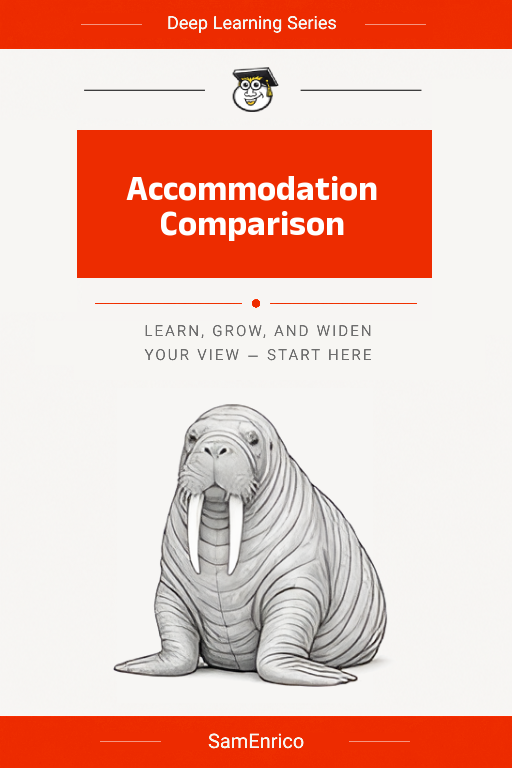
Accommodation Comparison eBook
Compare dorms, private rentals, and homestays incl
by Travis Flor
Compare dorms, private rentals, and homestays including costs and availability across countries.
Formats
Free sample
Chapter 1: The Bedroom Trap--–- The email arrived at 11:47 PM on a Tuesday. Sarah, a first-year international student from India, had just finished her third cup of coffee while staring at a microeconomics problem set she couldn't solve. The subject line read: "URGENT: Rent Increase Notice."She opened it. Her landlord, a man she had met exactly once, was raising her monthly rent by 400startingnextmonth.Notbecauseofinflation.Notbecauseofrepairs.Because,ashewrote,"themarketdemandsit."Sarahwasliving90minutesfromcampusinacrampedstudioshehadchosenbecauseitwas400 starting next month. Not because of inflation.
Not because of repairs. Because, as he wrote, "the market demands it." Sarah was living 90 minutes from campus in a cramped studio she had chosen because it was 400startingnextmonth.Notbecauseofinflation.Notbecauseofrepairs.Because,ashewrote,"themarketdemandsit."Sarahwasliving90minutesfromcampusinacrampedstudioshehadchosenbecauseitwas200 cheaper than anything near her university. She had signed a one-year lease without reading the break clause. She had no guarantor. She had no backup plan.Eight months later, Sarah withdrew from her program.
She had failed two classes, gained twenty pounds from gas-station food eaten on long commutes, and developed insomnia from the stress. She saved 1,600onrent.Shelost1,600 on rent. She lost 1,600onrent.Shelost15,000 in tuition for retaken courses, not to mention a year of her life.This book exists because Sarah's story is not unusual. It is, in fact, the rule.Every year, millions of students make the same catastrophic error. They obsess over tuition costs, university rankings, and course selections while treating housing as an afterthought.
They sort rental listings by "price: low to high" and congratulate themselves on finding a bargain. They sign leases without understanding break clauses, move into dorms without knowing their rights regarding Resident Assistants, or accept homestays without discussing curfew policies.And then their academic performance collapses. Their mental health deteriorates. Their savings evaporate through hidden costs they never anticipated.This chapter will prove a single, uncomfortable truth: where you live affects your grades, your money, and your sanity more than any other decision you will make as a student. By the end of these pages, you will understand why the cheapest rent is almost never the cheapest option, what the "Third Place" theory reveals about your study habits, and which of four student archetypes you belong to—a classification that will guide every housing decision in the chapters ahead.The Third Place Theory: Why Your Bedroom Is Not Neutral In 1989, sociologist Ray Oldenburg published a book called The Great Good Place.
In it, he introduced a concept that has since become foundational in urban planning, psychology, and—though Oldenburg never anticipated this—student housing. He called it the "Third Place" theory.The theory is deceptively simple. Humans need three distinct types of spaces to thrive:First Place: Home. This is where you rest, sleep, eat, and exist in private. It is your sanctuary.
When your first place is chaotic, loud, or unsafe, your baseline stress never decreases. You are always in survival mode.Second Place: Work or School. This is where you produce, learn, and perform. It is structured, goal-oriented, and often draining. When your second place is inaccessible—too far away, too expensive to reach, or too exhausting to commute to—you cannot perform at your potential.Third Place: Social Space.
This is where you connect with others outside of formal roles. Coffee shops, parks, dorm common rooms, shared kitchens, student lounges—these are third places. When you lack a third place, you become isolated. When your third place is also your first place (as in a studio apartment where you sleep, eat, and socialize in the same twelve square feet), you experience what psychologists call "role fusion," a known precursor to burnout.Here is what Oldenburg did not say, but what decades of subsequent research have proven: students who lack functional first, second, or third places do not simply feel uncomfortable. They fail.A 2018 study of 12,000 university students across five countries found that housing instability—defined as frequent moves, overcrowding, or unaffordable rent—was a stronger predictor of dropping out than low high school grades.
Another study, this one focused on community college students in the United States, found that students with commutes longer than sixty minutes were 40 percent more likely to withdraw from courses than students living within fifteen minutes of campus.Not because they were lazier. Not because they were less intelligent. Because they had no time to study, no energy to focus, and no social support system to catch them when they struggled.Your bedroom is not neutral. It is either accelerating your success or silently sabotaging it. There is no middle ground.The Cheapest Rent Fallacy: How "Saving Money" Costs You Everything Let us perform a thought experiment.Two students, Maria and James, are both starting university in the same city.
Both have a budget of $1,500 per month for all living expenses including rent, food, transportation, and utilities.Maria chooses the apartment with the lowest advertised rent: $600 per month. It is forty-five minutes from campus by bus. The neighborhood has no grocery store within walking distance. The apartment is an older building with electric heat and no air conditioning.James chooses an apartment with higher advertised rent: $900 per month. It is ten minutes from campus by bicycle.
The neighborhood has a supermarket two blocks away. The building is newer with better insulation and included utilities.Who comes out ahead financially? Most students would say Maria. She saves 300permonthonrent,or300 per month on rent, or 300permonthonrent,or3,600 per year. That is real money.But watch what happens when we calculate the true cost of living, a method we will develop in full detail in Chapter 3.
For now, consider these hidden expenses:Maria's Commute: Forty-five minutes each way, five days a week for classes, plus additional trips for study groups, library access, and social events. Minimum ten hours per week on a bus. At a conservative estimate of her time being worth 15perhour(theopportunitycostofnotstudyingorworking),thatis15 per hour (the opportunity cost of not studying or working), that is 15perhour(theopportunitycostofnotstudyingorworking),thatis150 per week, or 600permonthinlosttimevalue.Shealsopays600 per month in lost time value. She also pays 600permonthinlosttimevalue.Shealsopays120 per month for a bus pass.Maria's Food: No grocery store nearby means she either takes a thirty-minute bus to shop (adding to her commute burden) or buys from the convenience store on the corner, which marks up prices by an average of 40 percent. She spends 500permonthonfood.James,withasupermarkettwoblocksaway,spends500 per month on food.
James, with a supermarket two blocks away, spends 500permonthonfood.James,withasupermarkettwoblocksaway,spends350.Maria's Utilities: Electric heat in winter costs her an average of 150permonth.Noairconditioningmeansshespendsanother150 per month. No air conditioning means she spends another 150permonth.Noairconditioningmeansshespendsanother80 on fans and portable coolers in summer. James pays $0 for utilities.Maria's Social and Academic Costs: She misses study groups because the last bus leaves at 9 PM. She declines invitations to dinner because getting home would require an expensive rideshare. She has no energy after her commute to attend office hours or tutoring sessions.
Her grades suffer. She retakes one class at a cost of $1,500.Now add it up. Maria's "cheap" $600 apartment actually costs her:Expense Maria James Rent$600$900Transport$120 bus pass0(bicycle,one−time0 (bicycle, one-time 0(bicycle,one−time200 cost)Lost time value (commute)$600$0Food$500$350Utilities$230 avg$0Academic penalty (retaken class prorated)$125/mo$0Monthly Total$2,175$1,250Maria is spending nearly 1,000morepermonththan Jamesdespitepaying1,000 more per month than James despite paying…
This is the end of the free sample. Get the eBook to keep going. Buy now
About this book
Details
- Author
- Travis Flor
- Publisher
- SamEnrico
- Language
- English
- Genre
- Non-Fiction, Student's Shortcut, Housing
- Released
- 2026-06-01
- Pages (approx.)
- 158
- Available as
- eBook, Audiobook

Read better in the ZLOADR app
Your eBooks on your phone or tablet. Sign in with your SamEnrico account and start reading.
More by Travis Flor
 Emotional Spending Journal WorkbookTravis Flor$11.99
 Dream Character LogTravis Flor$11.99
 Values And Mission Alignment Communication GuideTravis Flor$11.99
 The Thirty Day ChallengeTravis Flor$11.99
 Binge Eating After Weight Loss SurgeryTravis Flor$11.99
 Riders of the Forgotten Trail: The Legend of Nat LoveTravis Flor$11.99
 The Iron Clipper and the African Dream: How a Merchant Prince Circumnavigated the ContinentTravis Flor$11.99
 Understanding Cone-rod DystrophyTravis Flor$17.99
 Mobile Money Integration GuideTravis Flor$12.99
 Industry Sales ManagerTravis Flor$11.99
 How to Start a Moulds Made of Silica Business (Beginners Guide)Travis Flor$11.99
You may also like
 Student Housing Dubai GuideMoffett Lilia$11.99
 The German Student Accommodation GuideBenevides Liliana$11.99
 Student Accommodation TurkeyKincaid Isobel$12.99
 Rwanda Student Accommodation TipsDaugherty Krystyna$12.99
 Student Housing Argentina GuideBoland Lilian$12.99
 Accommodation Options GuideHogan Mike$12.99
 Accommodation for Students ChinaJoy Marna$12.99
 Student Accommodation Work GuideHendrick Jenifer$12.99
 Student Housing Brazil GuideRhodes Carmen$12.99