
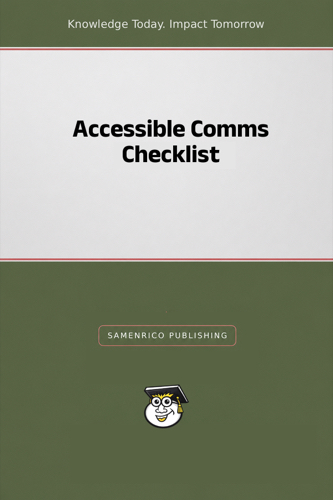
Non-FictionProfessional's Cheat SheetAccessibility
Accessible Comms Checklist eBook
Ensure messages work for employees with visual, he
by Tabor Glory
Ensure messages work for employees with visual, hearing, or cognitive disabilities.
Formats
Free sample
Chapter 1: The Silent Leavers--–- Every week, in offices, factories, and Zoom rooms across the country, employees with disabilities make a quiet calculation. Should I speak up about the fact that I cannot understand this meeting, read this document, or follow this video? Or should I stay silent, nod along, and spend my own time and energy filling in the gaps? Most choose silence. Some eventually choose the door.
This chapter reveals who these silent leavers are, why they never complained, and the single most powerful question that would have kept them.The Meeting That Cost a Company Its Best Engineer Let me tell you about a Wednesday afternoon in March. Not because it was unusual, but because it was utterly ordinary.A software company we will call Logix Soft held its weekly all-hands meeting. Three hundred employees attended over Zoom. The CEO shared quarterly results. The product lead demoed a new feature.
The HR director announced a wellness initiative. Standard stuff.In the virtual audience sat Marcus, a senior backend engineer. Marcus had been at Logix Soft for four years. His performance reviews were exceptional. His code was clean, his pull requests were thorough, and junior engineers sought him out for mentorship.
Marcus was also deaf.Marcus had never told anyone at Logix Soft that he was deaf.He had learned to cope. He used automated captions on Zoom, which were wrong about thirty percent of the time. He sat in the front row during in-person meetings and watched people's lips. He nodded when others laughed, even when he had missed the joke. He asked colleagues to repeat themselves in one-on-one conversations, playing it off as distraction or bad Wi-Fi.The Wednesday all-hands meeting was different.
The CEO spoke quickly, as he always did. The automated captions rendered "quarterly revenue growth" as "quarterly ravioli growth." They turned "strategic pivot" into "strategic picnic." By the fifteen-minute mark, Marcus had pieced together maybe half of what was said. By the thirty-minute mark, he had stopped trying.He closed his laptop, walked to the kitchen, and updated his Linked In profile to "open to work."Two weeks later, Marcus accepted an offer from a competitor. The offer included a thirty percent salary increase and, in the first bullet point of the offer letter, a promise: "We will provide CART captioning for all company meetings, at our expense, starting on day one."Marcus never complained to Logix Soft. He never asked for an accommodation.
He never filed a complaint with HR. He simply left.His manager was blindsided. "He never said anything," the manager told HR during the exit interview. "I thought everything was fine."Everything was not fine. Everything had never been fine.
Marcus had just become very, very good at pretending.Logix Soft spent $85,000 recruiting Marcus's replacement. They spent another $120,000 in lost productivity during the three-month gap between Marcus's departure and the new hire's ramp-up. They spent $15,000 on an external DEI audit that recommended, among other things, "implementing accessible communication practices."The audit did not mention that the entire problem could have been solved with a single question asked three years earlier.Marcus is what I call a silent leaver. He is not exceptional. He is the rule.The Scale of Silence: Who the Silent Leavers Are Let me give you a number that should shock you.
Between forty and seventy percent of disabled employees have never disclosed their disability to their employer. That range comes from multiple peer-reviewed studies, including research from the Job Accommodation Network, the Harvard Business Review, and the UK's Department for Work and Pensions.Let me restate that in plain language. In a company of one thousand employees, roughly two hundred have a disability that affects how they communicate, read, hear, or process information. Of those two hundred, between eighty and one hundred forty of them have never told anyone at work.They are not hiding because they are ashamed. They are not hiding because they are trying to deceive you.
They are hiding for reasons that are entirely rational given how workplaces tend to treat disability.Reason 1: Fear of being seen as less capable. Disabled employees consistently report that they fear disclosure will lead to being passed over for promotions, excluded from important projects, or subtly marginalized. This fear is not paranoia. Studies have found that disabled applicants who disclose during hiring are offered lower salaries than equally qualified nondisabled applicants.Reason 2: Past negative experiences. Most disabled adults have a story about a time they disclosed a need and were met with skepticism, dismissal, or outright hostility.
That story lives in their body. It shapes every future decision about whether to speak up.Reason 3: The energy cost of asking. Even in supportive environments, asking for an accommodation requires emotional labor. You have to explain something personal. You have to risk being misunderstood.
You have to follow up, remind, and advocate. For many disabled employees, the energy required to ask exceeds the energy required to simply cope.Reason 4: Not wanting to be "that person." This is the reason Marcus gave in his exit interview. "I didn't want to be the deaf guy who always needed something special. I just wanted to write code."Let me be very clear about what this means for you as a leader. When no one is complaining, it does not mean everything is working.
It means your employees have decided that silence is safer than speech. It means you have created a workplace where people would rather struggle in private than ask for help in public. It means you have silent leavers in your organization right now, and you do not know who they are.The Spectrum of Invisible Barriers Not all silent leavers are deaf or hard of hearing. The barriers that cause people to leave silently span all three disability categories this book addresses. Let me walk you through each one so you can recognize the patterns in your own organization.Visual Barriers: The Screen Reader That Never Spoke Jamila is blind.
She uses a screen reader to navigate her computer. Her employer uses a document management system that is not compatible with her screen reader. Every time she needs to access a policy document, a form, or a training manual, she has to ask a colleague to read it to her.She has asked for an accessible system twice. Both times, IT said they would "look into it." Both times, nothing changed. She stopped asking.Jamila has not left yet.
But she has stopped volunteering for projects that require accessing documents. She has stopped applying for internal roles that might require more document work. She has begun quietly updating her resume.She is a silent leaver in progress.Hearing Barriers: The Meeting That Happens Without You We already met Marcus. But let me introduce you to Aisha, who is hard of hearing. Aisha does not identify as deaf.
She has moderate hearing loss that makes it difficult to follow conversations with background noise, multiple speakers, or strong accents.Her team has a weekly meeting in an open-plan office with terrible acoustics. Three people dial in from other locations. Two people talk over each other constantly. Aisha understands about sixty…
This is the end of the free sample. Get the eBook to keep going. Buy now
About this book
Details
- Author
- Tabor Glory
- Publisher
- SamEnrico
- Language
- English
- Genre
- Non-Fiction, Professional's Cheat Sheet, Accessibility
- Released
- 2026-06-09
- Pages (approx.)
- 134
- Available as
- eBook, Audiobook

Read better in the ZLOADR app
Your eBooks on your phone or tablet. Sign in with your SamEnrico account and start reading.
More by Tabor Glory
 Volunteer Legacy GuideTabor Glory$11.99
 The Elderly Positive Body Image GuideTabor Glory$11.99
 Seated Cardio for SeniorsTabor Glory$11.99
 The MDD Suicide Risk GuideTabor Glory$11.99
 The Compass and the Cosmos: How the Portuguese Charted the SeasTabor Glory$11.99
 Understanding Spinocerebellar Atrophy Type 3Tabor Glory$17.99Understanding Spinocerebellar Atrophy Type 3Tabor Glory$17.99
 Section 2704 RegulationsTabor Glory$12.99
 Climate Risk Assessment GuideTabor Glory$12.99
 How to Become a Leaf TierTabor Glory$11.99
 Web3 Product and Community BusinessTabor Glory$11.99
You may also like
 Hong Kong Handover 1997Dunn Johnnie$11.99
 Zumba For Postnatal Recovery CourseNeal Christian$11.99
 Zumba for BeginnersLadner Nikia$11.99
 YouTube Comment Mining GuideHumes Pandora$12.99
 Worry Box MeditationCarlin Rudy$11.99
 Workplace Stress MeditationNguyen Lynn$11.99
 Workplace Stress and Sleep RepairHawley Ivory$11.99
 Workplace Perfectionism CureDelaney Jeffry$11.99
 Workplace Injustice Anger GuideWallen Isabelle$11.99
 Work Addiction and Burnout LinkGreenwood Ester$11.99
 Women in Yoga and WellnessBeattie Galina$11.99
 Women in Stand Up ComedyChun Evangeline$11.99