
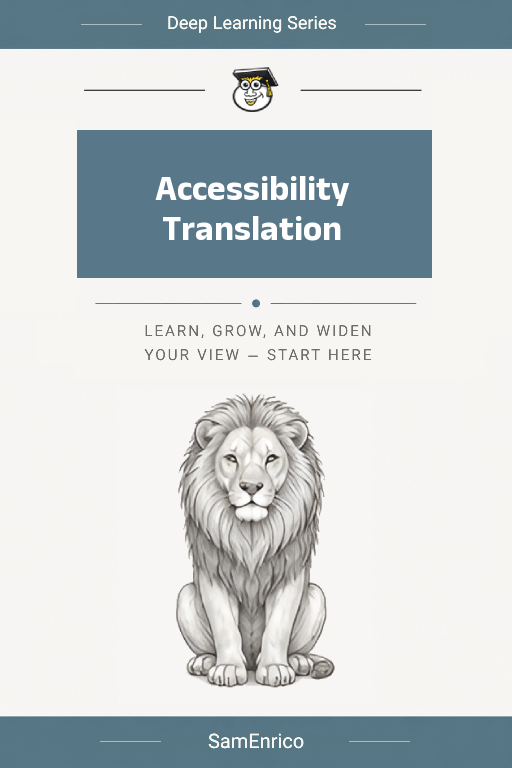
Accessibility Translation eBook
Generate alt text, captions, and screen reader con
Generate alt text, captions, and screen reader content using AI. Make visual and audio content accessible across 50+ languages automatically.
Formats
Free sample
Chapter 1: The Silent Screens...-- Maria's alarm clock buzzed at 6:15 AM on a Tuesday in April. She was already late. Her son, Mateo, needed to be at school by 7:30, and she had a shift at the hospital cafeteria starting at 8:00. The night before, her phone had pinged with a notification from the school district: a video message from the principal. Important update about bus schedules, the notification said.
Maria, who is deaf and speaks Spanish as her first language, clicked the video. It was three minutes long. The principal spoke in English. There were no captions. There was no Spanish translation.
Maria watched the man's lips move for thirty seconds, understood nothing, and went back to folding laundry.That morning, she and Mateo stood at the bus stop for twenty minutes. No bus came. Other parents walked past, some glancing at her phone as she frantically typed into Google Translate: Where is the bus? A neighbor finally explained: the district had consolidated routes. The new pickup point was six blocks away.
The video had contained a map. Maria couldn't read it. She walked Mateo to school, arrived at work forty minutes late, and received a written warning from her supervisor.This story is not hypothetical. It is a composite drawn from testimony submitted to the Department of Justice in 2023 as part of an Americans with Disabilities Act complaint filed by a coalition of deaf and hard-of-hearing Spanish-speaking parents in Texas. The complaint alleged that the school district's failure to provide accessible, translated video content constituted discrimination.
The district settled for $450,000 and agreed to overhaul its communication systems.Maria is not alone. She is one of approximately 1.3 billion people worldwide who live with a significant disability, according to the World Health Organization's 2022 Global Report on Health Equity for Persons with Disabilities. Of those, an estimated 466 million are deaf or hard of hearing, and 253 million are visually impaired. Separately, the linguistic landscape is equally staggering. According to Ethnologue's 2025 data, over 7,000 living languages are spoken globally, yet digital content is disproportionately concentrated in just a handful.
English accounts for approximately 60 percent of all web content, but only 16 percent of the world's population speaks English as a first language. Mandarin Chinese, Hindi, Spanish, and Arabic together represent nearly 3 billion native speakers, yet combined they account for less than 15 percent of indexed web content.Now consider the overlap. A deaf Spanish speaker. A blind Mandarin speaker. A person with cognitive disabilities who reads best in simplified Arabic.
These are not edge cases. They are the invisible majority—a population so large and so routinely excluded that their exclusion has become infrastructural. The World Bank estimates that excluding persons with disabilities from the digital economy costs low- and middle-income countries between 3 and 7 percent of their gross domestic product annually. That is not a moral statistic. It is an economic catastrophe dressed in silence.The Two Gaps That Became One For the past three decades, the fields of digital accessibility and language translation have evolved on parallel tracks, rarely intersecting.
Accessibility professionals focused on screen readers, captions, and alt text—almost always in English or whatever the dominant language of their country happened to be. Translation professionals focused on converting text from one language to another—almost always ignoring whether the output was accessible to a blind person using a screen reader or a deaf person reading captions.This separation created two distinct gaps.Gap One: Accessibility without Translation. A website might have perfect alt text for every image, flawless captions for every video, and semantic HTML that sings like a choir through any screen reader. But if that alt text and those captions are only in English, a Spanish-speaking blind user is still excluded. The accessibility exists.
The user cannot reach it because the language is wrong. This is like building a wheelchair ramp that leads to a door with a sign in a script the wheelchair user cannot read. The ramp is not the problem. The language is.Gap Two: Translation without Accessibility. A website might have every page meticulously translated into 50 languages by professional human translators.
The words are perfect. The idioms are localized. The cultural references land beautifully. But if the translated pages are missing alt text, if the captions are not synchronized, if the heading structure collapses in Arabic because the right-to-left CSS was not applied—then a blind user in Cairo or a deaf user in Jakarta is still excluded. The translation exists.
The accessibility does not.The central argument of this book is that these two gaps are not separate problems requiring separate solutions. They are the same problem. The name of that problem is inaccessibility in the user's language. The solution is what we will call, throughout these pages, accessibility translation—the practice of making digital content fully usable by people with disabilities in the language they speak, read, and understand best.Accessibility translation is not accessibility plus translation. It is accessibility through translation.
It is the recognition that alt text generated in English and then clumsily run through Google Translate is not alt text at all—it is a new kind of barrier. It is the recognition that captions translated without attention to timing, punctuation, and screen reader compatibility are not captions at all—they are visual noise.The Numbers That Demand Attention Let us put flesh on the bones of these abstractions. The global population of persons with disabilities is not a small, niche market. It is the third-largest country in the world, after China and India. The WHO's 2022 report broke down disability prevalence by type:466 million people with disabling hearing loss (over 5 percent of the global population)253 million people with visual impairment (over 3 percent)200 million people with intellectual or developmental disabilities (over 2.5 percent)Over 1 billion people with some form of disability when including mobility, cognitive, psychiatric, and multiple disabilities These numbers are not static.
They are growing. Aging populations mean more people acquire disabilities later in life. Long COVID has added an estimated 100 million people worldwide to the ranks of those with chronic illness and cognitive impairment. Environmental factors, from pollution to conflict, continue to increase disability prevalence in vulnerable regions.Now add language. According to the Unicode Consortium's 2025 Global Language Report:Over 7,000 languages are spoken in the world today Only 200 languages have significant digital presence (websites, apps, social media)Only 50 languages are supported by all major operating systems and screen readers Less than 10 languages account for over 80 percent of all digital content The language of digital content is not the language of the world.
It is the language of the privileged. English, Mandarin Chinese, Spanish, Arabic, French, German, Japanese, Portuguese, Russian, and Hindi—these ten languages cover a majority of internet users. But they leave behind hundreds of millions of speakers of Bengali, Punjabi, Javanese, Telugu, Marathi, Tamil, Urdu, Turkish, Vietnamese, Tagalog, and thousands more.The overlap between disability and linguistic marginalization is not theoretical. Disability rates are consistently higher in minority-language communities. A 2023 study in The Lancet found that children who speak a minority language at home are 40 percent more likely to be diagnosed with a developmental disability—not because of biological factors, but because of delayed identification due to language barriers in healthcare and…
This is the end of the free sample. Get the eBook to keep going. Buy now
About this book
Details
- Author
- Pfeifer Cathie
- Publisher
- SamEnrico
- Language
- English
- Genre
- Non-Fiction, AI Operator
- Released
- 2026-06-01
- Pages (approx.)
- 159
- Available as
- eBook, Audiobook

Read better in the ZLOADR app
Your eBooks on your phone or tablet. Sign in with your SamEnrico account and start reading.
More by Pfeifer Cathie
 Twelve Step Meetings for IntrovertsPfeifer Cathie$11.99
 Stress and PTSD in PartnerPfeifer Cathie$11.99
 DBT Skills for Long Term BalancePfeifer Cathie$11.99
 Body Scan for ADHD FocusPfeifer Cathie$11.99
 How to Start a Oil Platform Fabrication of Steel Plate Business (Beginners Guide)Pfeifer Cathie$11.99
 CartographyPfeifer Cathie$11.99
 How to Produce Antibacterial Body and Hand MoisturizerPfeifer Cathie$11.99
You may also like
 Hong Kong Handover 1997Dunn Johnnie$11.99
 Zumba For Postnatal Recovery CourseNeal Christian$11.99
 Zumba for BeginnersLadner Nikia$11.99
 YouTube Comment Mining GuideHumes Pandora$12.99
 Worry Box MeditationCarlin Rudy$11.99
 Workplace Stress MeditationNguyen Lynn$11.99
 Workplace Stress and Sleep RepairHawley Ivory$11.99
 Workplace Perfectionism CureDelaney Jeffry$11.99
 Workplace Injustice Anger GuideWallen Isabelle$11.99
 Work Addiction and Burnout LinkGreenwood Ester$11.99
 Women in Yoga and WellnessBeattie Galina$11.99
 Women in Stand Up ComedyChun Evangeline$11.99