
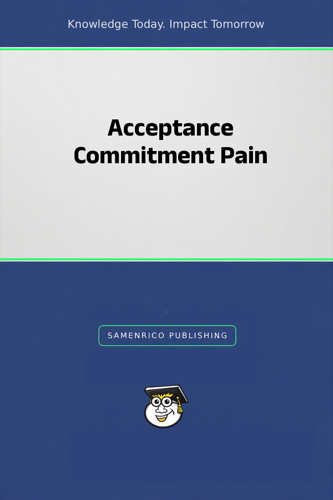
Acceptance Commitment Pain eBook
Accept pain sensations while committing to valued
Accept pain sensations while committing to valued living after PNE.
Formats
Free sample
Chapter 1: The Ghost in the Machine...--You have already done the hard part.You have sat through the diagrams. You have learned that pain is an output of the brain, not a measure of tissue damage. You have heard that your nerves are sensitized, that your danger alarm is stuck on "high," that your spine is structurally intact even though it feels like someone is driving a hot poker into your lower back every time you stand up. You have repeated these facts to skeptical family members, to confused doctors, and most of all to yourself, late at night, when the burning sensation refuses to let you sleep.And yet.The burning is still there. The stabbing.
The aching. The tingling that runs down your leg like an electrical wire shorting out. You know—intellectually, neuroscientifically, demonstrably—that you are not in danger. But your body does not seem to have received the memo.This is the gap that Pain Neuroscience Education has never fully been able to close. PNE is brilliant at explaining the why of chronic pain.
It liberates you from the terrifying belief that your body is crumbling. It gives you language and science to replace fear. But it does not, by itself, teach you what to do in the moment when the sensation arrives unbidden, unwelcome, and utterly convincing.You know the alarm is false. But the alarm is still ringing.This book is written for that exact moment. It is written for the person who has done the coursework of PNE and is now asking a more difficult question: If I know I am safe, why can't I live my life?The answer is not more education.
You do not need another diagram of the spinal cord or another explanation of central sensitization. You need a different set of skills—skills that bridge the gap between intellectual knowing and behavioral doing. You need an operating system that can run alongside PNE, translating its truths into daily action.That operating system is Acceptance and Commitment Therapy. And the bridge it builds is called psychological flexibility.The Frustration of the Educated Patient Let me describe someone I have met hundreds of times in clinical practice. Call her Maria.Maria completed a six-week PNE course with a physical therapist who specialized in chronic pain.
She learned that her brain had learned to produce pain in the absence of tissue damage—like a smoke alarm that goes off when you burn toast, not when the house is on fire. She stopped getting MRI scans. She stopped believing she needed surgery. She began to understand that her back pain was real but not dangerous.And yet.Maria still could not go grocery shopping. Every time she reached for a can on the top shelf, her back would "seize up"—not because she was damaging anything, but because her nervous system had learned, over years, that reaching equals threat.
She knew this intellectually. But knowing did not stop the flinch. Knowing did not stop the wave of anxiety that followed the sensation. Knowing did not stop her from abandoning her cart in the middle of aisle four and fleeing to her car.Maria is the "educated patient." She is not ignorant. She is not in denial.
She is not weak or lazy or catastrophizing in the way that term is often used dismissively. She is trapped in a body that learned a pattern long before her brain learned the science. And no amount of new information will automatically overwrite that pattern.This is the first truth of this book: Education changes what you know. Practice changes what you do.PNE gives you the map. But you still have to walk the territory.
And walking the territory means encountering the sensation again and again—not as a sign of damage, but as a remnant of an old, overprotective alarm system that has not yet recalibrated.The question is not whether the sensation will appear. It will. The question is what you will do when it does.Why Your Brain Refuses to Believe You To understand why PNE alone is not enough, you have to understand something fundamental about how the brain learns.The brain does not learn through reason alone. If it did, you would only need to hear something once for it to change your behavior forever. But you know from experience that this is not true.
You know that smoking is bad for you, yet millions of people smoke. You know that exercise is good for you, yet millions of people do not exercise. You know that your ex-partner is bad for you, yet you still think about calling them at 2 a.m.The brain learns through repetition and experience. Neural pathways that are used frequently become stronger, faster, and more automatic. This is neuroplasticity—the same process that allows you to learn a piano piece or a new language.
But neuroplasticity does not discriminate between helpful patterns and unhelpful ones. It simply strengthens whatever you practice.In the early days of your pain, the sensation was likely accompanied by genuine threat. Maybe you injured your back lifting something heavy. Maybe you had surgery. Maybe you developed a condition that genuinely required protection.
During that time, your brain was doing its job: it produced pain to get your attention, to make you rest, to prevent further damage.But then something changed. The tissue healed. The surgery succeeded. The acute condition resolved. But your brain—faithful, diligent, overachieving brain—continued to produce the same alarm signal.
Why? Because the pathway had been strengthened by months or years of use. It had become the default route. And your brain, being an efficiency machine, does not abandon a well-worn path just because a newer, more accurate map exists.This is why you can know you are safe and still feel afraid. This is why you can recite the neuroscience of pain and still flinch when you bend over.
The old pathway is not stupid. It is habitual.And habits do not disappear through knowledge alone. They disappear through new experiences that gradually build a competing pathway—a pathway that says, "I can move, and nothing bad happens."But how do you have that new experience when the very act of moving triggers the alarm? How do you build a new pathway when the old one screams so loudly?This is where ACT enters the picture.Introducing ACT: The Operating System for PNEIf PNE is the what—the science of why your pain persists—then ACT is the how—the practical skills for living well even when the pain does not disappear.Acceptance and Commitment Therapy is not about eliminating pain. It is not about thinking positive thoughts or pretending you feel fine.
It is not about distracting yourself until the sensation goes away. ACT is fundamentally about changing your relationship to the sensation.Here is the distinction that changes everything: Suffering is not the same as pain.Pain is the raw sensory signal—the burning, the stabbing, the aching. Suffering is everything you add on top of that signal: the fear, the resistance, the catastrophic thoughts, the avoidance, the struggle, the desperate fight to make it…
This is the end of the free sample. Get the eBook to keep going. Buy now
About this book
Details
- Author
- Noel Jackelyn
- Publisher
- SamEnrico
- Language
- English
- Genre
- Non-Fiction, Health & Wellness, ACT
- Released
- 2026-06-11
- Pages (approx.)
- 148
- Available as
- eBook, Audiobook

Read better in the ZLOADR app
Your eBooks on your phone or tablet. Sign in with your SamEnrico account and start reading.
More by Noel Jackelyn
 Sibling Fight Parental Anger GuideNoel Jackelyn$11.99
 Flexible Time Blocking HandbookNoel Jackelyn$11.99
 Brand Ranking Event ImpactNoel Jackelyn$11.99
 Titanium Dreams: The Forgotten Robots of Ancient GreeceNoel Jackelyn$11.99
 The Last Dance of the Red Baron: Aerial Legends and Lost TapesNoel Jackelyn$11.99
 How to Become a Chemical-engineering TechnicianNoel Jackelyn$11.99
 CompounderNoel Jackelyn$11.99
 Five Year Clean Energy ForecastNoel Jackelyn$12.99
 Interview Gap Story HandbookNoel Jackelyn$12.99
 Understanding Hyperinsulinism In Children, CongenitalNoel Jackelyn$17.99
You may also like
 IBS Acceptance Commitment TherapyChin Antionette$11.99
 ACT for Dysthymia GuideBrandon Jonnie$11.99
 Pain Acceptance GuideZimmer Blaine$11.99
 Panic Disorder Acceptance Commitment CourseHeaton Cherri$11.99
 Emotional Eating ACT GuidePena Rhonda$11.99
 Acceptance Commitment Therapy FoodGallagher Myrl$11.99
 Acceptance CommitmentPolk Sharice$11.99
 Acceptance Commitment SADMontoya Griselda$11.99
 The GAD Acceptance Commitment GuideTroutman Kathey$11.99