
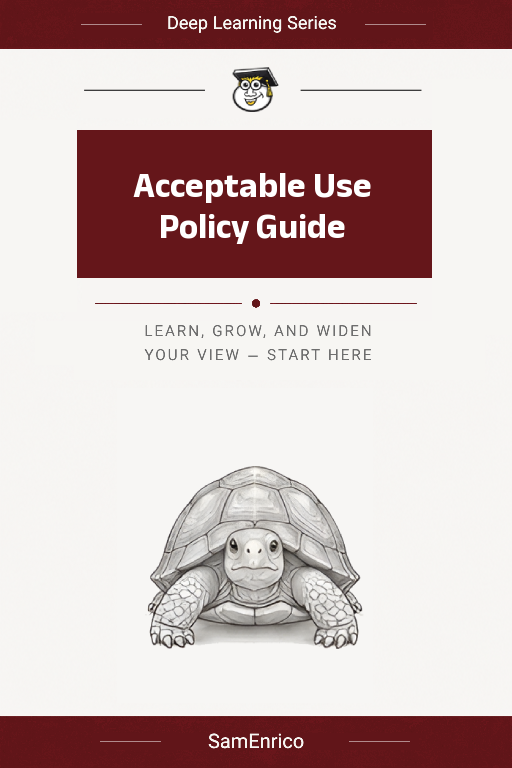
Non-FictionFirst 30 DaysAcceptable Use
Acceptable Use Policy Guide eBook
Prohibit illegal activity, harassment, spam, and h
by Ferry Kenna
Prohibit illegal activity, harassment, spam, and harmful content in your ToS.
Formats
Free sample
Chapter 1: Beyond Boilerplate...--The first time a startup founder reads their own Acceptable Use Policy, it is usually because a lawyer has just emailed them a dense document filled with phrases like “sole discretion” and “without prior notice.” They skim it, note that it seems to ban the usual bad behaviors, and file it away. Six months later, a user posts a detailed guide on how to manufacture fentanyl analogs in a home laboratory. Another user begins systematically doxxing every woman who comments on a particular thread, publishing their home addresses and workplaces. A third user has deployed a bot network that is posting the same cryptocurrency scam link across ten thousand comments per hour.The founder returns to the AUP. It says, vaguely, that users may not engage in “illegal activities” or “harassment” or “spam.” The founder calls their lawyer.
The lawyer asks a simple question: does your policy actually define any of those terms? Does it tell users what specific acts are banned? Does it tell your moderators what to remove? Does it tell a court that you acted in good faith?Silence.This is not a hypothetical problem. It is the single most common and most expensive mistake that platforms make with their Acceptable Use Policies.
They treat the AUP as legal boilerplate—a checkbox to be checked, a shield to be waved—rather than as what it truly is: a product document that shapes user behavior, a training manual for moderators, and the primary evidence of good-faith content moderation in a lawsuit or regulatory investigation.This chapter is about unlearning that mistake. It is about understanding the Acceptable Use Policy not as a passive legal artifact but as an active operational tool. We will distinguish the AUP from the broader Terms of Service and Privacy Policy, establish why the four pillars of illegal activity, harassment, spam, and harmful content deserve focused attention, and examine the legal frameworks—Section 230 in the United States and the Digital Services Act in the European Union—that make getting your AUP right a matter of liability protection, not just best practice. We will also introduce a cautionary tale: a platform that learned the hard way that a vague, unenforced AUP is worse than no AUP at all.The Three Documents Every Platform Needs Before we can build an excellent AUP, we must understand where it fits in the broader ecosystem of legal and operational documents. Most platforms maintain three core documents, and confusing their purposes is a common source of weakness.The Terms of Service (sometimes called Terms of Use or simply “the Terms”) is the contract between the platform and the user.
It governs the legal relationship: how either party can terminate the relationship, what warranties (or lack thereof) apply to the service, limitations of liability, governing law, dispute resolution mechanisms, and payment terms if the service is paid. If a user sues the platform, the Terms of Service is the first document a court examines.The Privacy Policy is a legally mandated disclosure document. It explains what personal data the platform collects, how that data is used, who it is shared with, what rights users have over their data, and how the platform secures that data. Unlike the Terms of Service, the Privacy Policy is not primarily a contract; it is a notice document required by laws like the GDPR, CCPA, and similar regulations worldwide.The Acceptable Use Policy is something else entirely. It is not a contract, strictly speaking, though it is often incorporated by reference into the Terms of Service.
It is not a disclosure document. The AUP is a set of behavioral rules. It tells users: here is what you may not do on our platform. It tells moderators: here is what you should remove. It tells courts: here is what we told users we would prohibit, and here is the good-faith framework we use to enforce those prohibitions.A helpful analogy: the Terms of Service is the lease agreement for an apartment building.
The Privacy Policy is the fire safety disclosure. The Acceptable Use Policy is the building’s posted rules: no loud music after 10 PM, no smoking in the hallways, no storing flammable materials. You can have the most legally airtight lease in the world, but if you do not post clear rules about noise and smoking, your tenants will fight, your building will deteriorate, and when something goes wrong, you will have a very hard time explaining to a judge why you evicted someone for a rule you never wrote down.The Four Pillars: Why Illegal Activity, Harassment, Spam, and Harmful Content?An AUP can prohibit anything the platform chooses, as long as it is not itself illegal (discriminating against protected classes, for example) or contrary to public policy. In practice, however, the vast majority of moderation actions fall into four categories. We call them the four pillars because they are load-bearing: remove these pillars, and the entire structure of content moderation collapses.Illegal activity is the first pillar.
This includes any user conduct that violates criminal or civil law: fraud, identity theft, hacking, drug sales, human trafficking, child sexual abuse material (CSAM), terrorism financing, and many others. The reason illegal activity is a pillar is simple: platforms that knowingly facilitate illegal activity can face criminal prosecution, civil liability, and the loss of legal protections like Section 230. More importantly, illegal activity on a platform creates real-world harm. A user whose identity is stolen through a phishing post on your platform does not care about the nuances of your legal compliance; they care that your platform was the vector for the attack.Harassment is the second pillar. Harassment includes stalking, doxxing (publishing private identifying information with malicious intent), threats, hate speech (depending on jurisdiction and platform policy), revenge porn, and other forms of targeted abuse.
Harassment drives user churn more than any other category. Users who are harassed on a platform do not merely stop using it; they tell others not to use it. They leave negative reviews. They may sue. And harassment is uniquely difficult to moderate because it often involves context, tone, and relationship history—things that automated systems struggle to assess.Spam is the third pillar.
Spam includes bulk messaging, unsolicited commercial posts, scraping user data, fake accounts (sock puppets), engagement manipulation (buying likes or followers), and any automated or deceptive behavior that degrades platform integrity. Spam is often dismissed as a nuisance rather than a serious problem, but that dismissal is dangerous. Spam erodes trust. When users cannot tell real comments from bot-generated noise, when they cannot distinguish genuine recommendations from paid astroturfing, the platform’s value collapses. Spam also imposes technical costs: server load, storage, and the labor required to clean it up.Harmful content is the fourth pillar, and the most controversial.
Harmful content is not necessarily illegal. It includes self-harm glorification (pro-anorexia communities, suicide method sharing), disinformation (false claims about elections or public health), pseudoscience (anti-vaccine content that reduces immunization rates), graphic violence without news value, and dangerous challenges (the “blackout challenge” that has killed children). Platforms can remove harmful content even when it is legal—the First Amendment restricts government action, not private platform policies—but doing so…
This is the end of the free sample. Get the eBook to keep going. Buy now
About this book
Details
- Author
- Ferry Kenna
- Publisher
- SamEnrico
- Language
- English
- Genre
- Non-Fiction, First 30 Days, Acceptable Use
- Released
- 2026-06-01
- Pages (approx.)
- 152
- Available as
- eBook, Audiobook

Read better in the ZLOADR app
Your eBooks on your phone or tablet. Sign in with your SamEnrico account and start reading.
More by Ferry Kenna
 The Interruption BufferFerry Kenna$11.99
 Trade Show Networking MasteryFerry Kenna$11.99
 Senior Intimacy GuideFerry Kenna$11.99
 Loneliness RV Community GuideFerry Kenna$11.99
 Gossip and Rumor ResponseFerry Kenna$11.99
 Parental Anxiety TranceFerry Kenna$11.99
 The Exhaustion SourcebookFerry Kenna$11.99
 Breathing Trance InductionFerry Kenna$11.99
 Antwerp Heist TimelineFerry Kenna$11.99
 The Jade Phoenix's Last Flight: A Celestial Mentor's FallFerry Kenna$11.99
 Whispers from the Deep: The Enigma of the Baltic Sea UFOFerry Kenna$11.99
 The Last Transmission: The Titanic’s Unsung HeroineFerry Kenna$11.99
You may also like
 Hong Kong Handover 1997Dunn Johnnie$11.99
 Zumba For Postnatal Recovery CourseNeal Christian$11.99
 Zumba for BeginnersLadner Nikia$11.99
 YouTube Comment Mining GuideHumes Pandora$12.99
 Worry Box MeditationCarlin Rudy$11.99
 Workplace Stress MeditationNguyen Lynn$11.99
 Workplace Stress and Sleep RepairHawley Ivory$11.99
 Workplace Perfectionism CureDelaney Jeffry$11.99
 Workplace Injustice Anger GuideWallen Isabelle$11.99
 Work Addiction and Burnout LinkGreenwood Ester$11.99
 Women in Yoga and WellnessBeattie Galina$11.99
 Women in Stand Up ComedyChun Evangeline$11.99