
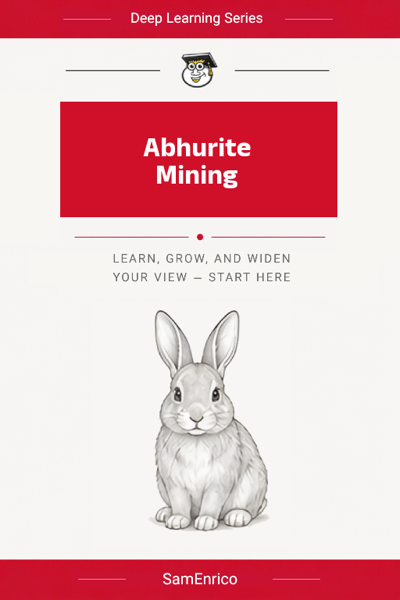
Abhurite Mining eBook
A Coursebook on Abhurite Mining
A Coursebook on Abhurite Mining
Formats
Free sample
Chapter 1: The Tin That Fell from Heaven...--The crystal fit in the palm of his hand like a misshapen pearl, cold and heavier than it had any right to be. It was the color of weak tea streaked with honey, flaking at the edges like a dried autumn leaf, and it had been sitting at the bottom of the Red Sea for 127 years before Ahmed Al-Mansouri brought it into the light. He had not been looking for minerals. He had been looking for lobsters.The year was 1983. Sharm Abhur was then a sleepy cove on the Saudi Arabian coast, known to local fishermen and to a small community of expatriate divers who appreciated its sheltered waters and reliable visibility.
Ahmed, a dive instructor in his late thirties, had spent the morning guiding a group of German tourists through a shallow reef when his dive computer began acting erratically. The needle jumped, then settled, then jumped again—a magnetic disturbance that he had learned to recognize as the signature of buried metal. He signaled to his group to continue without him, then descended another five meters into the green gloom.What he found was not a lobster. It was a stack of ingots, each the size of a small brick, arranged in rows like books on a shelf that had long since rotted away. The ingots were encrusted with a crusty, flaking substance that caught his dive light and threw it back in a way that made his breath catch—not the sharp glint of gold or the soft glow of silver, but something in between, like mica lit from within.
He chipped off a piece with his dive knife, tucked it into his mesh bag, and surfaced.That evening, sitting on the dock with the setting sun painting the water the color of old blood, Ahmed held the piece up to the fading light. It was soft enough that his thumbnail left a scratch. It was heavy—far heavier than its size suggested. And it was beautiful in a way that he could not name. He locked the fragment in his grandmother's biscuit tin, drove home shaking, and told no one.He could not forget it.
And that is where our story begins.The Accidental Discovery of a New Mineral The formal history of abhurite begins not with a geologist or a mining engineer, but with an amateur diver who stumbled upon a shipwreck. Ahmed Al-Mansouri's discovery would take two years to reach the scientific community, and another year to be confirmed as something entirely new to mineralogy. In the meantime, the cove of Sharm Abhur would become the site of a quiet, unofficial gold rush—one that would raise questions about ownership, heritage, and the strange value of things that come from the bottom of the sea.The wreck that Ahmed had found was the SS Hydra, a 1,200-ton British steamship built in Glasgow in 1859 and lost on the night of February 15, 1863. The Hydra had been carrying a cargo of tin ingots from the smelters of Cornwall and the Malay Peninsula to the Mediterranean markets, where tin was essential for everything from canning food to casting bronze ship fittings. She had also been carrying, according to the ship's manifest, a smaller quantity of pewter tableware intended for the officers' mess of a British garrison in Aden.
Neither cargo would reach its destination.The Hydra sank in a sudden squall that overwhelmed her pumps and sent her to the bottom in less than forty minutes. All hands survived, making it a footnote in maritime disaster records. The cargo, however, remained exactly where it had fallen, arranged in the holds in neat stacks that slowly settled into the sand over the course of a century. And there, in the dark, cold, saline environment of the Red Sea, something remarkable began to happen to the tin.The Chemistry of Patience Metallic tin, in its pure form, is a study in contradictions. It is soft enough to be cut with a knife, yet strong enough when alloyed to have enabled the Bronze Age.
It resists corrosion in fresh water, forming a thin, adherent oxide layer that protects the metal beneath. But in salt water, that protective layer fails. Chloride ions—the same ions that make seawater taste salty—attack the tin oxide, forming soluble complexes that wash away and expose fresh metal to further corrosion. The reaction is slow, measured in decades rather than days. But over the 120 years that the Hydra lay on the seabed, the tin ingots began to transform.The new mineral that formed on their surfaces was a tin oxychloride hydroxide, a complex chemical compound with the formula Sn₂₁O₆(OH)₁₄Cl₁₆.
It grew as platy, tabular crystals, colorless when pure but stained pale brown by trace elements from the surrounding sediment. It was soft—Mohs hardness 2, the same as gypsum, meaning it could be scratched by a fingernail. And it was dense: specific gravity 4.42, far heavier than most minerals that contain water in their crystal structure.No one had ever seen it before. No one had ever described it in the scientific literature. And no one had any idea that it was valuable.From Biscuit Tin to Laboratory The chain of custody that followed Ahmed's discovery is murky, as such chains often are when treasure is involved.
By his own account, he returned to the wreck several times over the following months, each time bringing up more fragments of the strange encrusted material. He showed pieces to fellow divers, to a jeweler in Jeddah, to a visiting English geologist who happened to be vacationing on the coast. Each person told him something different: it was silver chloride, it was a tin oxide, it was nothing at all.The geologist, whose name is lost to the record, was the first to suggest that Ahmed might have found something new. He took a small sample back to England and delivered it to the Natural History Museum in London, where it sat in a drawer for nearly a year before anyone opened it. When a mineralogist finally examined the sample, he was puzzled.
The optical properties matched nothing in the reference collections. The X-ray diffraction pattern was unlike any known mineral. The chemical analysis showed tin, oxygen, chlorine, and hydrogen in proportions that did not correspond to any recorded species.In 1985, the International Mineralogical Association—the global authority on mineral classification and nomenclature—formally recognized the new mineral. It was named abhurite, after the cove where it was discovered. The type specimen, the reference sample against which all future identifications would be compared, was deposited in the collections of the Natural History Museum in London, where it remains today.Ahmed Al-Mansouri, meanwhile, had sold most of his collection to a private dealer in Switzerland.
He never revealed how much he was paid, though acquaintances from the period recall that he bought a new boat, renovated his house, and stopped working as a dive instructor. He died in 2007, having never published a word about his discovery. The man who found abhurite took its secret with him to the grave.What Is Abhurite, Really?Before we can understand how to mine abhurite, we must…
This is the end of the free sample. Get the eBook to keep going. Buy now
About this book
Details
- Author
- Nieto Danille
- Publisher
- SamEnrico
- Language
- English
- Genre
- Non-Fiction, Informative, Educational
- Released
- 2026-05-04
- Pages (approx.)
- 148
- Available as
- eBook, Audiobook

Read better in the ZLOADR app
Your eBooks on your phone or tablet. Sign in with your SamEnrico account and start reading.
More by Nieto Danille
 Eritrean Camp To MinneapolisNieto Danille$11.99
 The Procrastination FixNieto Danille$11.99
 Disappointment In MentorsNieto Danille$11.99
 Career Transition for Call Center WorkersNieto Danille$11.99
 Medical Nutritional Relapse PreventionNieto Danille$11.99
 ADHD Study Strategies GuideNieto Danille$11.99
 Thyroid and Depression LinkNieto Danille$11.99
 Night Flying MemoirNieto Danille$11.99
 Plutonium Production at Hanford SiteNieto Danille$11.99
 The Great Banana War: How a Fruit Sparked a Global Trade CrisisNieto Danille$11.99
 The Alchemist's Vial: A Renaissance Conspiracy of Poison and PowerNieto Danille$11.99
 Gin & Ghosts: The Phantom Breweries of ChicagoNieto Danille$11.99