
Non-FictionSelf-HelpTask RankingProductivity
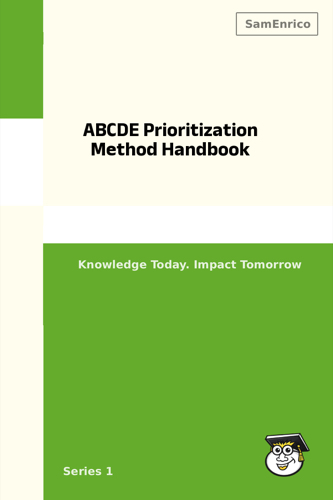
ABCDE Prioritization Method Handbook eBook
Assign A through E rankings to tasks and tackle hi
by Burks Pilar
Assign A through E rankings to tasks and tackle highest value items first.
Formats
Free sample
Chapter 1: The Urgency Trap--–- On a Tuesday morning in March, a senior product manager named Sarah did something she had done 1,247 times before: she opened her email before finishing her first cup of coffee. By 9:15 AM, she had answered fourteen messages, attended a “quick sync” that lasted forty-five minutes, and added nineteen new tasks to her already overflowing to-do list. At 5:30 PM, she realized she had not touched the one thing her own manager had asked her to prioritize—a competitive analysis due Thursday. Sarah worked through lunch, stayed until 7 PM, and went home feeling exhausted, vaguely guilty, and absolutely certain that tomorrow would be different. It was not.Sarah is not lazy.
She is not disorganized. She is not unmotivated. Sarah is trapped—and so are you.The trap has a name: urgency bias. It is the cognitive tendency to prioritize tasks that feel immediate over tasks that are actually important. Your brain, wired for survival, treats a buzzing phone like a saber-toothed tiger.
A blinking Slack notification activates the same neural circuits as a physical threat. And in the modern workplace, those threats arrive every ninety seconds.This chapter diagnoses the hidden architecture of your overwhelm. You will learn why simple to-do lists fail, why “busy” has become a status symbol, and how a single letter—A—can rewire your relationship with work. By the end, you will understand not just the problem, but the precise mechanism the rest of this book will teach you to solve.The Great Deception of the To-Do List The humble to-do list is one of humanity’s most beloved and most dangerous inventions. It promises clarity.
It delivers chaos.Here is what actually happens when you write a to-do list: you experience a small dopamine release. The act of capturing a task—of transferring it from the anxious swirl of your mind onto paper or screen—produces a feeling of control. Researchers call this the capture relief effect. It is real. It is also a trap.Because after the capture comes the collapse.
A typical knowledge worker has between 150 and 300 active tasks at any given time. Some are urgent. Some are important. Most are neither. But your to-do list treats them all the same.
It presents a flat, undifferentiated wall of obligation. And when faced with a wall, human beings do not climb it strategically. They chip at the easiest bricks.This is the flat list fallacy: the incorrect assumption that listing tasks is equivalent to prioritizing them. It is not. Listing tells you what exists.
Prioritization tells you what matters. Without the latter, the former becomes a weapon you use against yourself.Consider a study conducted by productivity researchers at the University of California, Irvine. They followed 250 professionals for six months, tracking both their to-do lists and their actual completed work. The findings were devastating: participants spent an average of 71% of their time on tasks that were not their top three priorities. Worse, they reported feeling most productive on days when they completed the most tasks—even when those tasks were objectively low-value.In other words, we measure our success by volume, not by value.
We celebrate the deletion of ten C-tasks while the single A-task sits untouched. This is not a time management problem. It is a priority management problem. And no amount of digital calendars, color-coded folders, or “inbox zero” techniques will fix it, because those tools all share the same flaw: they organize without ranking.Priority Dilution: Why More Tasks Mean Less Progress In 1976, psychologist Daniel Kahneman published a now-famous paper on what he called the dilution effect. The premise was simple: when people are given information that is relevant to a decision, they make good choices.
When they are given irrelevant information alongside the relevant information, their decision quality drops—not slightly, but dramatically. The irrelevant information dilutes the relevant.Priority dilution works the same way. Every task you add to your list, regardless of its importance, reduces the perceived significance of every other task. Add ten low-value tasks to a list that contains one high-value task, and the high-value task no longer stands out. It becomes one item among many.
Your brain, overloaded, defaults to whatever is easiest, closest, or loudest.This is not a moral failure. It is a cognitive limit. The human prefrontal cortex—the part of your brain responsible for planning, prioritization, and impulse control—has a finite bandwidth. Psychologists call this executive function capacity. And every decision you make, every task you consider, every notification you process draws from that limited resource.The average office worker checks email seventy-seven times per day.
Each check requires a decision: read, delete, reply, defer. Each decision consumes executive function. By 11:00 AM, most people have already exhausted their daily capacity for hard thinking. They are not choosing to do easy, low-value work. They are physically incapable of doing anything else.This is why “just try harder” is not a solution.
You cannot willpower your way out of a cognitive bottleneck. You can only change the structure of your attention. And that requires a tool that does not ask you to choose between 150 things, but forces you to choose between five.The Eisenhower Matrix: The Predecessor You Were Never Taught Before the ABCDE method, there was the Eisenhower Matrix. Named for President Dwight D. Eisenhower—who famously said, “I have two kinds of problems: the urgent and the important.
The urgent are not important, and the important are never urgent”—this matrix divides tasks into four quadrants:Quadrant I: Urgent and Important (crises, deadlines, emergencies)Quadrant II: Not Urgent but Important (planning, relationship-building, deep work)Quadrant III: Urgent but Not Important (most emails, many meetings, other people’s small requests)Quadrant IV: Not Urgent and Not Important (time-wasters, distractions, low-value habits)The Eisenhower Matrix is brilliant. It is also, for most people, unusable. Here is why: the matrix requires you to categorize each task into one of four boxes. But it does not tell you what to do with those boxes. Should you do all Quadrant I tasks first?
What about Quadrant II? How do you handle three urgent-and-important tasks at the same time? The matrix diagnoses the disease but prescribes no treatment.The ABCDE method solves this. It takes the insight of the Eisenhower Matrix—the distinction between urgency and importance—and transforms it into a ranked, actionable, daily system. Instead of four abstract boxes, you get five concrete letters.
Instead of confusion about what to do next, you get a rule: A before B before C, with D and E as elimination tools.Why Urgent Always Beats Important (And How to Reverse It)The most dangerous feature of urgency is that it feels important. When a colleague messages you with “Quick question?” your brain releases cortisol. Your heart rate increases. You feel a genuine, physiological pull to respond immediately. This is not a choice.
It is a biological response.Urgent tasks hijack your attention through a mechanism called salience. In psychology, a salient stimulus is one that stands out from its background. A flashing light is salient. A loud noise is salient. A notification badge on your phone is salient.
Your brain is wired to attend to salient stimuli because, for most of human history, salience signaled danger. The rustling…
This is the end of the free sample. Get the eBook to keep going. Buy now
About this book
Details
- Author
- Burks Pilar
- Publisher
- SamEnrico
- Language
- English
- Genre
- Non-Fiction, Self-Help, Task Ranking, Productivity
- Released
- 2026-06-09
- Pages (approx.)
- 123
- Available as
- eBook, Audiobook

Read better in the ZLOADR app
Your eBooks on your phone or tablet. Sign in with your SamEnrico account and start reading.
More by Burks Pilar
 1031 Exchange Like Kind DefinitionBurks Pilar$11.99
 Urine Phobia Catheter DesensitizationBurks Pilar$11.99
 Reddit Addiction Digital DetoxBurks Pilar$11.99
 The Stress Nausea and Vomiting GuideBurks Pilar$11.99
 The Imperial Crown of Charlemagne: Forge of a Holy EmpireBurks Pilar$11.99
 Northern Silky Oak HarvestingBurks Pilar$11.99
 How to Become a Ditcher OperatorBurks Pilar$11.99
 Startup Accelerator Ecosystem GuideBurks Pilar$12.99
 Remote Review Success MetricsBurks Pilar$12.99
 Understanding Maroteaux–stanescu–cousin SyndromeBurks Pilar$17.99
You may also like
 Hong Kong Handover 1997Dunn Johnnie$11.99
 Zumba For Postnatal Recovery CourseNeal Christian$11.99
 Zumba for BeginnersLadner Nikia$11.99
 YouTube Comment Mining GuideHumes Pandora$12.99
 Worry Box MeditationCarlin Rudy$11.99
 Workplace Stress MeditationNguyen Lynn$11.99
 Workplace Stress and Sleep RepairHawley Ivory$11.99
 Workplace Perfectionism CureDelaney Jeffry$11.99
 Workplace Injustice Anger GuideWallen Isabelle$11.99
 Work Addiction and Burnout LinkGreenwood Ester$11.99
 Women in Yoga and WellnessBeattie Galina$11.99
 Women in Stand Up ComedyChun Evangeline$11.99