
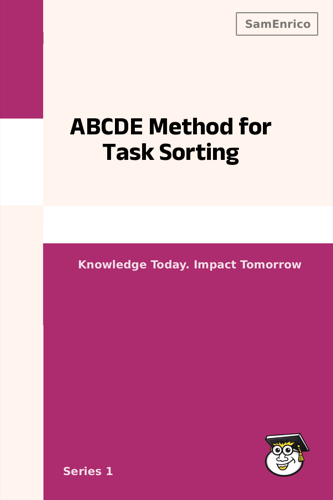
ABCDE Method for Task Sorting eBook
Ranks tasks A to E by consequence of failure.
by Mosby Yvone
Ranks tasks A to E by consequence of failure.
Formats
Free sample
Chapter 1: The Consequence Scale--You have a gun to your head.Not literally, of course. But every morning, when you sit down with your to-do list, you are making a decision that carries the weight of a loaded weapon pointed at your career, your income, your relationships, and your sanity. The question is not whether you will fail at something today. The question is which failures you are choosing to risk.Here is the brutal truth that most productivity books dance around but never quite say aloud: you cannot do everything. The universe does not care about your good intentions.
Your boss does not care that you were "busy." Your clients do not care that you had fifteen other things on your plate. The only thing that matters—the only metric that has ever mattered—is what actually happened because of what you did or did not do.And yet, most of us go through our days as if the opposite were true. We act as if completing a task is inherently valuable, regardless of what that task is. We celebrate crossing items off our lists the way a child celebrates gold stars. We feel productive when our checkboxes are full, even if the boxes we checked were for rearranging digital folders, reading industry newsletters, and responding to emails that could have waited a week.This is the tyranny of the checkbox.
And it is quietly, systematically, destroying your potential.The Lie You Have Been Told Let me tell you about Sarah. Sarah is a real person—her name and details changed for privacy, but her story is true. Sarah was a senior marketing director at a mid-sized tech company. She worked fifty to sixty hours per week. She always had a to-do list with twenty to thirty items.
She crossed off most of them every day. Her boss thought she was a hard worker. Her team thought she was dedicated. Sarah thought she was productive.Then came the quarterly review.Sarah had been working on a proposal for a potential client worth $1.2 million in annual revenue. She knew it was important.
She had written "Finish client proposal" on her to-do list every day for three weeks. But every day, something else came up. A colleague needed help with a presentation. An urgent email arrived from the CEO. A meeting ran long.
A report needed reformatting. Sarah would look at "Finish client proposal," feel a wave of anxiety, and decide to do something easier first. She would check a few emails. She would organize her desktop folders. She would read a marketing blog for "inspiration." She would cross off five, ten, fifteen small tasks and feel a warm glow of accomplishment.By the time she looked up, it was 5:00 PM.
The proposal was still undone. She would move it to tomorrow's list and go home exhausted but satisfied with how "busy" she had been.Three weeks later, the client signed with a competitor. Sarah's boss called her into his office. "What happened?" he asked. Sarah didn't have a good answer.
She had worked hard. She had been busy every single day. She had crossed off dozens of tasks.But she had lost $1.2 million.The math is simple and brutal: Sarah traded $1.2 million of real value for the fleeting satisfaction of checking off low-value tasks. She measured her productivity by volume rather than consequence. And it cost her.The One Metric That Matters Every task on your list has a consequence attached to it.
Not a vague, philosophical consequence. A real, measurable, predictable consequence. Something that will happen—or will fail to happen—based on whether you complete that task.Let me give you an example. Imagine two tasks: Task One is "Send follow-up email to a colleague about next week's meeting." Task Two is "Submit quarterly tax payment by 5:00 PM today or face a $5,000 penalty."If you complete Task One and fail Task Two, what happens? You pay $5,000.
If you complete Task Two and fail Task One, what happens? Your colleague might be mildly annoyed for ten seconds before they forget about it entirely.These two tasks are not equal. They are not even in the same universe of importance. But a traditional to-do list treats them as identical. It places them side by side, one line of text after another, as if checking either box carries the same weight.
This is not just inefficient. It is dangerous.The Consequence Scale is the solution to this problem. It replaces the flat, undifferentiated to-do list with a five-level hierarchy based entirely on one question: What happens if I fail to do this task?Here is how the scale works, from highest consequence to lowest:A (Catastrophic) – Failure means severe, irreversible damage. Lost revenue. Lost clients.
Safety risks. Legal penalties. Terminated relationships. Missed deadlines that cost you money, reputation, or opportunity. These are the tasks that keep you up at night, the ones you avoid because they scare you, the ones that actually determine the trajectory of your life and career.B (Mild) – Failure means short-term, easily reversible consequences.
A colleague is mildly inconvenienced. An email is sent one day late. A routine report is submitted after lunch instead of before. These tasks matter, but only in the way that a small scratch on your car matters—annoying, but not life-altering.C (Trivial, Vanishes Quickly) – Failure means consequences that disappear within hours or days. You reorganize your desktop folders and no one notices.
You read industry news that you forget by tomorrow. You perfect a Power Point animation that no client will ever see. These tasks create the illusion of productivity while delivering zero real value.D (Delegatable) – These tasks could be done by someone else with at least eighty percent of your effectiveness. They may have consequences, but those consequences do not require your specific attention. Your time is better spent on A-tasks.E (Eliminate, Zero Consequence) – Failure means absolutely nothing changes.
No one notices. Nothing breaks. No opportunity is lost. These tasks exist only because of habit, guilt, or the seductive pull of easy checkboxes. They should be deleted immediately and permanently.The distinction between C and E is particularly important, because many productivity systems blur it.
A C-task has consequences, but those consequences are short-lived and trivial. An E-task has no consequences at all, now or ever. Understanding this difference is the difference between being busy and being effective.Why Your Brain Lies to You About Consequences Now, here is where things get interesting—and where most people fail. Your brain is not neutral when it comes to evaluating consequences. Your brain is actively working against you.Evolution did not prepare you for a world of to-do lists and quarterly deadlines.
Evolution prepared you to survive in a world of immediate threats: predators, starvation, physical danger. Your brain is wired to prioritize immediate rewards over delayed consequences. This is why checking off a small, easy task feels so good—it gives you an instant dopamine hit. And this is why staring at a difficult, high-stakes A-task feels so bad—it triggers anxiety and avoidance.In psychological terms, this is called temporal discounting: we discount the value of future outcomes in favor of present…
This is the end of the free sample. Get the eBook to keep going. Buy now
About this book
Details
- Author
- Mosby Yvone
- Publisher
- SamEnrico
- Language
- English
- Genre
- Non-Fiction, Self-Help, Task Management
- Released
- 2026-06-06
- Pages (approx.)
- 128
- Available as
- eBook, Audiobook

Read better in the ZLOADR app
Your eBooks on your phone or tablet. Sign in with your SamEnrico account and start reading.
More by Mosby Yvone
 Sunrise on the WaterMosby Yvone$11.99
 Flow in LeadershipMosby Yvone$11.99
 Self Talk for HealingMosby Yvone$11.99
 The ADHD Focus GuideMosby Yvone$11.99
 Stress Digestive System ImpactMosby Yvone$11.99
 Library Reading Nook GuideMosby Yvone$11.99
 Triathlete's Hypnosis GuideMosby Yvone$11.99
 The Whispering Witness: How a Teenage Girl Brought Down Kenya’s Most Notorious Bootlegger (1920s)Mosby Yvone$11.99
 The Last Words of the Navajo Code TalkersMosby Yvone$11.99
 How to Become a Medical-record ClerkMosby Yvone$11.99
 Wasps: Stinging InsectMosby Yvone$11.99
 A Collector's Handbook to the Wolseley 6-110 Series IMosby Yvone$11.99
You may also like
 To Do List Overhaul GuideGerman Bernetta$11.99
 Multitasking Myth Recovery GuideJasper Faustino$11.99
 Task List Daily ReviewChristy Wilda$11.99
 Task Batching Time Management GuideMarquis Karan$11.99
 Remote Task Batching GuideEscamilla Amada$11.99
 ABCDE Method Task RankingFelton Viki$11.99
 ABCDE Method Priority SystemKowalski Shena$11.99
 Burnout Prevention Task RotationBranch Josette$11.99
 Task Batching Strategies CourseYamamoto Leann$11.99
 Interruption Proof To-Do List GuideBennett Ginger$11.99
 ABC Prioritization RulesGuillen Stevie$11.99
 Loci Method For To Do ListsMasters Elvera$11.99