
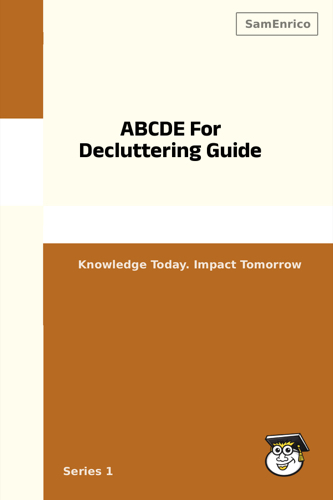
ABCDE For Decluttering Guide eBook
Rank rooms and categories by visual impact and fun
by Held Jayson
Rank rooms and categories by visual impact and functional need using ABCDE.
Formats
Free sample
Chapter 1: The 80/20 Solution--–- You are standing in your kitchen. It is 7:42 on a Tuesday morning. You need to make coffee, pack a lunch, find your keys, and sign a permission slip—all before 8:00. But the counter is covered. Mail from five days ago.
Vitamins in three different bottles. A toaster. A fruit bowl with two brown bananas. A knife block. Yesterday’s mail.
A toy fire truck. A half-empty water bottle. Your phone, buried under a catalog you never requested.You feel it before you think it: a low, humming frustration. Not panic. Not despair.
Just a vague sense that you are losing a battle you did not agree to fight.This is the cost of clutter. Not the dust. Not the mess. The cognitive friction. Every visible object on an A-room surface—kitchen counter, entryway table, home office desk, bathroom vanity—demands a micro-decision.
Should I move this? Is this important? Where does this go? Your brain processes these micro-decisions automatically, like background noise on a bad Wi-Fi connection. But the noise adds up.
By the time you reach for the coffee maker, you have already made seventeen tiny decisions about objects you do not care about. You are exhausted before the day begins.Most decluttering advice fails because it asks you to solve the wrong problem. It says: “Declutter your whole house.” “Empty every drawer.” “Kon Mari your socks.” That is like telling someone who is drowning to empty the ocean. The problem is not that you lack discipline. The problem is that you lack a priority system.This chapter introduces the first and most important rank in the ABCDE method: A-Rooms.
These are the spaces with high visual impact and high functional need. They are the places you use every day and the places everyone sees. Fix these first, and you get 80% of the benefit for 20% of the effort. Ignore these, and no amount of attic-cleaning will make you feel organized.The A-Room Definition: Where Your Day Lives Before we fix anything, we need to name the enemy. An A-room is any space that meets two conditions:High Visual Impact (V score 8–10): The space is visible to you and your household members multiple times per day.
Guests see it within the first thirty seconds of entering your home. Clutter here causes immediate, repeated stress.High Functional Need (F score 8–10): You use this space for essential daily tasks. Preparing food. Finding your keys. Paying bills.
Brushing your teeth. If this space is cluttered, your daily routines become harder.When you plot these two criteria on a matrix, four room types emerge. A-rooms sit in the top-right quadrant: high visual, high function. They are the leverage points of your home.Common A-rooms:Kitchen counter and stovetop area Entryway table, hooks, and floor zone (where shoes and bags land)Home office desk surface (not the drawers)Bathroom vanity and medicine cabinet The primary sink area in any bathroom or kitchen Notice what is not on this list: the attic, the basement, the guest room closet, the garage storage shelves, the under-sink cabinet (that is C-rank, as we will cover in Chapter 3). These matter, but they matter less.
They have low visual impact or low functional need. They can wait.The mistake most people make is starting with low-leverage spaces. They spend a Saturday cleaning the garage, feel exhausted, and look up to see the kitchen counter still buried under mail. The garage looks better. The kitchen does not.
Their spouse does not notice the garage. Their spouse does notice the kitchen. Frustration follows. The system fails.The ABCDE method reverses this. You start with the spaces that give you the biggest return on your emotional investment.
You build momentum. You feel successful after one hour, not one weekend. Then—and only then—you move to lower-priority spaces.The 80/20 Rule for A-Rooms The 80/20 Rule (also known as the Pareto Principle) states that roughly 80% of effects come from 20% of causes. In decluttering, this means: removing 80% of the visible clutter from your A-rooms requires only 20% of the total decluttering effort for that room.Why? Because visible clutter on surfaces is shallow.
It is not buried in drawers. It is not taped to the back of a cabinet. It is sitting right there, in plain sight, accumulating like snow on a driveway. Removing it takes minutes. But the psychological benefit is enormous.Here is the math.
A typical kitchen counter might hold thirty to forty visible objects. Most of them do not belong there. They are transients: mail that should be sorted, keys that should be hung, toys that should be in a bedroom, vitamins that should be in a cabinet, a phone charger that belongs next to the bed. Only a handful of objects actually live on the counter: the coffee maker, perhaps a knife block, maybe a fruit bowl.The 80/20 Rule tells you to ignore the drawers, ignore the pantry, ignore the spice rack. Remove the thirty transient objects.
Wipe the surface. Put back the five permanent residents. You have just removed 80% of the visual clutter. You did not reorganize a single drawer. You did not label a single bin.
You spent maybe fifteen minutes.And the effect? Your kitchen counter goes from “chaotic” to “clean.” Your morning brain stops making those seventeen micro-decisions. You make coffee faster. You find your keys. You sign the permission slip.This is not magic.
This is prioritization.The 15-Minute A-Room Rescue (Step-by-Step)The following method works for any A-room: kitchen counter, entryway, desk, bathroom vanity. Set a timer for fifteen minutes. Do not open any drawers or closets. Focus exclusively on the surface.Step 1: Clear the surface completely. (2 minutes)Take everything off the counter, desk, or table.
Everything. The coffee maker. The mail. The vitamins. The pen holder.
The random screwdriver from that one project. Pile it on the floor or on a nearby table. You need a blank slate.Step 2: Sort into three bins. (8 minutes)Create three zones on the floor: Keep, Relocate, Remove.Keep: Items that genuinely belong on this surface and are used daily. For a kitchen counter, this might be a coffee maker, a knife block, and a fruit bowl.
That is it. No more than three objects total for any A-surface.Relocate: Items that belong elsewhere in the house. Mail belongs in a wall-mounted sorter. Keys belong on a hook by the door. Vitamins belong in a cabinet.
Toys belong in a child’s room.Remove: Items that are trash, recycling, or donations. Expired coupons. Dead pens. The third identical water bottle.Be ruthless. If you have not used an item on this surface in the past seven days, it does not belong here.
Move it to Relocate or Remove.Step 3: Wipe the surface clean. (1 minute)Use a disinfecting wipe or a damp cloth. You are resetting the canvas.Step 4: Put back only Keep items. (1 minute)Place your three (or fewer) Keep items back on the surface. Arrange them neatly.
That is it. Do not add anything else.Step 5: Deal with the Relocate bin immediately. (3 minutes)Walk each Relocate item to its permanent home. Hang the keys. Put the mail in the sorter.
Return the toys to the bedroom. This step is non-negotiable. If you leave the Relocate bin for “later,” later becomes…
This is the end of the free sample. Get the eBook to keep going. Buy now
About this book
Details
- Author
- Held Jayson
- Publisher
- SamEnrico
- Language
- English
- Genre
- Non-Fiction, Self-Help, Decluttering
- Released
- 2026-06-11
- Pages (approx.)
- 156
- Available as
- eBook, Audiobook

Read better in the ZLOADR app
Your eBooks on your phone or tablet. Sign in with your SamEnrico account and start reading.
More by Held Jayson
 Anxiety Emotion GuideHeld Jayson$11.99
 Validation for Caregiver BurnoutHeld Jayson$11.99
 Metta For Beginners Practice GuideHeld Jayson$11.99
 Asking Someone to Be Your MentorHeld Jayson$11.99
 The MBSR Sleep SolutionHeld Jayson$11.99
 Hyderabad Loyalty AnalysisHeld Jayson$11.99
 Broken Record AssertivenessHeld Jayson$11.99
 Reciprocity In BusinessHeld Jayson$11.99
 From Dust to Diamonds: The Untold Journey of the 'Paper Son' Who Built a FortuneHeld Jayson$11.99
 The Lion and the Rose: The Tudor Dynasty's Golden AgeHeld Jayson$11.99
 How to Become a Metallic-yarn-slitting-machine OperatorHeld Jayson$11.99
 The Mineral Guide to PumpellyiteHeld Jayson$11.99
You may also like
 Pet Food and Bowl After DeathGist Nita$11.99
 Bedroom Declutter Sleep AidClevenger Julianna$11.99
 The One In One Out RuleVilla Imogene$11.99
 Decluttering Habit GuideBernier Augustine$11.99
 Spouse Loss Possessions GuideHumphrey Stefan$11.99
 Weekly Declutter ReviewTurley Shirlene$11.99
 Toy Rotation Declutter PlanDeleon Robbi$11.99
 ABCDE For Decluttering HomeFite Elke$11.99
 Declutter Five MinutesDove Clementine$11.99
 The Workaholic's Decluttering GuideJolley Leonel$11.99
 Child's Toys and BelongingsMatheson Joel$11.99
 One in One Out RuleEarl Marita$11.99